
Solar Powered Security Camera Information Hub | Section 2: Types of Solar Powered Security Cameras
When shopping for a solar powered security camera in Australia, you will often see specifications such as 1080p, 2K, 4MP, 6MP and 4K.
These numbers describe the camera's image resolution, but what do they actually mean?
Does a 6MP camera always produce clearer images than a 4MP model? Is a 4K solar security camera worth the additional cost? And how much resolution do you really need to monitor your driveway, backyard or construction site?
Higher resolution can provide more image detail, but it does not automatically guarantee better security footage.
Image quality also depends on the camera's lens, image sensor, lighting conditions and video processing technology.
This guide explains the most common security camera resolutions and helps Australian homeowners, builders and rural property owners understand what to look for when comparing solar powered security cameras.
1. What Does Camera Resolution Mean?
Camera resolution refers to the number of pixels used to create a digital image.
Pixels are the tiny individual elements that make up a photograph or video frame.
A camera with a higher pixel count can potentially capture more fine detail than a lower-resolution camera.
For example, a 1080p camera typically records video at 1920 × 1080 pixels.
This equals approximately 2.1 million pixels, commonly described as 2 megapixels (2MP).
A 4MP camera captures approximately four million pixels per image.
In suitable conditions, the additional pixels can help preserve more detail when viewing or enlarging recorded footage.
However, the actual clarity depends on more than pixel count alone.
2. Understanding Common Security Camera Resolutions
The following table compares commonly advertised camera resolutions.
| Resolution | Typical Pixel Dimensions | Approximate Megapixels |
|---|---|---|
| 720p (HD) | 1280 × 720 | 0.9MP |
| 1080p (Full HD) | 1920 × 1080 | 2.1MP |
| 2K | Varies by manufacturer | Often around 3–4MP |
| 4MP | Commonly 2560 × 1440 | 3.7MP |
| 6MP | Varies by manufacturer | Approximately 6MP |
| 4K (Ultra HD) | 3840 × 2160 | 8.3MP |
Important: Terms such as 2K and 4MP are not always used consistently in security camera marketing.
The actual recorded pixel dimensions provide a more reliable basis for comparison.
720p – Basic HD Resolution
720p is an older HD video resolution.
It may be sufficient for basic monitoring, but fine details can become difficult to distinguish, particularly when subjects are far from the camera.
For modern outdoor security applications, higher-resolution options are generally worth considering.
1080p – Full HD Resolution
1080p remains a practical resolution for many everyday monitoring applications.
It can provide clear footage of nearby entrances, pathways and small outdoor areas when lighting and camera positioning are suitable.
For homeowners monitoring a front door or small garden, a good-quality 1080p camera may provide sufficient detail.
2K and 4MP – Higher-Detail Monitoring
Cameras advertised as 2K or 4MP generally provide more pixels than Full HD models.
This additional resolution can be useful when monitoring wider areas or reviewing recorded footage.
For example, a 4MP camera monitoring a driveway may preserve more detail than a comparable 1080p camera with the same viewing angle.
However, consumers should check the actual recording resolution because marketing terminology varies.
6MP – Increased Image Detail
A 6MP camera captures approximately six million pixels per image.
This can provide additional detail for monitoring larger outdoor areas, depending on the camera's lens and sensor performance.
However, 6MP resolution should not be confused with a lens specification.
A product advertised as having a 6MP lens does not necessarily record genuine 6MP video.
The camera's image sensor and actual video output resolution must also support that level of detail.
4K – Ultra HD Resolution
4K security cameras commonly record at 3840 × 2160 pixels.
This provides approximately 8.3 million pixels per frame.
Under suitable conditions, 4K cameras can capture substantial image detail.
However, higher-resolution recording may require more storage space, processing capacity and network bandwidth.
For solar powered cameras, these requirements should be considered alongside battery performance and recording methods.
3. Does Higher Resolution Mean Better Image Quality?
Not necessarily.
Resolution determines how many pixels are available, but several other factors influence how useful those pixels are.
Image Sensor Quality
The image sensor converts incoming light into digital information.
A high-quality sensor may produce clearer images with less noise, particularly in challenging lighting conditions.
A poorly performing high-resolution sensor may produce worse results than a lower-resolution sensor of better quality.
Lens Quality
The lens determines how light reaches the image sensor.
Lens sharpness, optical design and viewing angle all influence recorded detail.
A high-resolution sensor cannot fully compensate for a poor-quality lens.
Lighting Conditions
Bright daylight generally allows cameras to capture more detail than poorly illuminated environments.
At night, image quality depends heavily on the camera's low-light performance and available illumination.
Video Compression
Security cameras compress video to reduce file sizes.
Excessive compression can remove image detail, even when the original resolution is high.
The best image quality comes from a combination of suitable resolution, sensor quality, lens performance and effective image processing.
4. Can Higher Resolution Help Identify Faces and Number Plates?
Many Australian consumers choose higher-resolution cameras because they want to identify people or vehicles.
However, resolution alone cannot guarantee successful identification.
Recognising Faces
A camera installed near a front entrance may capture useful facial detail when a person approaches within a suitable distance.
However, facial identification becomes more difficult when the person is far away, moving quickly or poorly illuminated.
Camera angle and the number of pixels covering the person's face are important.
Reading Vehicle Number Plates
Higher resolution may help preserve number plate detail, but successful plate recognition also depends on:
- Distance between the vehicle and camera.
- Camera viewing angle.
- Vehicle movement and motion blur.
- Lighting and reflections.
- Lens quality and image processing.
For example, a 4K camera with an extremely wide viewing angle may still struggle to capture a distant number plate.
A camera specifically designed and positioned for number plate recognition may perform better.
Monitoring Packages and Deliveries
For front-door monitoring, a suitable 1080p or 4MP camera may provide sufficient detail to observe package deliveries.
The camera's installation position and viewing angle are often more important than choosing the highest advertised resolution.
5. Resolution and Viewing Distance
Another important consideration is the relationship between image resolution and monitoring distance.
A camera viewing a small entrance concentrates its available pixels on a relatively limited area.
A camera monitoring a large backyard spreads those pixels across a wider scene.
As a result, distant objects may occupy only a small portion of the recorded image.
Higher resolution can help preserve additional detail, but it does not automatically overcome limitations caused by distance or viewing angle.
For larger properties, camera positioning and lens selection may be more effective than simply purchasing a higher-resolution model.
6. Does Higher Resolution Affect Solar Camera Battery Life?
Higher-resolution recording can increase the amount of video data that a camera processes and stores.
Depending on the camera's hardware and software, this may influence electricity consumption.
However, battery performance is not determined by resolution alone.
Other factors include:
- Recording frequency and duration.
- Motion detection activity.
- Night-time illumination.
- Remote live viewing.
- Video compression and transmission.
- Camera power management.
A well-designed higher-resolution camera may operate efficiently, while a lower-resolution model with frequent recording activity may consume considerable energy.
Consumers should therefore compare manufacturer specifications and realistic operating conditions rather than assuming that higher resolution always means shorter battery life.
7. How Does Resolution Affect Storage and Internet Usage?
Higher-resolution recordings often contain more video data than lower-resolution recordings, assuming similar compression settings and recording conditions.
This can affect storage requirements and network usage.
Local Storage
A camera recording high-resolution footage may fill its microSD card more quickly than a comparable lower-resolution camera.
However, actual storage consumption depends on video bitrate, compression, frame rate and recording duration.
Cloud Storage
Uploading higher-resolution video may increase internet or mobile data consumption.
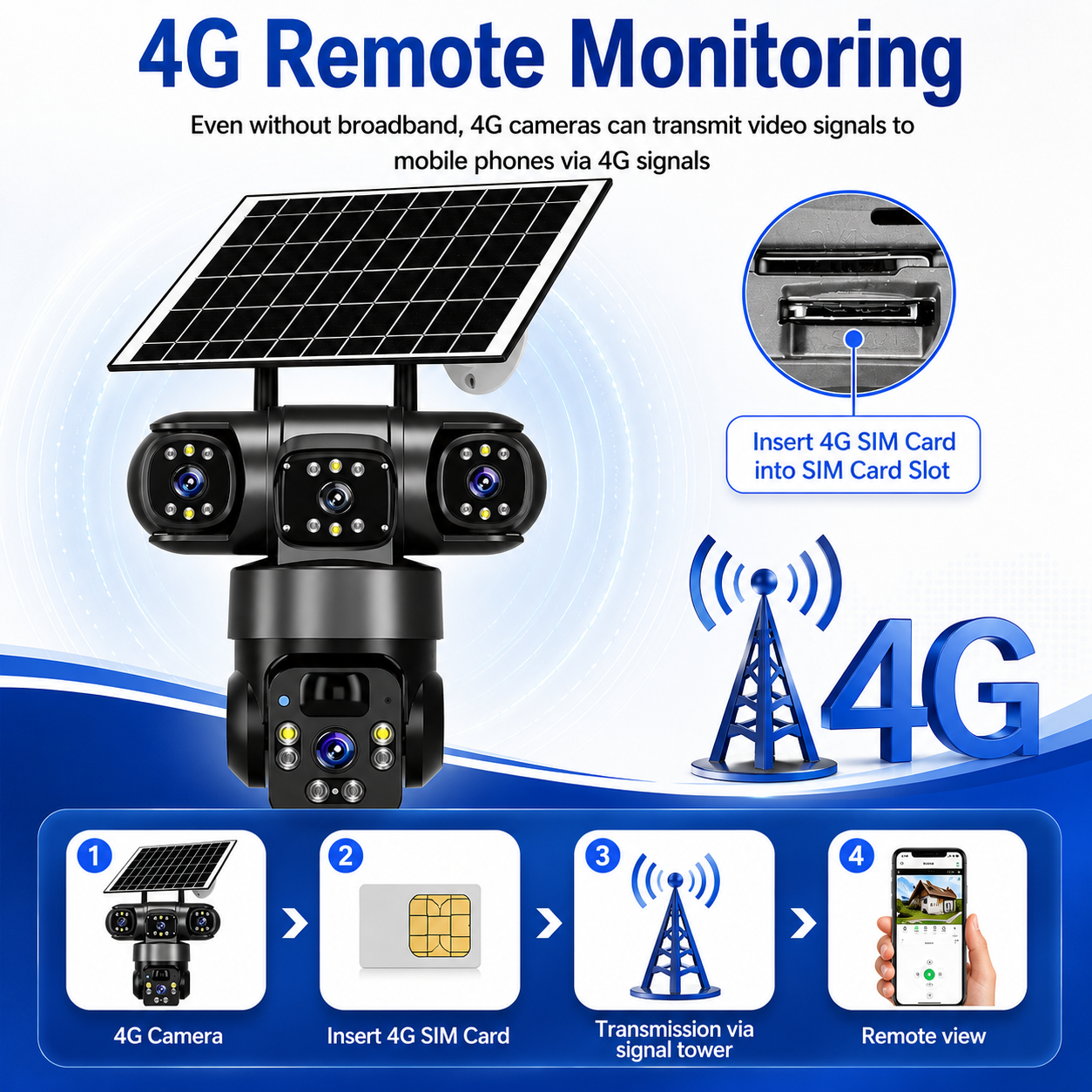
This is particularly relevant for 4G solar security cameras using paid mobile data plans.
Some cameras allow users to select different recording or streaming quality settings.
For more information about recording storage, see T05 – Solar Security Cameras with Local Storage vs Cloud Storage: What's the Difference?
8. Which Resolution Is Suitable for Australian Properties?
Different monitoring applications may benefit from different resolutions.
The following table provides general guidance.
| Application | Resolution to Consider | Main Consideration |
|---|---|---|
| Front Door | 1080p–4MP | Nearby visitors and deliveries |
| Small Backyard | 1080p–4MP | General outdoor monitoring |
| Residential Driveway | 4MP–6MP | Additional detail across a wider area |
| Large Backyard | 4MP–4K | Wider monitoring requirements |
| Detached Garage | 1080p–4MP | Monitoring a defined entrance |
| Construction Site | 4MP–4K | Monitoring equipment and site activity |
| Farm Entrance | 4MP–4K | Distance and camera positioning |
| Large Rural Property | 4MP–4K | Coverage, lens selection and viewing distance |
These ranges are starting points, not guaranteed performance recommendations.
For example, a well-positioned 4MP camera may provide more useful footage of a farm entrance than a poorly positioned 4K camera.
Likewise, a compact 1080p camera may be entirely adequate for monitoring a small residential entrance.
The most suitable resolution depends on what needs to be observed and how far the subject is from the camera.
9. Common Misunderstandings About Camera Resolution
Is 4K Always Better Than 4MP?
4K generally provides more pixels than 4MP.
However, actual image quality also depends on lens performance, lighting and processing.
A higher pixel count does not guarantee better footage in every situation.
Does a 6MP Lens Mean the Camera Records 6MP Video?
Not necessarily.
A lens-related marketing claim should not be treated as confirmation of the camera's recording resolution.
Check the image sensor specification and actual video output dimensions.
Can Digital Zoom Improve Image Detail?
Digital zoom enlarges part of an existing image.
It does not create genuine new detail beyond what was originally captured.
Optical zoom, where available, changes the lens magnification and can provide additional detail of distant subjects.
Is Higher Resolution Always Worth the Extra Cost?
Not always.
For monitoring a small entrance, a reliable 1080p or 4MP camera may meet the property's requirements.
Higher resolution may be more valuable when additional image detail is genuinely needed.
Final Thoughts
Understanding camera resolution helps Australian consumers make more informed decisions when comparing solar powered security cameras.
1080p remains a practical option for basic outdoor monitoring, while 4MP and 6MP cameras can provide additional image detail under suitable conditions.
4K cameras offer a higher pixel count but may also introduce greater storage and data requirements.
However, the highest resolution is not necessarily the best choice for every property.
Lens quality, image sensor performance, camera positioning, lighting conditions and recording requirements are equally important.
For Australian homeowners, builders and rural property owners, the most effective approach is to choose a camera that provides sufficient image detail for the intended monitoring area.
A properly positioned camera with suitable resolution will often provide more useful security footage than a higher-resolution camera installed in the wrong location.
About SolarEasy
SolarEasy is an Australian-owned online retailer specialising in solar powered products for homes, gardens and outdoor applications.
Our Solar Powered Security Camera Information Hub provides practical educational resources to help Australian homeowners, builders, property developers and rural property owners understand solar security technology and make informed purchasing decisions.