
How to Choose a Good Solar Flood Light – Look Beyond the Wattage
Have you ever searched online for a solar flood light and found products labelled 500W, 1000W, 2000W or even higher?
Many buyers naturally assume that a higher wattage means a brighter and more powerful light. A "2000W" solar flood light must surely be better than a "500W" model — right?
Unfortunately, it isn't that simple.
Some wattage figures used in solar lighting can be confusing because they may not represent the actual continuous electrical power consumed by the LEDs.
So, if you can't simply compare the biggest wattage number, how do you choose a genuinely good solar flood light?
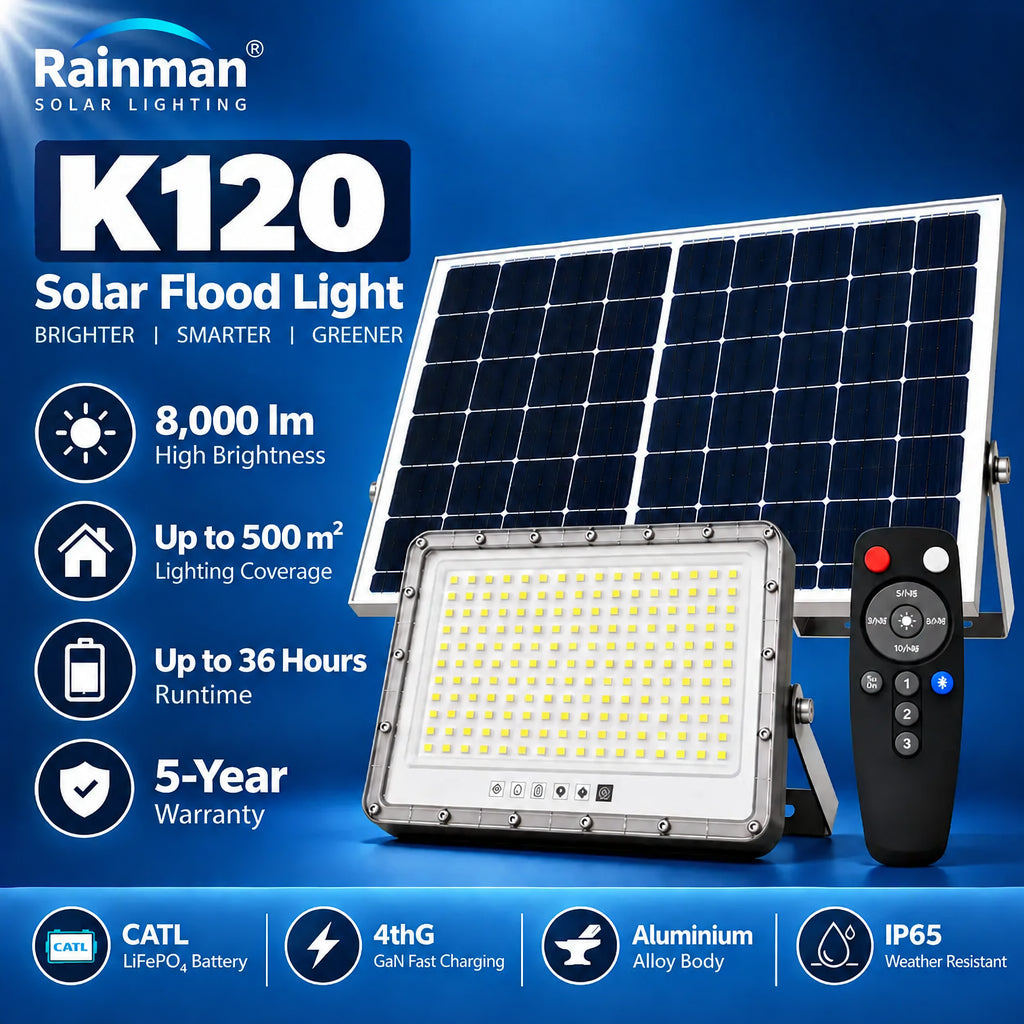
The answer is to look at the real engineering behind the product: brightness, battery storage, solar-panel capacity, energy consumption, runtime and overall build quality.
Start With a Reality Check: Can a Solar Flood Light Really Be 1000W?
Let's start with some very simple maths.
Imagine a solar flood light that genuinely consumes 1,000 watts continuously.
If you wanted that light to operate for eight hours overnight:
1,000W × 8 hours = 8,000Wh
That's 8kWh of stored energy.
This is already a substantial amount of battery storage for a single outdoor light.
Now the system needs to put that energy back into the battery during the following day.
If we assume approximately five peak-sun-hours of useful solar generation, even under simplified ideal conditions:
8,000Wh ÷ 5 hours = 1,600W
And that's before allowing for real-world losses through charging, the battery, wiring, temperature and other system inefficiencies.
In practice, you could therefore be looking at a solar array approaching 2kW to reliably replace that amount of energy.
For perspective, that is roughly equivalent to:
5 × 400W residential solar panels.
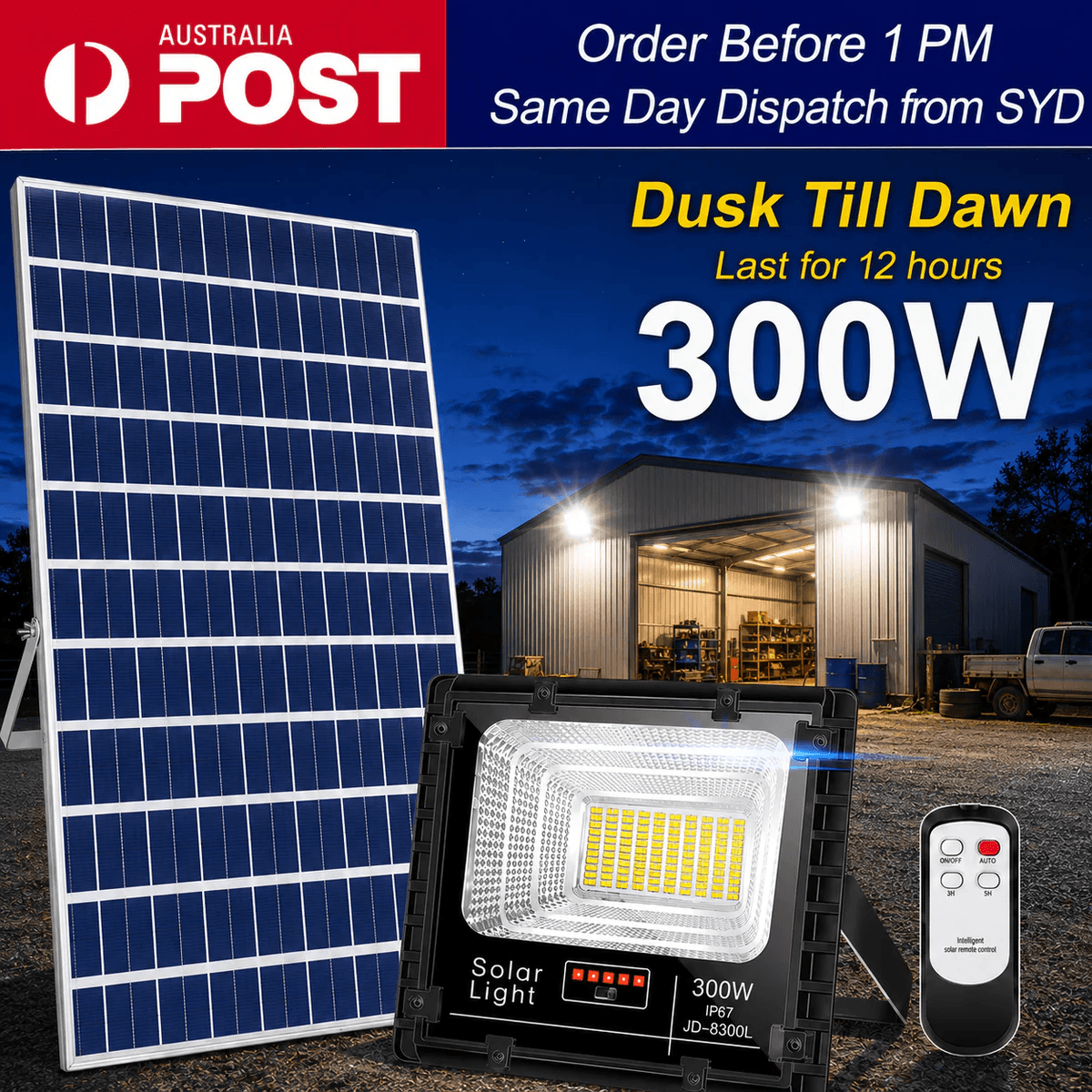
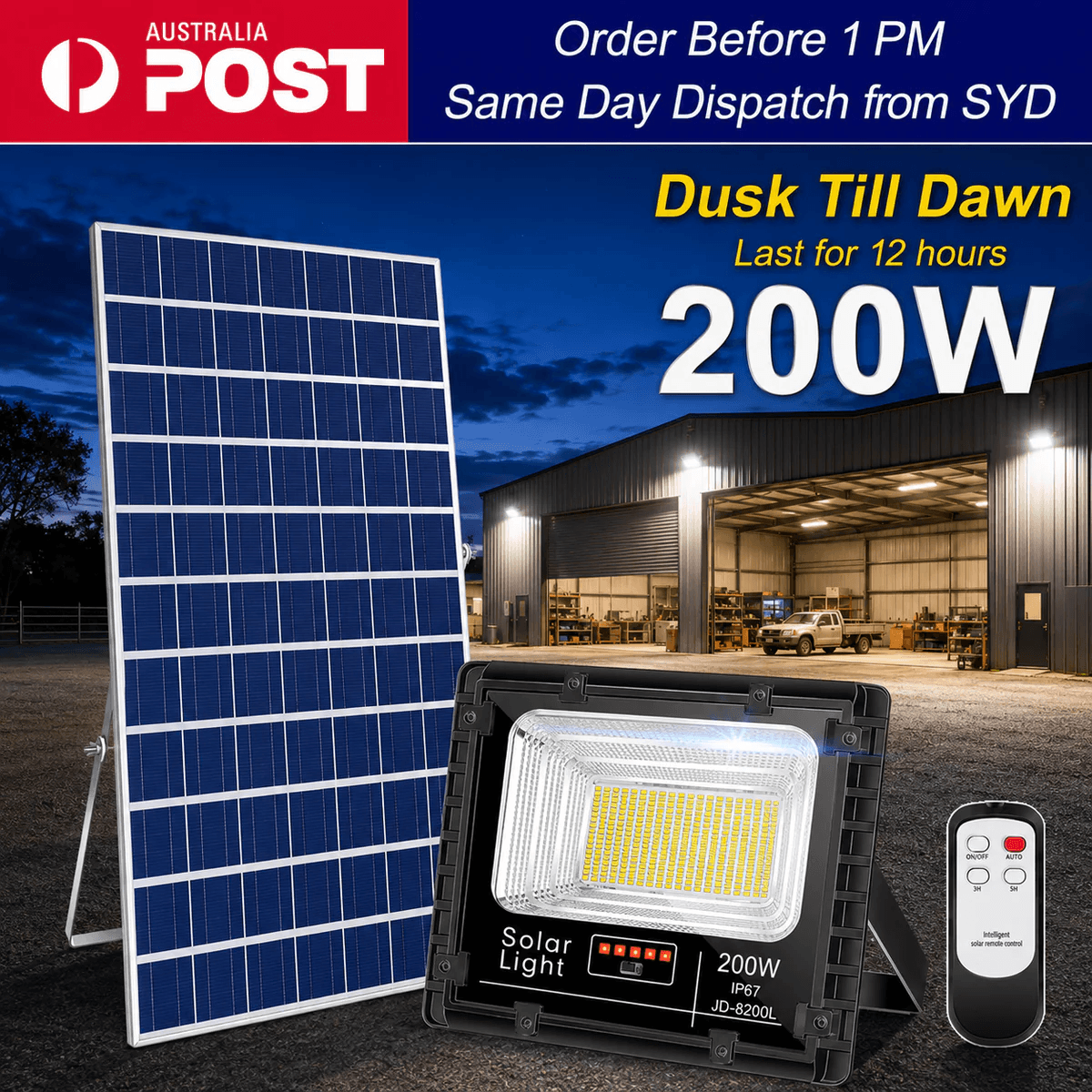
Now compare five full-sized residential solar panels with the relatively compact solar panel supplied with many so-called "1000W" solar flood lights.
The physical difference tells an important story.
This isn't about criticising any particular seller or product. It is simply basic energy arithmetic.
If the solar panel and battery are relatively small, it is reasonable to question whether an enormous advertised wattage represents the light's genuine continuous electrical consumption.
For Brightness, Look at Lumens
If wattage isn't the best way to compare brightness, what should you use?
Look for lumens (lm).
Watts and lumens measure two different things:
Watts = electrical power consumption
Lumens = amount of visible light produced
If your main question is:
"How bright is this solar flood light?"
then a credible lumen figure is much more useful than a large wattage number in a product title.
For example, two lighting systems could consume similar amounts of electricity while producing different lumen outputs because one uses more efficient LEDs.
That is why a well-designed solar flood light isn't necessarily the one consuming the most power.
It is the one that converts its available energy into useful light efficiently.
For more demanding applications, you can go one step further and look at lux, which tells you how much light actually reaches a particular surface or area.
Ideally, lux figures should be provided together with the test distance or recommended installation height.
Check the Battery in Watt-Hours, Not Just Amp-Hours
The next important specification is the battery.
Many products advertise battery capacity in amp-hours (Ah). This is useful, but Ah alone doesn't tell you how much energy is actually stored because battery voltage also matters.
A better comparison is watt-hours (Wh).
The calculation is straightforward:
Battery voltage (V) × Battery capacity (Ah) = Battery energy (Wh)
For example:
A 12.8V 20Ah battery contains approximately:
12.8 × 20 = 256Wh
This gives you a much better idea of how much energy is available to power the light overnight.
Battery chemistry and quality matter too.
Look for information about the battery type, expected cycle life, battery management system and whether replacement is possible.
A large capacity figure isn't particularly useful if the battery deteriorates rapidly after repeated charging and discharging.
Look at the Solar Panel – Not Just the Battery
A large battery sounds impressive, but there is another question you should immediately ask:
"Can the solar panel actually recharge it?"
The battery stores energy. The solar panel has to produce that energy first.
Check the panel's:
Rated wattage
Physical dimensions
Solar-cell type and efficiency
A tiny solar panel combined with a very large claimed battery capacity should encourage you to look more closely at the specifications.
This becomes especially important in Australia during winter.
As discussed in our guide to solar lighting in Australian winter conditions, shorter days, a lower sun angle and cloudy weather can substantially reduce daily solar generation.
A good system therefore needs enough charging capacity to recover the energy consumed during the previous night.
Ask How Long the Light Actually Runs
Runtime is one of the most important specifications for an outdoor solar flood light, particularly for dusk-to-dawn applications.
But simply seeing "12-hour runtime" isn't enough.
Ask:
At what brightness?
A light might operate for 12 hours at 20% output but only four hours at maximum brightness.
Some systems also use programmed power management. They may operate brightly during the first few hours of the evening and then reduce output later at night to conserve battery energy.
There is nothing inherently wrong with this approach — in fact, intelligent energy management can be an excellent feature.
The important point is transparency.
A meaningful runtime claim should tell you the operating mode and conditions under which the runtime was measured.
Consider Cloudy-Day Autonomy
For Australian outdoor applications, another useful specification is autonomy.
In solar lighting, autonomy describes how long the system can continue operating when solar charging conditions are poor.
This matters because real weather doesn't provide perfect sunshine every day.
One sunny day is relatively easy for a solar light.
The real test comes after two or three cloudy or rainy days in succession.
A system with adequate battery reserve, sufficient solar collection and sensible power management is much better positioned to handle these periods.
If reliable overnight lighting matters to you, ask the supplier:
"How long can this light continue operating after several days of poor solar charging?"
That question can be more useful than asking whether the product is "1000W".
Look at LED Efficiency and Lighting Coverage
A good solar flood light should not only be bright — it should put the light where you need it.
Consider the recommended:
Installation height
Beam angle
Lighting area
Lux at a stated distance or height
A product claiming an enormous coverage area without explaining the installation height or expected lux level provides very little meaningful information.
LED efficiency also affects the overall system.
More efficient LEDs can produce more useful light from the same amount of stored battery energy, helping the system balance brightness and runtime.
Again, the goal isn't simply maximum power.
It is useful illumination with efficient energy consumption.
Don't Forget Construction and Weather Protection
Solar flood lights spend their entire working life outdoors.
Australian conditions can mean strong UV exposure, high summer temperatures, rain, wind and, in coastal areas, potentially corrosive conditions.
Check the construction material.
An outdoor light with a well-designed aluminium housing, suitable surface treatment and proper weather sealing will generally offer a very different proposition from a lightweight product designed primarily around achieving the lowest possible price.
Look at the IP rating, operating temperature range and available weather-resistance information.
And remember that long-term reliability isn't determined by the housing alone.
The battery, LEDs, electronics, seals, solar panel and mounting system all contribute to the useful life of the complete product.
Warranty Can Tell You Something About Product Confidence
Finally, look carefully at the warranty.
A longer warranty doesn't automatically prove that a product is better, but it does tell you something important about what the supplier is prepared to stand behind.
Check:
How long is the warranty?
What components are covered?
Is the battery included?
Who handles warranty claims in Australia?
Is there genuine local after-sales support?
For a product expected to remain permanently outdoors for years, these questions matter.
Saving a small amount at the time of purchase may not represent good value if the entire light needs replacing after a relatively short period.
A Simple Solar Flood Light Buyer's Checklist
When comparing solar flood lights, don't begin with:
"Which one has the biggest wattage?"
Instead, check:
Actual lumens — How bright is it really?
Battery capacity in Wh — How much energy can it actually store?
Battery chemistry and cycle life — How long should the battery remain useful?
Solar panel wattage and dimensions — Can the system generate enough energy?
Actual LED power consumption — How quickly does the light consume its stored energy?
Runtime and test conditions — How long does it operate, and at what brightness?
Cloudy-day autonomy — What happens when sunshine is poor?
Lux and coverage — How much useful light reaches the area?
Housing and IP rating — Is it genuinely designed for long-term outdoor use?
Warranty and support — Who stands behind the product if something goes wrong?
The Bottom Line: Look for a Balanced System
Choosing a good solar flood light doesn't have to be complicated.
The biggest number on the product listing isn't necessarily the most useful number.
A quality solar flood light is fundamentally an energy-balanced system:
Solar panel → collects the energy
Battery → stores the energy
LEDs → convert that energy into light
Power management → determines how efficiently the available energy is used
If one part of that system is significantly undersized or poorly designed, the overall performance will suffer.
So rather than asking:
"Is this a 1000W or 2000W solar light?"
ask:
"How many real lumens does it produce, how much energy can its battery store, how much solar energy can its panel collect, and how long has it actually been tested to run?"
Those questions will tell you far more about the quality of a solar flood light — and give you a much better chance of choosing a product that performs reliably in real Australian conditions.