
How Weather, Winter and Cloudy Days Affect Solar Light Performance
Outdoor solar lights depend on a simple energy cycle.
During the day, the solar panel collects energy from sunlight and stores it in the battery. At night, the battery supplies that stored energy to the LED.
This means that tonight's lighting performance depends heavily on what happened during the day.
A bright sunny day may fully recharge the battery. A cloudy day may only provide a partial charge. Several cloudy days in a row can gradually reduce the amount of stored energy available.
This is why weather, winter conditions and consecutive cloudy days can have a noticeable effect on solar light brightness and runtime.
The basic energy path is:
Sunlight → Solar Panel → Battery → LED Light
Understanding this relationship makes it much easier to understand why solar lights perform differently from one season to another.
Why Sunny Weather Gives the Best Solar Light Performance
Solar panels normally produce the most energy when they receive strong, direct sunlight.
Under good conditions:
- Solar intensity is higher
- The panel generates more electricity
- The battery can recharge more quickly
- The light has more stored energy available at night
- Full-night operation becomes easier to achieve
This is one reason solar lights often perform particularly well during Australian summer conditions.
Summer generally brings longer days, higher sun angles and greater available solar energy.
The nights are also shorter, which can reduce the number of hours the light needs to operate.
For a solar lighting system, that is an excellent combination:
More energy coming in during the day and fewer hours of energy consumption at night.
However, even on a sunny day, panel location still matters.
A panel shaded by a building or tree may collect much less energy than a correctly positioned panel exposed to direct sunlight.
What Happens to a Solar Light on a Cloudy Day?
A common misunderstanding is that solar panels stop working when the sky is cloudy.
They do not.
Solar panels can still generate electricity from diffuse sunlight passing through clouds.
However, their output will usually be lower than under strong direct sunlight.
This means a solar light may continue charging on an overcast day, but the battery may receive only a partial charge.
For example, imagine a solar light uses approximately 200Wh of energy during the night.
On a good sunny day, the system might collect enough energy to replace all of that energy.
For illustration:
Energy used overnight: 200Wh
Energy collected during a sunny day: 220Wh
The system has replaced the previous night's consumption.
Now imagine a cloudy day where the solar panel only manages to collect 100Wh.
Energy used overnight: 200Wh
Energy collected during the day: 100Wh
The system now has an energy deficit of approximately:
100Wh
If the battery had reserve capacity, the light may still operate normally that night.
But some of the stored reserve has now been used.
Why Several Cloudy Days Matter More Than One Cloudy Day
One cloudy day is usually much easier for a well-designed solar lighting system to handle than several cloudy days in a row.
A good battery provides an energy buffer.
If it starts fully charged, there may be enough stored energy to compensate for one day of poor solar charging.
The problem occurs when the energy deficit continues.
For example:
Day 1
Battery starts full.
Cloudy weather only partially recharges the energy used the night before.
Day 2
Another cloudy day provides another incomplete charge.
Day 3
The battery now has considerably less stored energy available.
Eventually, the system may need to respond by:
- Reducing brightness
- Shortening operating hours
- Entering an energy-saving mode
- Switching off earlier
- Using motion sensing
- Protecting the battery from excessive discharge
This is an important principle:
If energy used each night is greater than energy collected each day, the battery level will gradually decline.
No solar lighting system has unlimited energy storage.
Why Winter Is More Challenging for Solar Lights
Winter can be more demanding than summer for several reasons.
In many parts of Australia, winter brings:
- Shorter daylight hours
- Lower sun angles
- Lower average daily solar energy
- Longer nights
- More challenging shading conditions
- Periods of cloudy or rainy weather
The most important point is that solar lights can face pressure from both sides of the energy equation.
During winter there can be:
Less energy coming in during the day
and at the same time:
More hours of lighting required during the longer night
This makes winter a much better test of a solar lighting system than a perfect summer day.
A solar light that operates easily through summer may experience shorter runtime during winter if the battery and panel have little reserve capacity.
Australian Summer vs Winter
Australia has excellent solar resources overall, but seasonal differences are still important.
The effect varies depending on where you live.
Northern Australian locations generally experience smaller seasonal changes in daylight than southern cities.
Locations such as Melbourne and Hobart usually experience a more noticeable difference between summer and winter than locations farther north.
A simple comparison is:
| Condition | Australian Summer | Australian Winter |
|---|---|---|
| Daylight hours | Longer | Shorter |
| Sun angle | Higher | Lower |
| Available solar energy | Generally higher | Generally lower |
| Night length | Shorter | Longer |
| Battery charging | Generally easier | More challenging |
| Overnight energy requirement | Often lower | Often higher |
This is why year-round solar light performance should be considered rather than relying only on summer test results.
Rain Affects Charging Differently From Waterproofing
It is useful to separate two different questions.
The first is:
Can the solar light physically withstand rain?
This relates to weather resistance, enclosure design and IP rating.
The second is:
How much energy can the solar panel collect during rainy weather?
These are completely different issues.
An outdoor solar light rated appropriately for the application may be able to withstand rain without difficulty.
But rainy weather normally means lower available solar radiation.
So the light may remain perfectly waterproof while the battery receives less charge.
If runtime becomes shorter after several rainy days, it does not necessarily mean the light has developed a fault.
The battery may simply have received less energy from the solar panel.
How Battery Capacity Helps During Bad Weather
Battery capacity provides reserve energy.
Imagine a light needs 150Wh every night.
If the battery has only enough usable capacity for approximately one night's operation, there is very little reserve for cloudy weather.
A larger battery may store enough energy to support several nights of operation, depending on the light's power consumption and control strategy.
This is particularly useful for:
- Rural properties
- Commercial sites
- Private roads
- Car parks
- Farm entrances
- Remote locations
where reliable lighting may be important even when the weather is poor.
But there is an important limitation:
A battery stores energy. It does not create energy.
If several days of poor weather prevent the solar panel from replacing the energy being consumed, even a large battery will eventually become depleted.
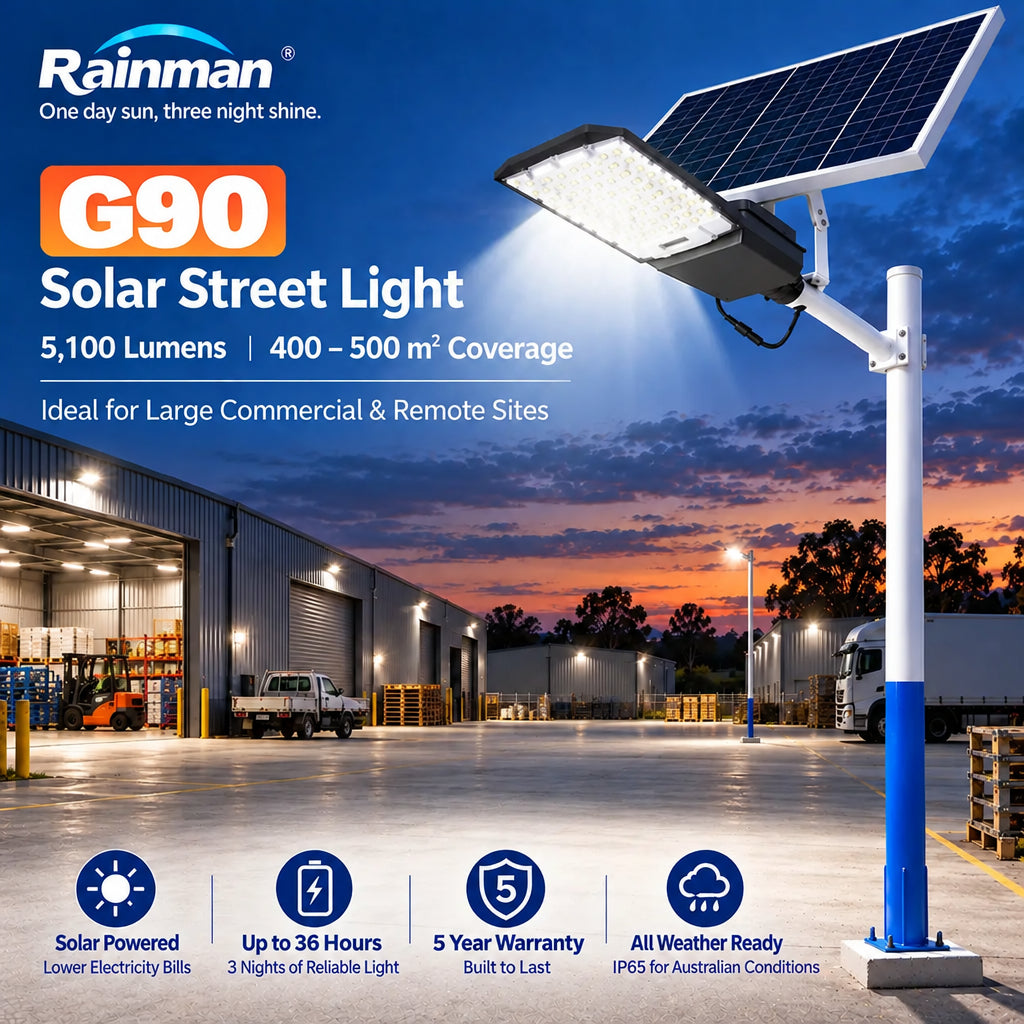
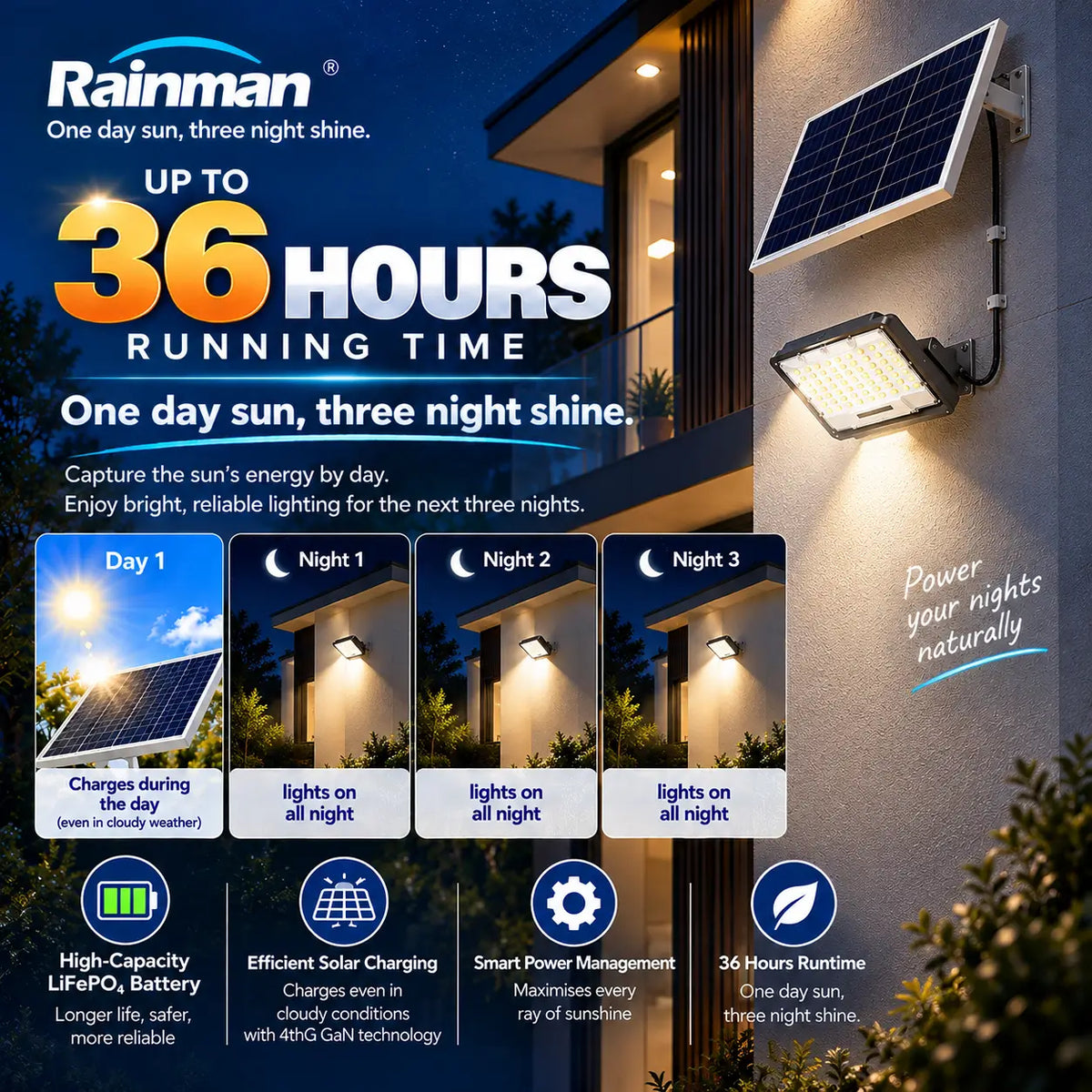
What Does "Three Nights of Backup" Really Mean?
Some solar lighting products advertise claims such as:
- Two rainy days of backup
- Three nights of operation
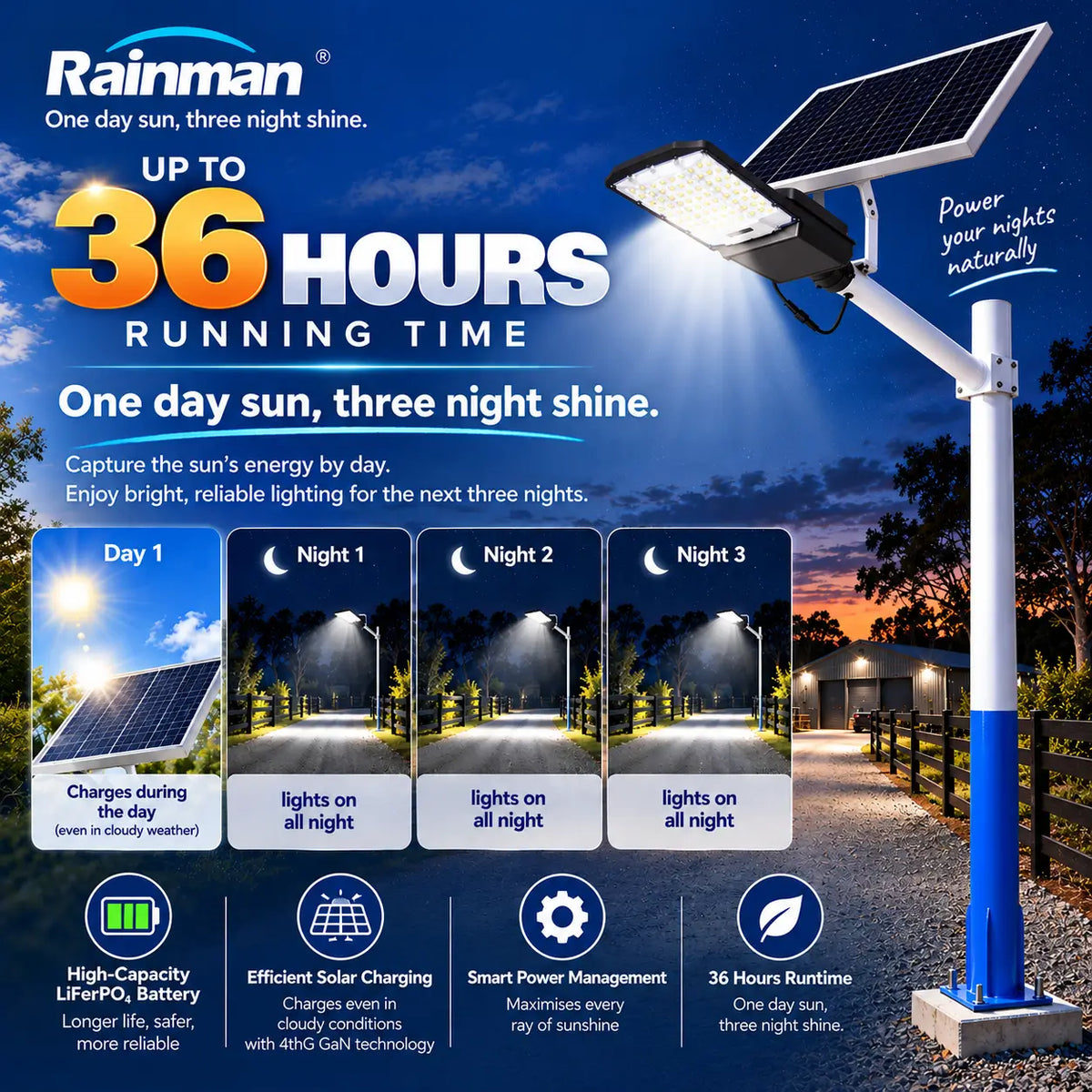
- 36-hour runtime
These figures can be useful, but buyers should understand what they mean.
The result may depend on:
- Whether the battery starts fully charged
- LED brightness
- Average power consumption
- Smart dimming
- Always-on or sensor operation
- Battery usable capacity
- Temperature
- Weather conditions
For example, a light may technically operate for several nights because the controller gradually reduces its power consumption.
That is very different from operating at maximum brightness continuously for the entire period.
When comparing backup claims, ask:
At what brightness level and under what operating mode was the runtime measured?
A transparent answer is much more useful than a large runtime number by itself.
Always-On Lights Are More Sensitive to Poor Weather
Always-on solar lights have a much greater energy requirement than many motion-sensor lights.
A sensor light may operate at full output for only a few minutes during the night.
Its average energy consumption can therefore be relatively low.
An always-on light continuously consumes battery energy.
For example:
A 10W light operating for 10 hours uses:
10W × 10h = 100Wh
A 30W light operating for 10 hours uses:
30W × 10h = 300Wh
A 60W light operating for 10 hours uses:
60W × 10h = 600Wh
That energy must eventually be replaced by the solar panel.
This means a well-designed always-on solar light normally requires:
- Larger battery capacity
- Greater solar panel capacity
- Efficient LEDs
- Efficient charging electronics
- Intelligent energy management
This is one reason a quality always-on solar lighting system may cost considerably more than a basic sensor light.
Smart Energy Management Can Extend Runtime
A well-designed solar light does not necessarily operate at exactly the same power level all night.
The control system may adjust output according to:
- Time of night
- Remaining battery charge
- Available energy reserve
- Previous charging conditions
- Motion detection
- Programmed lighting modes
For example, a light might operate at higher output during the busiest evening hours and gradually reduce power later at night.
This can significantly extend runtime.
Battery protection is also important.
Instead of draining the battery until its voltage becomes dangerously low, a good control system may reduce output or shut down before excessive discharge occurs.
This can help protect battery life.
Can Better Charging Technology Help During Cloudy Weather?
Solar panel size is very important, but charging electronics also affect how efficiently available solar energy is transferred into the battery.
On cloudy or less favourable days, the amount of available solar energy may already be limited.
Under those conditions, reducing unnecessary conversion losses becomes more valuable.
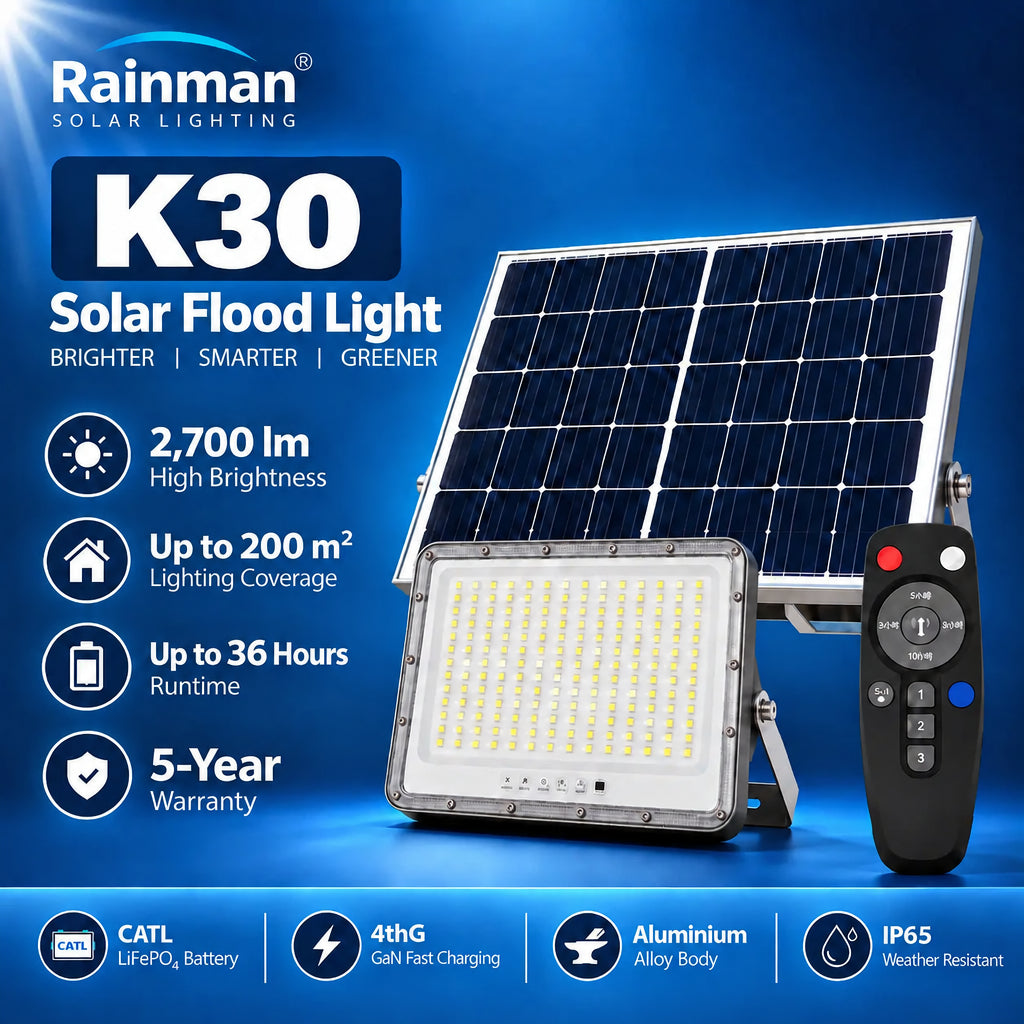
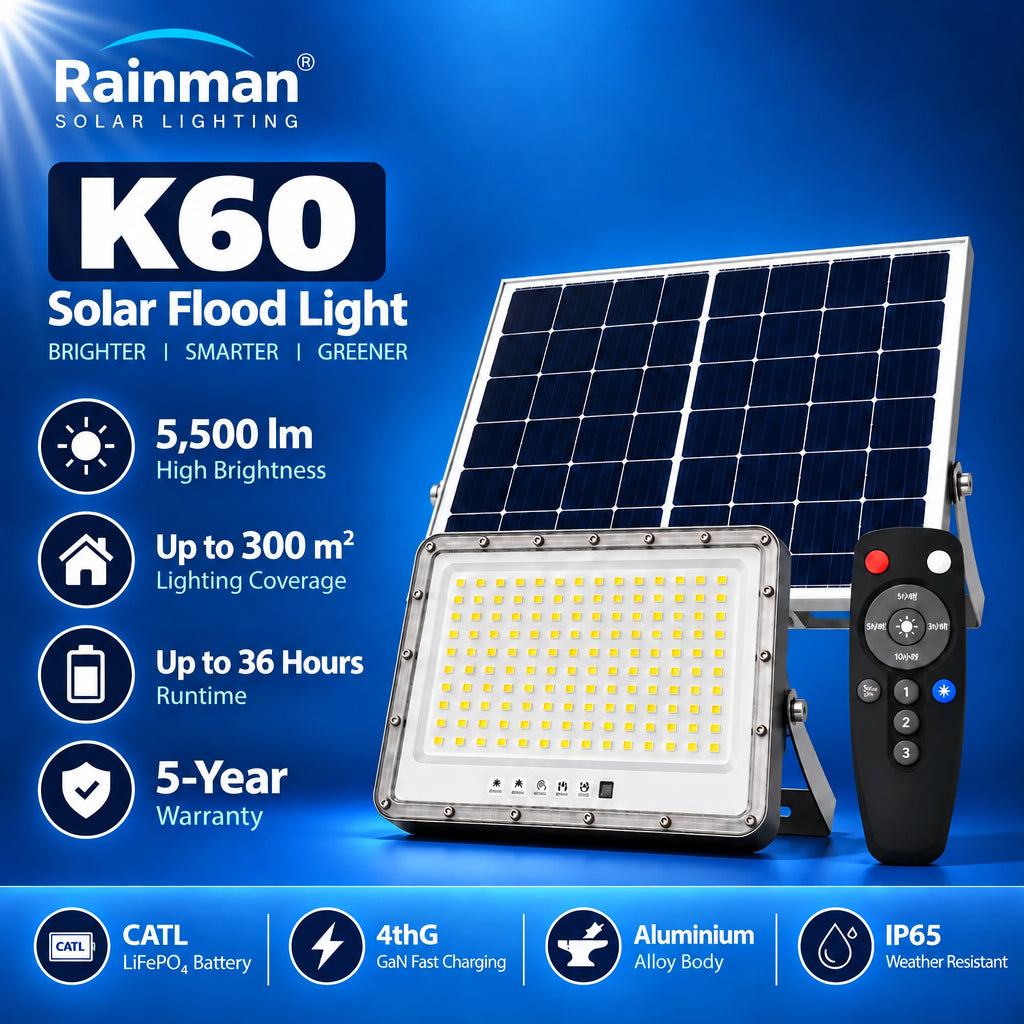
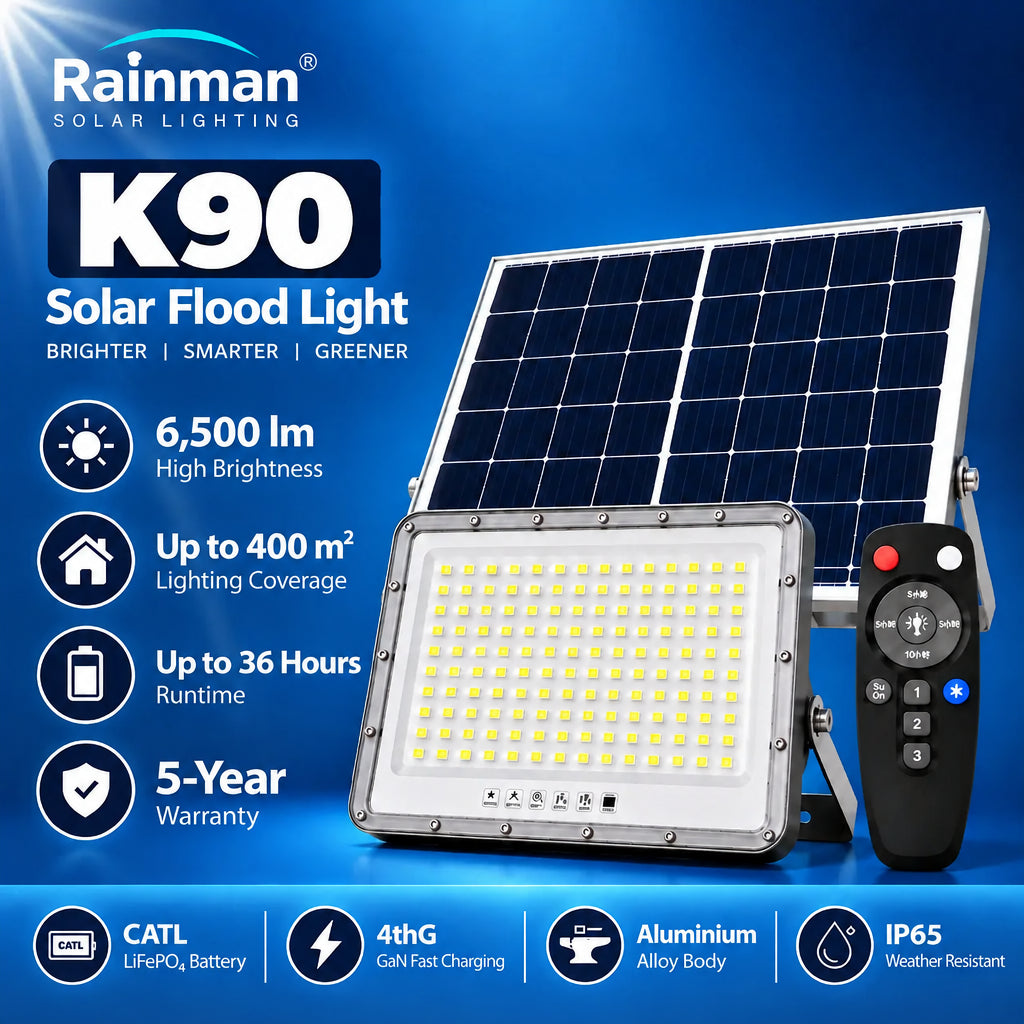
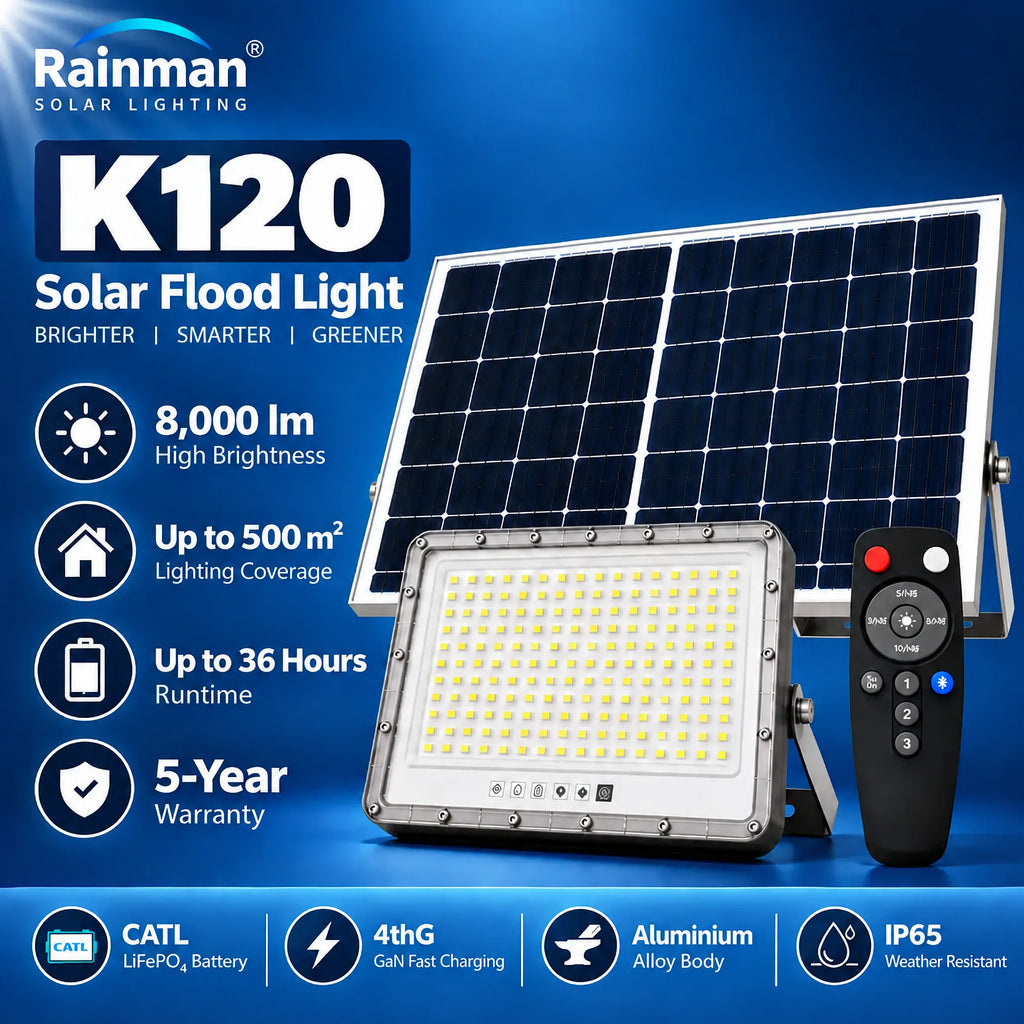
The RainMan solar lighting range uses a fourth-generation GaN (Gallium Nitride) fast-charging system designed to make efficient use of the solar energy available to the system, including under less favourable charging conditions.
GaN-based power electronics can support efficient high-frequency power conversion, helping reduce energy losses in appropriately designed charging systems.
For solar lighting, the practical objective is straightforward:
Get as much useful energy as reasonably possible from the solar panel into the battery.
This can be especially valuable when weather conditions are less than ideal.
However, it is important to keep the claim realistic.
Fast-charging technology cannot create solar energy that is not available.
If heavy cloud significantly reduces solar panel output, the total energy available for charging is still lower than on a sunny day.
The advantage of an efficient charging system is that it can make better use of the energy that is available.
In other words:
Better charging technology can reduce wasted energy, but it cannot replace sunlight.
This is why RainMan's charging technology works as part of a complete system together with the solar panel, battery capacity, LED efficiency and energy-management controls.
Temperature Also Affects Solar Light Performance
Weather is not only about sunlight and rain.
Temperature can also influence performance.
Cold Conditions
Battery performance can temporarily decline at lower temperatures.
The amount of usable energy available and charging behaviour can vary depending on battery chemistry.
For most Australian locations, extreme cold is less severe than in some northern-hemisphere climates, but winter temperatures can still affect battery behaviour.
Extreme Heat
Heat can be just as important, especially in Australia.
Solar lights installed in direct sunlight may experience high internal temperatures during summer.
Long-term heat exposure can accelerate battery ageing and affect electronic components.
This is why battery chemistry, housing design and temperature tolerance are important parts of outdoor solar lighting quality.
A product designed for long-term Australian use needs to deal with both energy availability and environmental stress.
Shade Can Become Worse in Winter
A solar panel location that works well during summer may not perform as well during winter.
Why?
Because the sun is lower in the sky.
A nearby:
- House
- Fence
- Tree
- Shed
- Commercial building
may cast a longer shadow across the solar panel.
This is an important installation issue.
When choosing a location for the panel, do not consider only how sunny the position looks during summer.
Think about winter sunlight as well.
A good practical rule is:
Check whether the panel has clear exposure to the sun during the middle of a winter day.
Trees and Vegetation Can Change Charging Conditions
Another common issue is vegetation.
A newly installed panel may initially receive excellent sunlight.
Six months or two years later:
- Trees may have grown
- Branches may extend over the panel
- Vines may spread
- Leaves may create additional shade
Even partial shading can reduce solar collection.
For long-term performance, periodically check whether the panel still receives good direct sunlight.
Dirt Can Reduce Solar Charging
Solar panels installed outdoors naturally collect:
- Dust
- Pollen
- Bird droppings
- Leaves
- Dirt
- Salt deposits near the coast
A dirty panel absorbs less usable sunlight.
During summer, a large solar reserve may hide the effect.
During winter or cloudy periods, that lost charging capacity becomes more important.
Keeping the solar panel reasonably clean is a simple way to maintain charging performance.
What Can You Do to Improve Winter Performance?
Several practical steps can help.
Give the Panel Maximum Sunlight
Install the panel where it can receive as much unobstructed direct sunlight as possible.
Avoid Winter Shade
Consider how buildings and trees affect the panel when the sun is lower.
Keep the Panel Clean
Remove dirt and debris when necessary.
Use the Correct Panel Orientation
For fixed installations in Australia, good access to the northern sky is generally beneficial.
Choose Sufficient Battery Capacity
Extra energy storage can help bridge periods of poor charging.
Choose a Properly Sized Solar Panel
A larger panel can collect more energy from the same available sunlight than a smaller panel of similar efficiency.
Use Appropriate Brightness Settings
If the product offers adjustable power levels, reducing unnecessary brightness can significantly extend runtime during difficult weather.
Consider the Operating Mode
If continuous lighting is unnecessary, sensor or adaptive modes can greatly reduce energy consumption.
How to Choose a Solar Light for Reliable Year-Round Performance
If you need reliable outdoor lighting throughout the year, do not judge the product only by how bright it looks in a demonstration.
Consider the entire energy system.
Useful specifications include:
- Battery capacity in Wh
- Battery chemistry
- Solar panel wattage
- Actual LED consumption
- Lumen output
- Always-on or sensor mode
- Charging technology
- Energy-saving controls
- Expected runtime
- Cloudy-day reserve
- Winter performance
- Warranty
For demanding applications, the better question is not simply:
"Will this light run for 12 hours tonight?"
Ask:
"Can the system collect, store and manage enough energy to operate reliably through changing weather conditions?"
Common Misunderstandings About Weather and Solar Lights
Myth 1: Solar Lights Do Not Charge on Cloudy Days
Not true.
Solar panels normally continue producing some electricity under cloudy conditions, but output is generally lower.
Myth 2: A Larger Battery Completely Solves Cloudy Weather
No.
A larger battery provides more energy reserve, but it still needs to be recharged.
Myth 3: Shorter Winter Runtime Means the Battery Is Faulty
Not necessarily.
Lower solar input, longer nights and increased shading can all reduce winter performance.
Myth 4: Australia Has So Much Sunshine That Winter Does Not Matter
Australia has excellent solar resources, but seasonal variation still matters.
This is particularly important for high-output or always-on solar lighting.
Myth 5: Fast Charging Means the Light Does Not Need Much Sunlight
No charging technology can create energy.
Efficient charging can make better use of available solar energy, but panel size and solar conditions still determine how much energy is available in the first place.
A Simple Energy Equation
The easiest way to understand weather-related solar light performance is:
Energy collected during the day – Energy used during the night = Battery gain or loss
If:
Energy in ≥ Energy out
the system can generally maintain its battery level.
If:
Energy in < Energy out
the battery gradually loses stored energy.
One poor day may not matter if the battery has enough reserve.
Several poor days can.
That is why a reliable solar lighting system needs enough capacity and margin to cope with real-world conditions rather than only ideal weather.
Final Takeaway
Weather has a direct effect on solar lighting because solar lights depend on energy collected during the day.
Sunny weather normally provides stronger charging.
Cloudy and rainy days provide less available solar energy.
Winter makes the challenge greater because days are shorter, solar energy is generally lower and nights are longer.
A larger battery can help provide reserve energy, but it cannot create electricity.
A larger solar panel can collect more energy, but it still depends on available sunlight.
Efficient charging technology, such as the fourth-generation GaN fast-charging system used in the RainMan range, can help make better use of the solar energy available to the system, particularly when conditions are less favourable.
But reliable year-round performance ultimately depends on the whole system working together:
Solar Panel → Charging System → Battery → LED → Energy Management
A good solar light is therefore not simply one that performs well after a perfect sunny day.
It is one designed with enough solar collection, battery storage, charging efficiency and intelligent energy management to cope with the changing weather conditions it will face throughout the year.