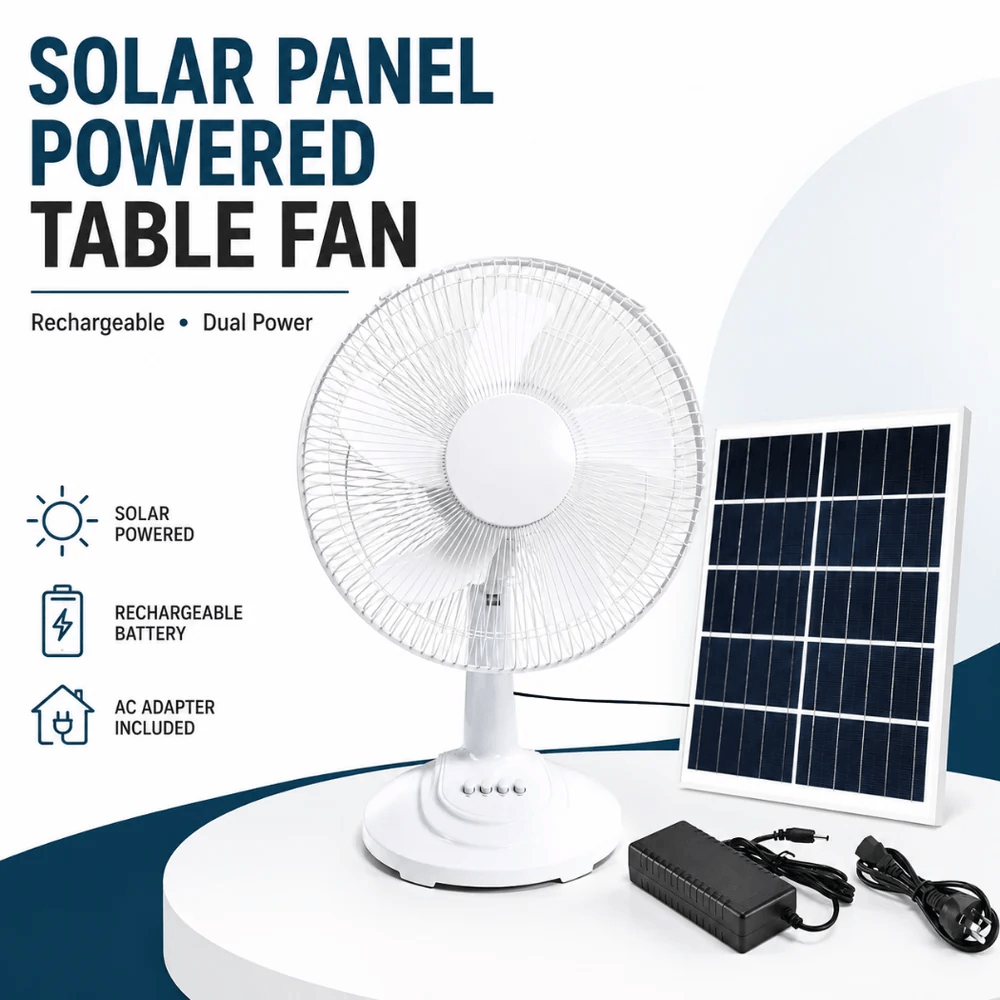

How Long Does It Take to Charge a Solar Fan? Solar vs AC Charging Explained
If you own a rechargeable solar powered fan, one of the most important questions is: How long does it take to fully charge the battery?
The answer depends on several factors, including the battery capacity, solar panel output, available sunlight and charging method.
Under suitable conditions, a solar powered fan may recharge within several hours. However, charging times can vary considerably between different models and weather conditions.
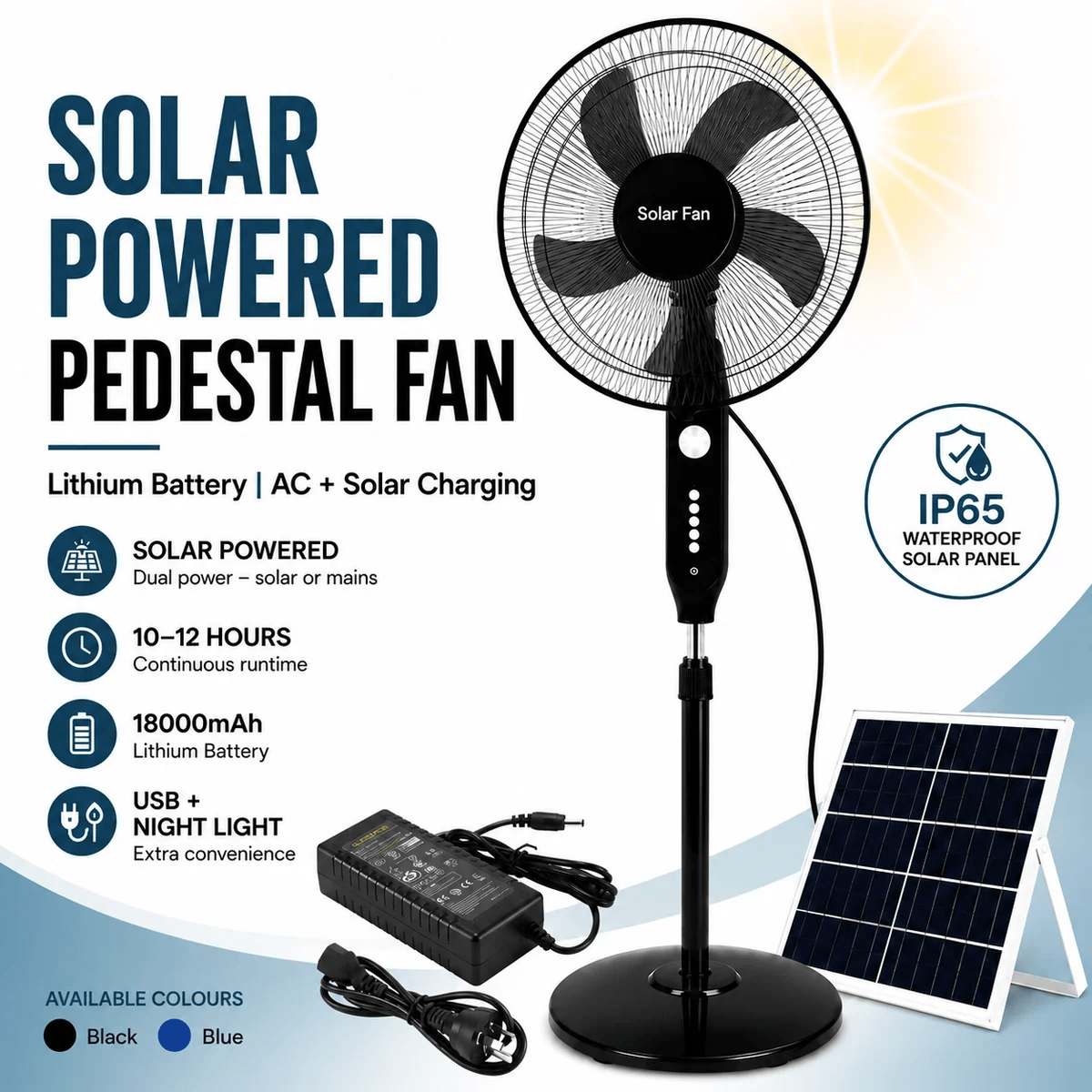
Some modern solar fans also support AC adapter charging, allowing the battery to be recharged using household electricity when sunlight is limited.
For Australian households, understanding the difference between solar charging and AC charging can help you plan daytime charging and ensure your fan is ready for evening use.
This guide explains how charging time works, what affects charging speed and how to charge your solar fan more effectively.
1. How Long Does Solar Charging Usually Take?
There is no universal charging time for every solar powered fan.
A fan with a small battery and a suitably rated solar panel may recharge relatively quickly under strong sunlight.
A model with a larger battery or lower-powered solar panel may require considerably longer.
Solar charging time depends primarily on three factors:
- The amount of energy the battery needs.
- The electricity the solar panel can generate.
- The efficiency and limitations of the charging system.
Understanding Solar Panel Wattage
Solar panels are rated in watts (W), indicating their maximum power output under standard test conditions.
For example, a 20W panel has a higher rated output than a 10W panel.
However, actual electricity generation is usually lower than the rated maximum because sunlight, panel temperature and operating conditions vary.
Example: Solar Charging Time
Consider a hypothetical solar fan with a 60Wh battery that needs a full recharge.
| Solar Panel Rating | Idealised Minimum Time |
|---|---|
| 10W | 6 hours |
| 15W | 4 hours |
| 20W | 3 hours |
| 30W | 2 hours |
These are simplified theoretical figures assuming continuous rated panel output and 100% energy transfer. They are not realistic guaranteed charging times.
Actual charging generally takes longer because of changing sunlight, electrical losses and battery charging behaviour.
Key Point: A higher-wattage solar panel can potentially shorten charging time, provided the fan's charging system supports the available power.
2. What Is the Difference Between Solar Charging and AC Charging?
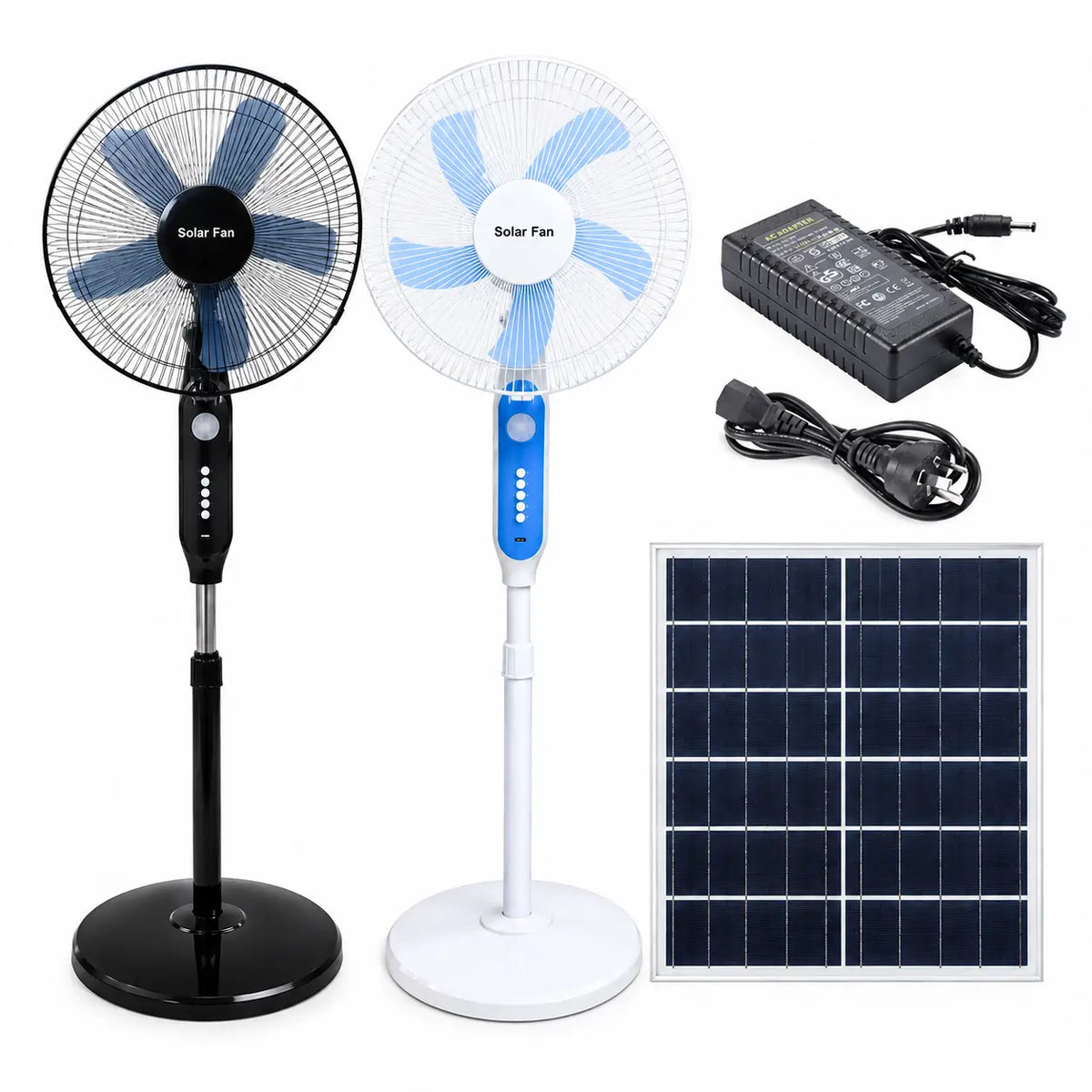
Some rechargeable solar powered fans support two charging methods: solar panel charging and AC adapter charging.
Although both methods replenish the battery, they operate under different conditions.
Solar Charging
Solar charging uses electricity generated by a solar panel exposed to sunlight.
The charging power changes throughout the day as sunlight intensity and environmental conditions change.
This means charging speed may vary considerably.
AC Adapter Charging
AC charging uses a compatible power adapter connected to household electricity.
The adapter converts mains electricity into the electrical output required by the fan's charging system.
Unlike solar panels, an AC adapter can generally provide a more consistent input when household electricity is available.
However, actual charging speed is limited by the adapter rating, battery management system and the fan's charging electronics.
Solar vs AC Charging Comparison
| Feature | Solar Charging | AC Adapter Charging |
|---|---|---|
| Energy Source | Sunlight | Household electricity |
| Charging Availability | Depends on sunlight | Available when mains electricity is supplied |
| Charging Consistency | Variable | Generally more consistent |
| Weather Dependence | Yes | No direct dependence |
| Overnight Charging | Not possible without another energy source | Possible if supported |
| Charging Speed | Depends on panel output and sunlight | Depends on adapter and charging system |
| Grid Electricity Required | No, when charging directly from sunlight | Yes |
Neither method is automatically faster in every situation.
A suitably sized solar panel under strong sunlight may provide substantial charging power, while a low-output AC adapter may charge more slowly.
Key Point: AC charging is generally more predictable, while solar charging performance depends heavily on environmental conditions.
3. How Long Does AC Adapter Charging Take?
AC charging time depends on the battery's energy requirements and the power accepted by the charging system.
For example, a fan with a 60Wh battery and a charging system accepting an average of 15W would require at least four hours to replenish 60Wh under ideal conditions.
60Wh ÷ 15W = 4 hours
However, actual charging may take longer because battery charging is not perfectly efficient.
Many rechargeable batteries also require charging current to decrease as they approach full charge.
Why Adapter Specifications Matter
An adapter may be labelled with an output such as:
- 5V / 2A
- 12V / 1A
- 12V / 2A
These specifications indicate the adapter's output voltage and maximum rated current.
For example, a 12V / 2A adapter has a maximum rated output of 24W.
However, this does not mean the fan will continuously charge at 24W.
The fan's charging circuitry determines how much power it can accept.
Important: Always use the manufacturer-approved adapter. Matching wattage alone is insufficient; voltage, polarity, connector type and other electrical requirements must also be compatible.
4. Why Does Solar Charging Take Longer on Some Days?
Solar panel output can change significantly throughout the day.
Even when a panel is positioned outdoors, several factors can reduce the electricity available for charging.
Cloud Cover
Clouds reduce the amount of sunlight reaching the solar cells.
A solar panel may continue generating electricity under cloudy conditions, but its output is usually lower than under strong direct sunlight.
Panel Orientation
A panel positioned towards the sun generally receives more useful sunlight than one facing away from it.
The most effective orientation depends on location, season and installation conditions.
Shading
Partial shading from trees, buildings or outdoor structures can significantly reduce panel performance.
Even a relatively small shaded area may affect electricity generation.
High Temperatures
Solar panels can become hot under strong Australian sunlight.
Higher cell temperatures generally reduce the electrical efficiency of conventional photovoltaic panels.
Dirty Solar Panels
Dust, leaves and other debris can block sunlight and reduce electricity generation.
Keeping the panel clean according to the manufacturer's instructions can help maintain performance.
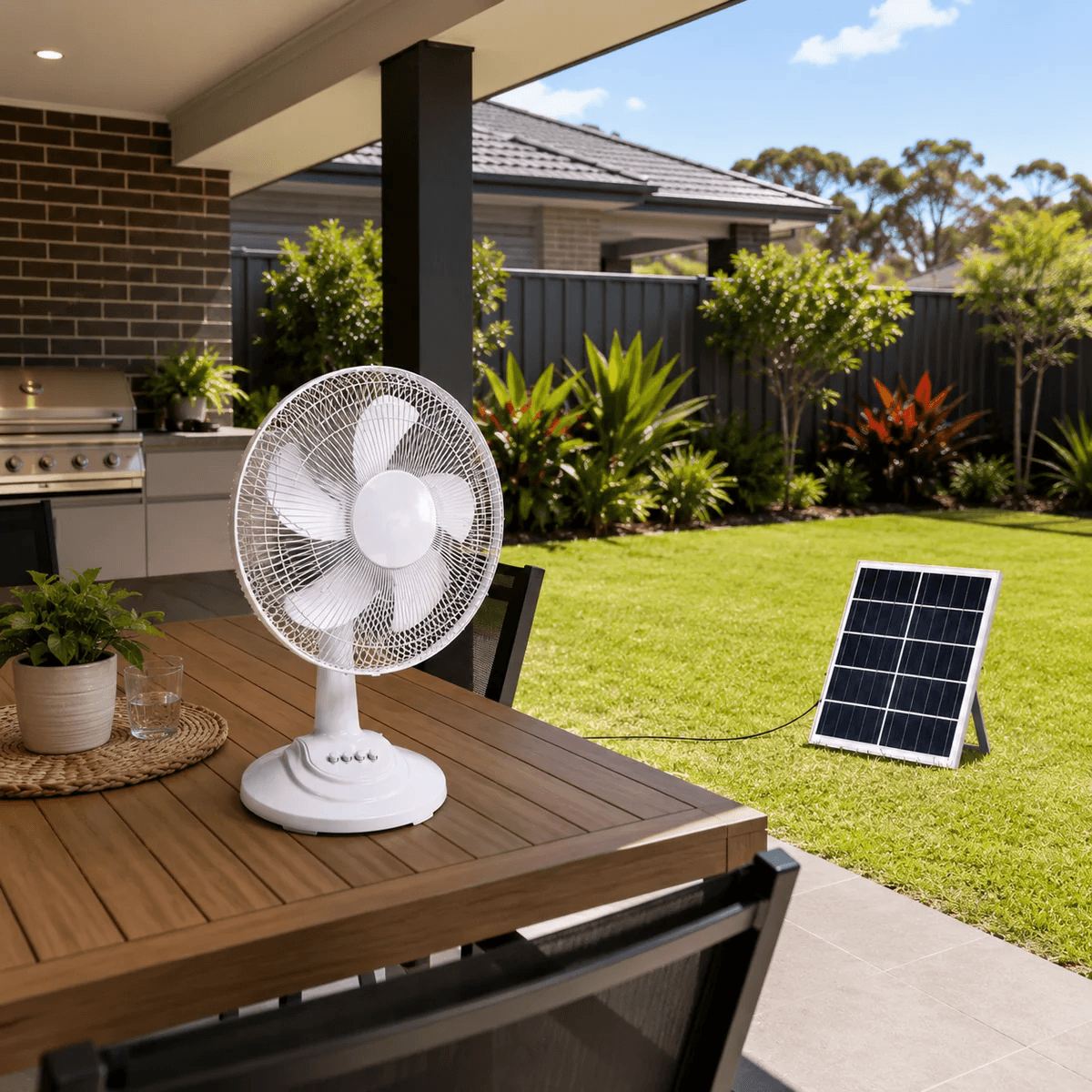
Practical Tip: Position the solar panel outdoors where it receives unobstructed sunlight, and avoid unnecessary shading throughout the charging period.
5. Can You Charge a Solar Fan While Using It?
Some rechargeable solar powered fans support simultaneous charging and operation.
This allows the fan to run while receiving electricity from the solar panel or a compatible adapter.
However, this capability varies between models.
How Does Simultaneous Charging Work?
When the fan operates during charging, some incoming electricity may be used to power the motor.
The remaining available electricity may be used to recharge the battery.
For example, suppose a solar charging system supplies 20W and the fan consumes 12W.
In a compatible system, some of the remaining power may be available for battery charging.
However, actual energy distribution depends on the charging controller and system design.
If incoming electricity is insufficient to support the fan's consumption, the battery may continue discharging.
Therefore, a fan may charge more slowly while operating than when switched off.
Practical Tip: If your priority is to recharge the battery as quickly as possible, switching the fan off during charging may help, depending on the model.
6. Can a Solar Fan Be Fully Charged in One Day?
Yes, some solar powered fans can be fully charged within one day of suitable sunlight.
However, whether this is possible depends on battery capacity, solar panel output and available solar energy.
Understanding Peak Sun Hours
Solar energy availability is often described using peak sun hours.
One peak sun hour represents solar energy equivalent to one hour of sunlight at an irradiance of 1,000W per square metre.
This does not mean the sun shines for only that number of hours.
Instead, it provides a convenient way to estimate total daily solar energy.
Example: Daily Solar Charging
Consider a hypothetical 20W solar panel receiving four equivalent peak-sun hours.
Its theoretical daily energy production would be:
20W × 4 hours = 80Wh
If we assume 75% of that energy reaches the battery:
80Wh × 0.75 = 60Wh
Under these simplified conditions, approximately 60Wh could be available for battery charging.
However, the battery may not accept all available energy, particularly as it approaches full charge.
Actual performance also depends on charging limits, battery temperature and the fan's electrical design.
Key Point: A solar fan can potentially recharge within one sunny day, but this should be confirmed against the manufacturer's specifications rather than assumed.
7. Does Charging Time Change Between Summer and Winter?
Yes. Seasonal changes can affect solar charging performance.
In Australia, summer generally provides longer daylight hours and greater solar energy availability than winter.
However, the exact difference depends on location, weather and panel positioning.
Summer Charging
During summer, longer daylight hours can provide more opportunities for solar charging.
However, very high panel temperatures can reduce conversion efficiency.
Winter Charging
During winter, shorter days and lower sun angles may reduce daily solar energy generation.
A fan that fully recharges during a sunny summer day may require longer or multiple days to recharge under less favourable winter conditions.
What About Different Australian Locations?
Solar energy availability varies across Australia.
For example, conditions in tropical Queensland can differ significantly from those in Melbourne or Tasmania.
Local weather patterns, seasonal cloud cover and panel orientation all affect charging performance.
Practical Tip: When planning regular solar charging, allow for less favourable weather rather than relying on ideal summer conditions.
8. How Can You Charge Your Solar Fan More Efficiently?
Several simple practices can improve charging reliability.
Position the Panel in Direct Sunlight
Avoid placing the panel behind windows or in shaded areas when direct outdoor sunlight is available.
Use the Supplied Solar Panel
Use the panel specified or approved by the manufacturer.
Keep the Panel Clean
Remove accumulated dirt and debris using the recommended cleaning method.
Avoid Excessive Heat Around the Battery
Keep the fan and battery in a suitable environment, particularly during hot Australian weather.
Use a Compatible AC Adapter
If your fan supports AC charging, use the approved adapter when solar charging is insufficient.
Check Charging Indicators
If the fan includes charging-status indicators, use them to determine whether charging is progressing normally.
Follow the Manufacturer's Instructions
Different battery chemistries and charging systems have different operating requirements.
These steps can improve charging reliability without requiring additional equipment.
9. What If Your Solar Fan Is Charging Too Slowly?
If your solar fan takes much longer to charge than expected, start by checking the charging conditions.
Check the Solar Panel
Make sure the panel is clean, properly connected and positioned in direct sunlight.
Inspect the Charging Cable
Check for loose connectors, damaged cables or other visible problems.
Do not use damaged charging equipment.
Check Whether the Fan Is Running
If the fan is operating during charging, some incoming energy may be consumed by the motor.
This can reduce the energy available to recharge the battery.
Consider Battery Condition
Rechargeable batteries gradually deteriorate with age and use.
An ageing battery may show reduced capacity or abnormal charging behaviour.
Try Approved AC Charging
If the model supports AC charging, using its approved adapter may help determine whether slow charging is related to sunlight conditions.
If charging problems continue, contact the manufacturer or supplier for assistance.
Do not attempt to modify the battery or charging circuit.
Final Thoughts
The time required to charge a solar powered fan depends on battery capacity, solar panel output, available sunlight and charging system efficiency.
Solar charging offers a practical way to replenish battery energy using sunlight, but charging speed can vary with weather, season and panel positioning.
AC adapter charging, when supported, provides a more predictable alternative during cloudy weather or when convenient indoor charging is required.
For Australian households, understanding these differences can help ensure a rechargeable solar fan is ready for evening or overnight use.
The most reliable approach is to follow the manufacturer's charging specifications and allow sufficient time for the battery to recharge under real-world conditions.
Explore rechargeable solar powered cooling solutions from SolarEasy Australia.