
Solar Powered Security Camera Information Hub | Section 3: Features & Technology Explained
Motion detection is one of the most important features of a modern solar powered security camera. Instead of requiring homeowners to constantly watch live footage, motion detection allows compatible cameras to identify activity, record events and send notifications when something happens.
However, not all motion detection technologies work in the same way.
When comparing solar security cameras in Australia, you may come across terms such as PIR Motion Detection, AI Human Detection and Auto Tracking.
Although these features are often advertised together, they perform different functions.
PIR sensors detect changes in infrared radiation, AI detection analyses images to identify particular objects, and auto tracking allows compatible cameras to follow movement.
Understanding these differences can help Australian homeowners, builders and rural property owners choose a camera that provides useful security monitoring without generating excessive notifications or consuming unnecessary battery power.
1. What Is PIR Motion Detection?
PIR stands for Passive Infrared.
A PIR sensor detects changes in infrared radiation within its detection area. People and animals emit infrared radiation because of their body temperature.
When a warm object moves across the sensor's detection zones, the sensor may recognise the change and trigger the camera.
Unlike conventional video-based motion detection, a PIR sensor does not need to continuously analyse every video frame to detect initial movement.
Advantages of PIR Motion Detection
PIR technology is particularly useful for battery-powered solar security cameras.
Its main advantages include:
- Low Power Consumption: PIR sensors can operate using relatively little electricity.
- Automatic Event Detection: The camera can respond when qualifying movement is detected.
- Battery Efficiency: Compatible cameras can remain in a low-power standby state between events.
- Practical Outdoor Monitoring: PIR sensors can detect movement around entrances, pathways and other monitored areas.
For example, a PIR-equipped solar camera installed near an Australian home's front entrance may detect someone approaching the doorway and trigger recording.
Limitations of PIR Detection
PIR sensors cannot determine whether the moving object is a person, pet or another heat source.
Animals may trigger the sensor, and detection performance can be affected by distance, movement direction and temperature differences.
A PIR sensor may also struggle when the temperature of a moving object is similar to its surroundings.
PIR detection is primarily a method of detecting movement, not identifying who or what caused it.
2. What Is AI Motion Detection?
AI motion detection uses image-processing algorithms to analyse what appears in the camera's field of view.
Instead of simply detecting movement, compatible AI systems attempt to recognise specific types of objects.
Depending on the camera model, these may include people, vehicles or animals.
AI Human Detection
Human detection is a common feature of AI-enabled security cameras.
The camera analyses video images and attempts to distinguish people from other objects.
For example, a camera monitoring a driveway may detect movement caused by a person walking towards the garage.
If human detection is enabled, the camera may classify the event as human activity and send an appropriate notification.
This can be particularly useful in outdoor environments where other movement is common.
Can AI Reduce False Alarms?
AI detection may help reduce unwanted notifications caused by irrelevant movement.
For example, a homeowner may want notifications when someone enters the backyard but not every time a branch moves in the wind.
AI classification can help filter certain events, depending on the camera's capabilities.
However, AI detection is not perfect.
Poor lighting, unusual viewing angles, partially obscured objects and challenging weather conditions may affect accuracy.
Some cameras also require particular settings or subscriptions for certain AI features.
AI detection can improve the relevance of security alerts, but it cannot guarantee completely accurate identification.
3. What Is Auto Tracking?
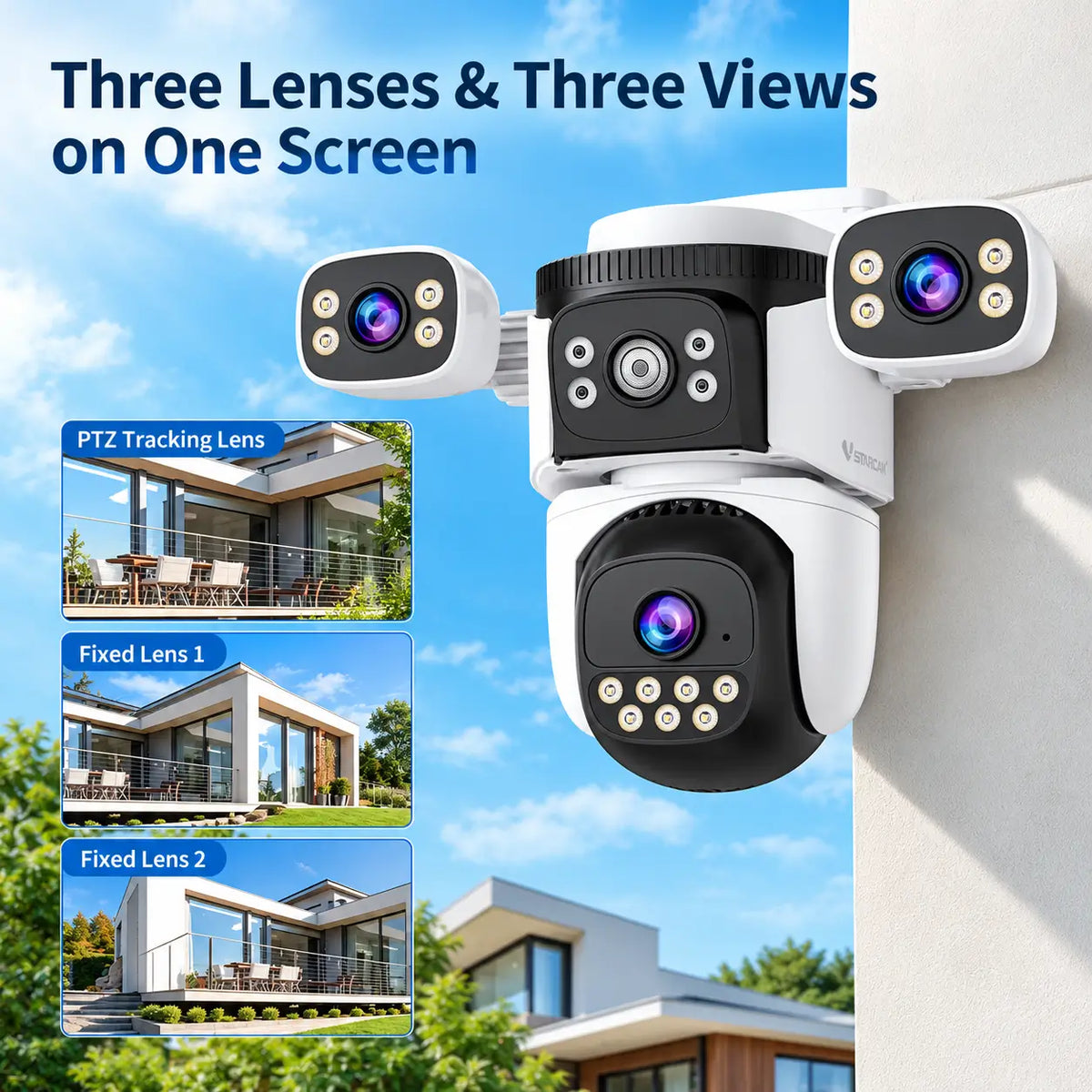
Auto tracking is a feature available on certain motorised PTZ security cameras.
PTZ stands for Pan, Tilt and Zoom.
When auto tracking is supported and enabled, the camera can automatically adjust its viewing direction to follow a detected moving target.
For example, a PTZ solar security camera installed near a driveway may detect a person walking towards the garage.
The camera may then rotate to keep that person within its field of view.
Advantages of Auto Tracking
Auto tracking can provide several benefits:
- Following movement across a wider monitored area.
- Recording more of a person's movement through the scene.
- Reducing the need to manually rotate the camera during an event.
- Providing flexible monitoring for driveways, yards and outdoor work areas.
However, not every PTZ camera supports automatic tracking.
Some models allow remote pan-and-tilt control but cannot automatically follow moving objects.
Limitations of Auto Tracking
Auto tracking may lose a target when it moves behind an obstacle, leaves the camera's movement range or moves too quickly.
Another consideration is that the camera may temporarily point away from its original monitoring position.
Therefore, auto tracking should not be confused with continuous monitoring of every direction.
For properties requiring simultaneous coverage of multiple locations, additional cameras or suitable multi-lens systems may be useful.
4. PIR vs AI Detection vs Auto Tracking: Key Differences
Although these technologies are related, their purposes are different.
| Feature | PIR Detection | AI Detection | Auto Tracking |
|---|---|---|---|
| Main Function | Detects infrared changes | Classifies objects in video | Follows moving targets |
| Technology | Infrared sensor | Image analysis | Motorised camera movement and tracking software |
| Human Recognition | No | Supported on some models | Depends on detection system |
| Camera Movement | Not required | Not required | Usually requires PTZ movement |
| Power Considerations | Generally low-power | Requires image processing | Motors and processing use energy |
| Main Benefit | Efficient motion triggering | More relevant alerts | Flexible movement monitoring |
| Main Limitation | Cannot identify object type | Classification errors possible | May lose targets or look away from other areas |
A useful way to understand these features is:
PIR detects a change, AI attempts to identify the object, and Auto Tracking follows the target.
However, cameras do not necessarily include all three technologies, and their operation varies by model.
5. How Do PIR, AI and Auto Tracking Work Together?
Some advanced solar security cameras combine these technologies into one monitoring system.
A typical sequence may work as follows.
Step 1 – PIR Detects Movement
A PIR sensor identifies a change in infrared radiation and triggers the camera to become active.
Step 2 – The Camera Analyses the Scene
The camera captures images and, where supported, uses AI to classify the detected object.
Step 3 – A Relevant Event Is Identified
If the detected activity meets the configured conditions, the camera may begin recording or send a notification.
Step 4 – Auto Tracking Begins
On supported PTZ models, the camera may automatically follow the detected target.
Step 5 – Recording and Notifications
The camera may save footage locally or to the cloud and send an alert through its smartphone application.
This is an illustrative example. Some cameras use video-based motion detection instead of PIR, while others use different processing sequences.
The exact operation depends on the camera's hardware, software and settings.
6. How Does Motion Detection Affect Battery Life?
Battery efficiency is particularly important for solar powered security cameras.
Unlike permanently powered cameras, solar models depend on rechargeable batteries and available solar energy.
Motion detection settings can influence how frequently a camera wakes, records video and transmits information.
Frequent Motion Events
A camera installed beside a busy road may detect activity much more frequently than one monitoring a quiet backyard.
Frequent recording and notifications can increase power consumption.
AI Processing
AI classification requires processing resources, although the amount of electricity used depends on the camera's hardware and software design.
PTZ Auto Tracking
Auto tracking may require additional energy to operate the camera's motors.
Frequent or extended tracking activity can therefore affect battery performance.
Improving Battery Efficiency
Users can often improve operating efficiency by adjusting motion sensitivity, detection zones and recording settings where supported.
For example, excluding a busy public road from the camera's detection area may reduce unnecessary events.
However, settings should not be reduced so aggressively that important activity is missed.
7. Where Are These Features Most Useful in Australia?
Different properties have different monitoring requirements.
| Application | Features to Consider | Main Benefit |
|---|---|---|
| Front Entrance | PIR and Human Detection | Relevant alerts when visitors approach |
| Residential Driveway | AI Detection and Auto Tracking | Monitoring people and movement |
| Small Backyard | PIR and Human Detection | Efficient monitoring of a defined area |
| Large Backyard | AI Detection and PTZ Tracking | Flexible monitoring across a wider area |
| Construction Site | Human Detection and Auto Tracking | Monitoring activity around equipment and materials |
| Farm Equipment Shed | PIR and AI Detection | Monitoring access to valuable equipment |
| Rural Property Entrance | PIR, AI and PTZ where suitable | Monitoring visitors and movement |
Australian Residential Homes
For ordinary residential properties, reliable detection and useful notifications are often more important than having every advanced feature.
A compact fixed solar camera with PIR detection may be suitable for monitoring a front entrance.
For larger driveways or backyards, AI detection and PTZ tracking may provide additional flexibility.
Construction Sites
Small builders and property developers may use solar security cameras to monitor temporary building sites.
Human detection can help identify activity around stored materials, while auto tracking may provide additional coverage of movement across the site.
However, camera placement and reliable connectivity remain important.
Farms and Rural Properties
Rural properties may experience movement from livestock, wildlife and vehicles.
Appropriate detection settings can help reduce unwanted notifications while maintaining monitoring of important areas.
No detection system should be assumed to distinguish every animal or person accurately.
8. Common Misunderstandings About Motion Detection
Does PIR Detect Humans Only?
No. PIR sensors detect changes in infrared radiation and may respond to animals or other suitable heat sources.
Does AI Detection Eliminate False Alarms?
No. AI may reduce certain unwanted alerts, but incorrect classifications can still occur.
Do All PTZ Cameras Have Auto Tracking?
No. PTZ movement and automatic tracking are separate capabilities.
Can Auto Tracking Monitor Multiple Directions Simultaneously?
A single movable lens generally observes its current field of view. It cannot necessarily record every direction at once.
Does More Sensitive Motion Detection Mean Better Security?
Not always. Excessive sensitivity can create unnecessary recording events and notifications.
The goal is reliable detection of relevant activity rather than detecting every possible movement.
Final Thoughts
PIR detection, AI motion detection and auto tracking are three different technologies that can improve the functionality of solar powered security cameras.
PIR provides an energy-efficient way to detect movement. AI can help classify objects and make notifications more relevant. Auto tracking allows compatible PTZ cameras to follow moving targets.
When these features are combined effectively, they can provide flexible monitoring for Australian homes, driveways, construction sites and rural properties.
However, not every solar security camera supports all three functions.
Consumers should check the manufacturer's specifications and understand which features are available, how they operate and whether they require configuration.
For solar powered cameras, it is also important to balance detection performance with battery efficiency.
The best security camera is not necessarily the one with the greatest number of features, but the one that provides reliable monitoring for the intended location.
About SolarEasy
SolarEasy is an Australian-owned online retailer specialising in solar powered products for homes, gardens and outdoor applications.
Visit SolarEasy to explore solar powered products and practical information for Australian properties.
Our Solar Powered Security Camera Information Hub helps homeowners, builders and rural property owners understand solar security technology and make informed purchasing decisions.