
How to Choose the Best Solar Powered Fan for Your Needs: A Complete Buying Guide
Choosing the right solar powered fan isn't simply about finding the biggest fan or the lowest price. The best option is one that delivers suitable airflow, reliable battery performance and convenient charging for your everyday needs.
For Australian households, solar powered fans can be particularly useful in bedrooms, living rooms, covered outdoor areas and camping environments.
However, not all solar fans offer the same performance. Differences in battery capacity, solar panel output, motor efficiency and charging options can significantly affect how well a fan suits your requirements.
This buying guide will help you evaluate the features that matter most, compare product specifications and choose a solar powered fan that offers practical value for your money.
1. Start With Your Main Cooling Requirements
Before comparing models, identify exactly where and how you intend to use your solar powered fan.
This will help you avoid purchasing a fan that is either too small for your needs or unnecessarily large.
Personal Cooling
If you need airflow while working at a desk, reading or sleeping, a compact fan may be sufficient.
Prioritise:
- Comfortable airflow at close range
- Low noise levels
- Compact dimensions
- Convenient speed adjustment
Family or Shared Spaces
For living rooms and family areas, look for a fan capable of distributing air across a wider space.
Prioritise:
- Suitable airflow performance
- Oscillation function
- Adjustable height or tilt
- Stable construction
Camping and Outdoor Activities
For camping, caravanning or use in covered outdoor areas, portability becomes particularly important.
Prioritise:
- Rechargeable battery capacity
- Lightweight construction
- Convenient solar charging
- Easy transportation and storage
Buying Tip: Choose your fan based on its intended application rather than appearance or advertised size alone.
2. Check Airflow Performance, Not Just Fan Size
Airflow is one of the most important specifications when comparing solar powered fans.
A larger fan does not necessarily provide better cooling performance.
Actual airflow depends on several factors, including blade design, motor efficiency and operating speed.
What Specifications Should You Compare?
Where available, look for:
Airflow Rating: Often measured in cubic metres per minute (m³/min) or cubic metres per hour (m³/h).
Fan Diameter: Indicates the approximate size of the fan blades or fan head, depending on the manufacturer's measurement method.
Speed Settings: Multiple speeds allow you to balance airflow and energy consumption.
Oscillation: Helps distribute airflow across different positions.
For example, a fan with strong airflow and oscillation may be more suitable for a family living room than a fan designed primarily for personal use.
However, airflow ratings should be compared using consistent measurement methods whenever possible.
Buying Tip: Prioritise verified airflow specifications over marketing claims such as "super powerful" or "extra strong wind".
3. Choose the Right Battery Capacity for Your Required Runtime
Battery capacity is particularly important if you plan to operate your solar fan during the evening or overnight.
When comparing products, look for battery capacity expressed in watt-hours (Wh).
Watt-hours indicate the amount of energy a battery can store.
How to Estimate Battery Runtime
A simple calculation can help you estimate how long a fan might operate.
Theoretical Runtime (hours) = Battery Capacity (Wh) ÷ Fan Power Consumption (W)
For example:
| Battery Capacity | Fan Power | Theoretical Runtime |
|---|---|---|
| 40 Wh | 10 W | 4 hours |
| 60 Wh | 10 W | 6 hours |
| 80 Wh | 10 W | 8 hours |
| 100 Wh | 10 W | 10 hours |
These figures are theoretical estimates. Actual operating times may be shorter due to electrical losses, battery condition and other operating factors.
What About Battery Capacity in Ah?
Some manufacturers advertise battery capacity in amp-hours (Ah).
To compare batteries accurately, you also need the battery's nominal voltage.
Battery Energy (Wh) = Battery Voltage (V) × Battery Capacity (Ah)
For example, a 12V 10Ah battery stores approximately 120Wh of nominal energy.
Buying Tip: If you need eight hours of overnight operation, compare the manufacturer's tested runtime at your preferred fan speed rather than relying only on the advertised battery capacity.
4. Match Solar Panel Output to Your Charging Needs
A solar powered fan's charging performance depends partly on the output of its solar panel.
Solar panel output is normally expressed in watts (W).
A higher-rated panel can potentially generate more electricity under suitable sunlight conditions.
However, actual charging performance depends on:
- Available sunlight
- Solar panel orientation
- Shading and weather conditions
- Charging controller efficiency
- Battery charging requirements
How to Evaluate Solar Charging Performance
When comparing two solar fans, check both the battery capacity and the solar panel's rated output.
For example, a large battery paired with a relatively small solar panel may require a longer charging period.
Conversely, a suitably sized solar panel may recharge the battery more quickly under favourable conditions.
Check the Charging Arrangement
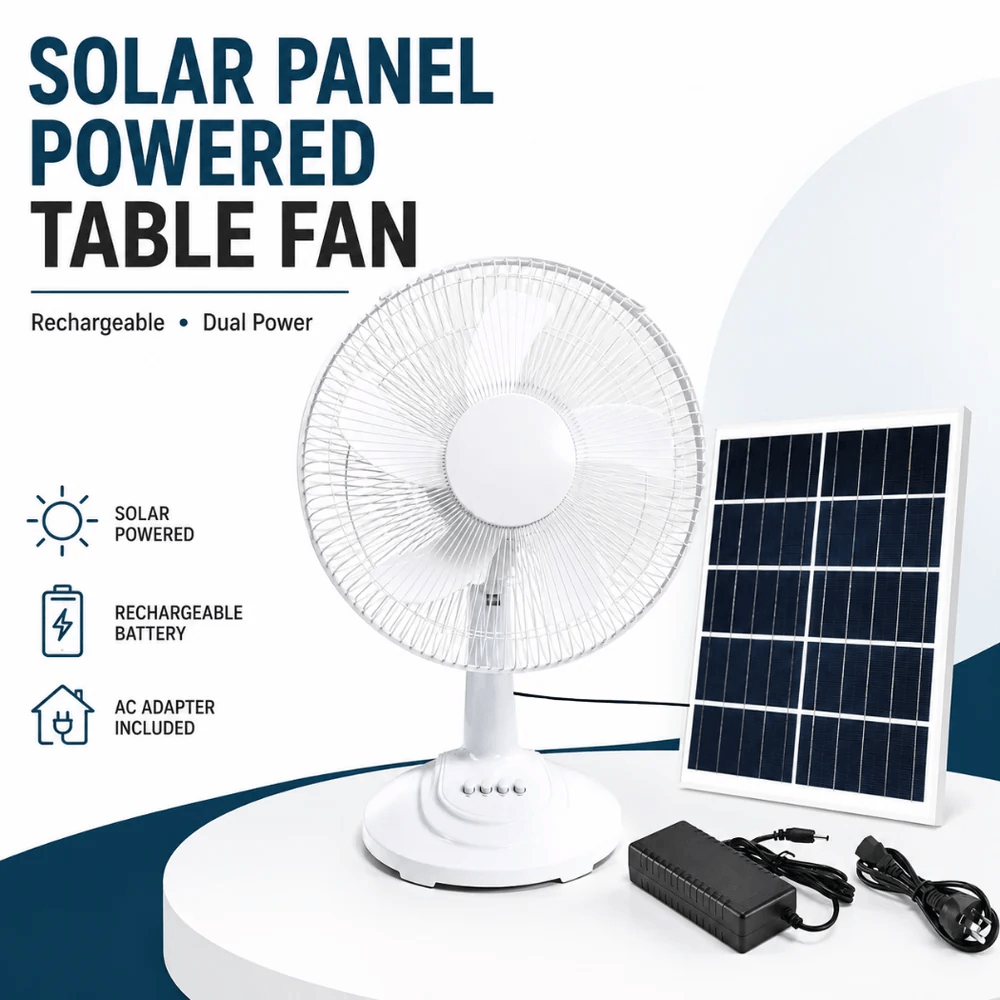
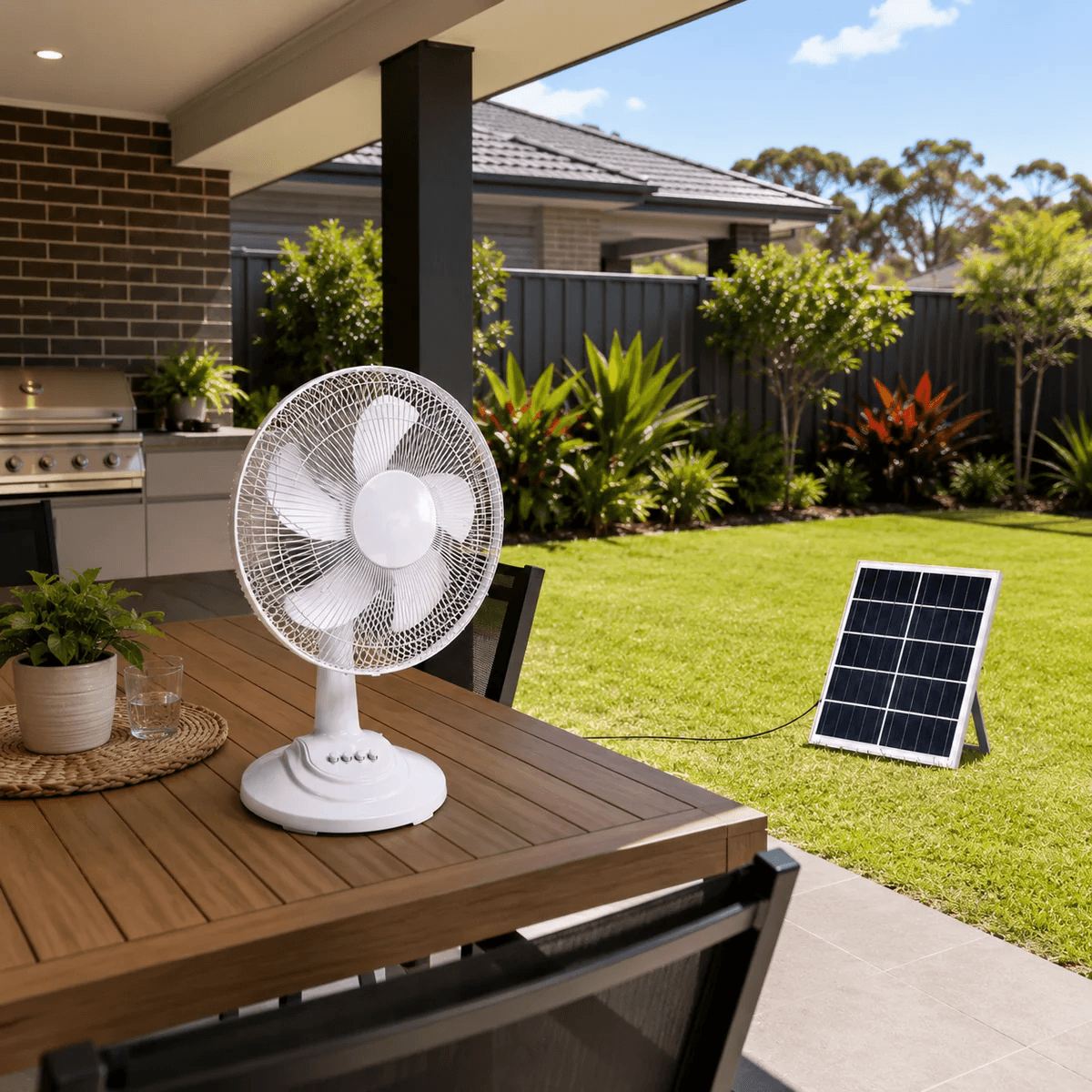
Before purchasing, confirm whether the fan includes a separate solar panel and whether the supplied cable allows the panel to be positioned outdoors while the fan remains indoors.
Also check whether the fan supports simultaneous operation and solar charging.
Not every model offers this capability.
Buying Tip: Ask for the manufacturer's estimated solar charging time and the conditions under which that estimate was measured.
5. Compare Charging Options Before Buying
For everyday household use, charging flexibility can be an important purchasing consideration.
Some solar powered fans support solar charging only, while others include alternative charging methods.
Solar Charging
Suitable for generating electricity from sunlight and reducing dependence on household electricity.
AC Adapter Charging
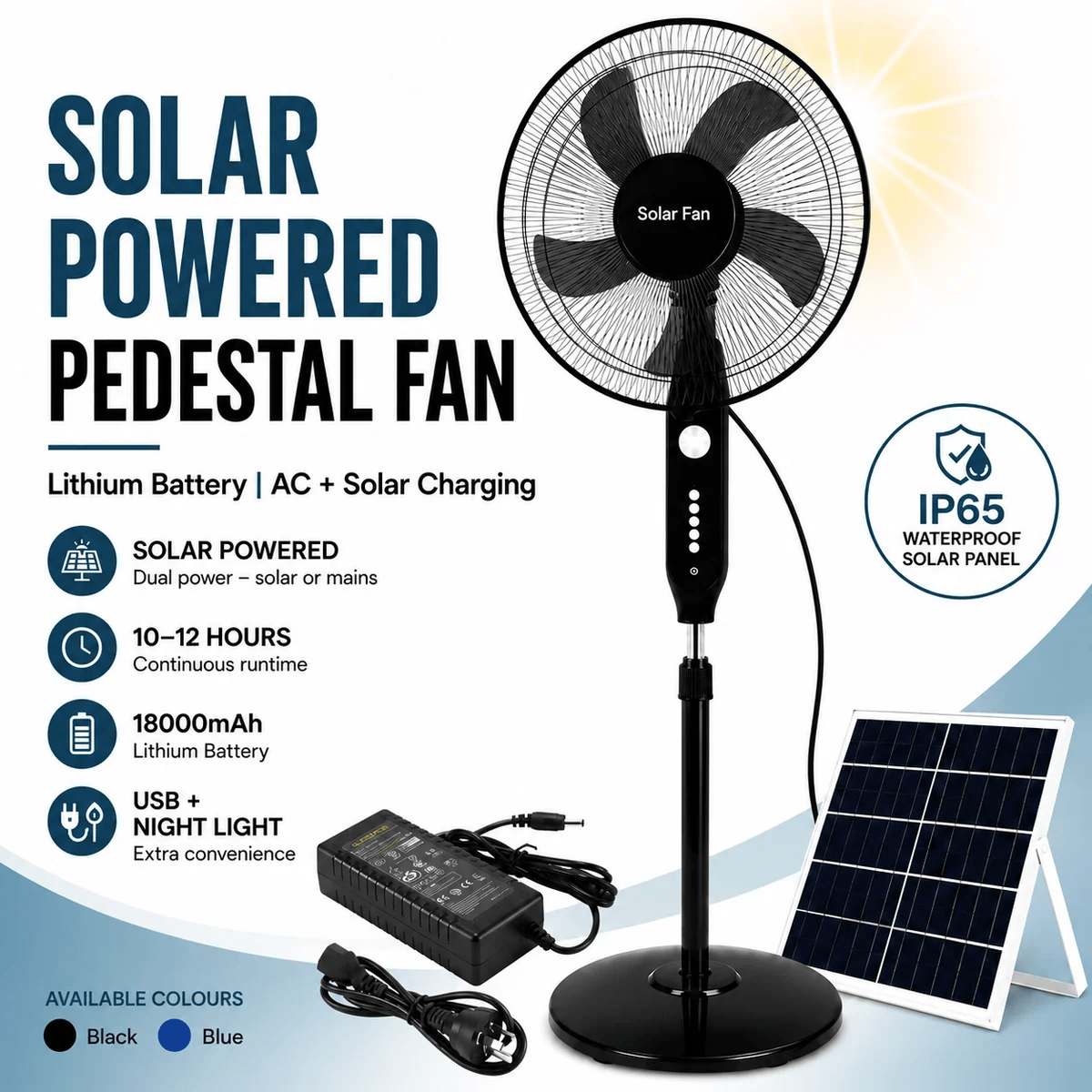
Selected models support charging through a compatible AC power adapter.
This can be useful during cloudy or rainy weather when solar charging is insufficient.
Battery Operation
Rechargeable models can operate using stored electricity without requiring a continuous connection to the solar panel.
What Should You Check?
Before purchasing, confirm:
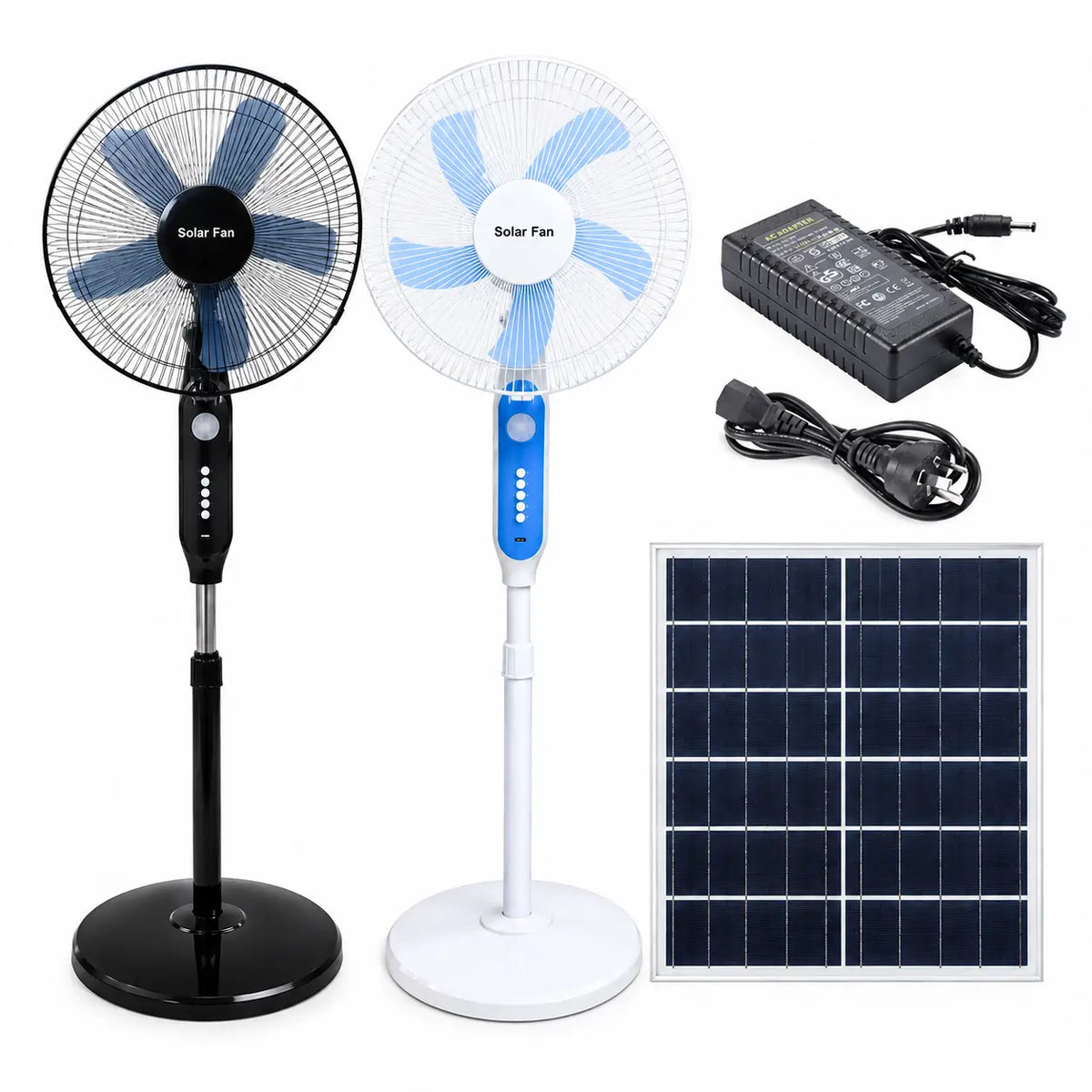
- Whether the solar panel is included.
- Whether an AC adapter is included or sold separately.
- The manufacturer's recommended charging time.
- Whether the fan can operate while charging.
- Whether the charging accessories are compatible with the fan.
Buying Tip: For regular household use, a model supporting both solar and AC adapter charging may provide greater convenience.
6. Evaluate Additional Features Based on Practical Value
Extra features can improve convenience, but not every feature is essential.
Consider which functions you will genuinely use.
| Feature | Why It Matters | Most Useful For |
|---|---|---|
| Remote Control | Adjust settings without approaching the fan | Bedrooms and living rooms |
| Timer | Automatically switches the fan off | Overnight use |
| Oscillation | Distributes airflow across a wider area | Shared spaces |
| Adjustable Height | Allows flexible airflow positioning | Living rooms and bedrooms |
| USB Power Output | Charges compatible small electronic devices | Camping and emergencies |
| Built-In Night Light | Provides gentle night-time illumination | Bedrooms and camping |
| Multiple Speeds | Balances airflow and battery consumption | Everyday use |
USB Charging Function
Some rechargeable solar fans include a USB output that allows the battery to charge mobile phones or other compatible low-power devices.
Check the USB output rating and supported charging standards before purchasing.
Remember that charging another device consumes battery energy and may reduce the fan's remaining runtime.
Built-In Night Light
Selected models include a small night light designed to provide gentle illumination.
This is useful for basic visibility at night but should not be considered a replacement for normal room lighting.
Buying Tip: Focus on features that improve your daily experience rather than paying extra for functions you are unlikely to use.
7. Consider Product Quality, Warranty and Local Support
A solar powered fan is a combination of electrical and mechanical components.
Build quality, battery performance and after-sales support should therefore be part of your purchasing decision.
Battery Quality
Check whether the manufacturer specifies the battery chemistry, capacity and recommended charging procedures.
Clear battery specifications make it easier to compare products.
Construction and Stability
For pedestal fans, look for a stable base and secure height-adjustment mechanism.
For portable fans, consider the strength of the housing, handle and supporting structure.
Warranty and After-Sales Support
Before purchasing, check:
- The manufacturer's warranty period
- Whether replacement parts or accessories are available
- The seller's contact and support options
- Applicable Australian Consumer Law guarantees
A longer advertised warranty is not automatically evidence of better quality, so consider the overall product specifications and seller support.
Buying Tip: Choose a supplier that provides clear product information and accessible after-sales assistance.
8. Match Your Budget to Your Actual Requirements
The cheapest solar powered fan is not always the best-value option.
Similarly, a more expensive model may include features you do not need.
Instead of comparing prices alone, consider the overall package.
Entry-Level Requirements
If you only need occasional personal cooling, prioritise basic airflow, portability and reliable battery operation.
Everyday Household Requirements
For regular use, consider battery runtime, charging flexibility, adjustable speeds and convenient controls.
Extended or Outdoor Use
For camping or extended battery operation, pay closer attention to battery capacity, solar panel performance, portability and useful backup functions.
Buying Tip: Compare the total purchase cost, including any separately sold solar panels, AC adapters or accessories.
9. Final Solar Powered Fan Buying Checklist
Before making your purchase, use this checklist to compare your preferred models.
| Buying Consideration | Question to Ask |
|---|---|
| Intended Use | Where will I use the fan most often? |
| Airflow | Is the airflow suitable for my needs? |
| Battery Capacity | Will it operate for my required number of hours? |
| Solar Panel | Is the panel output suitable for charging the battery? |
| Charging Options | Does it support solar and AC adapter charging? |
| Portability | Can I move and position it conveniently? |
| Extra Features | Do I need USB charging, a timer or night light? |
| Warranty | What warranty and after-sales support are provided? |
| Total Cost | Are all necessary accessories included? |
If a product does not clearly specify its battery capacity, charging requirements or expected runtime, consider requesting this information before purchasing.
Final Thoughts
The best solar powered fan is not necessarily the largest, most powerful or most expensive model.
It is the fan that best matches your cooling requirements, preferred operating time and charging conditions.
For Australian households, the most important buying considerations are airflow performance, battery capacity, solar panel output and charging flexibility.
Additional features such as USB charging, remote controls and built-in night lights can provide extra convenience, particularly for camping or overnight use.
By comparing actual specifications rather than marketing claims, you can make a more informed purchasing decision and choose a solar powered fan that offers practical long-term value.
Explore the solar powered cooling solutions available from SolarEasy Australia and find a fan suited to your everyday needs.