
What to Look for When Buying a Dual-Power Solar Fan in Australia: Charging Options, Battery Runtime & Extra Features
A solar powered fan can be a convenient way to stay comfortable during Australia's warmer months. However, relying entirely on sunshine for charging may not always be practical.
Cloudy weather, rainy days and indoor use can make charging flexibility an important consideration.
This is where dual-power solar fans offer an advantage.
These fans combine solar charging with an alternative household electricity charging option, allowing users to recharge their batteries under different conditions.
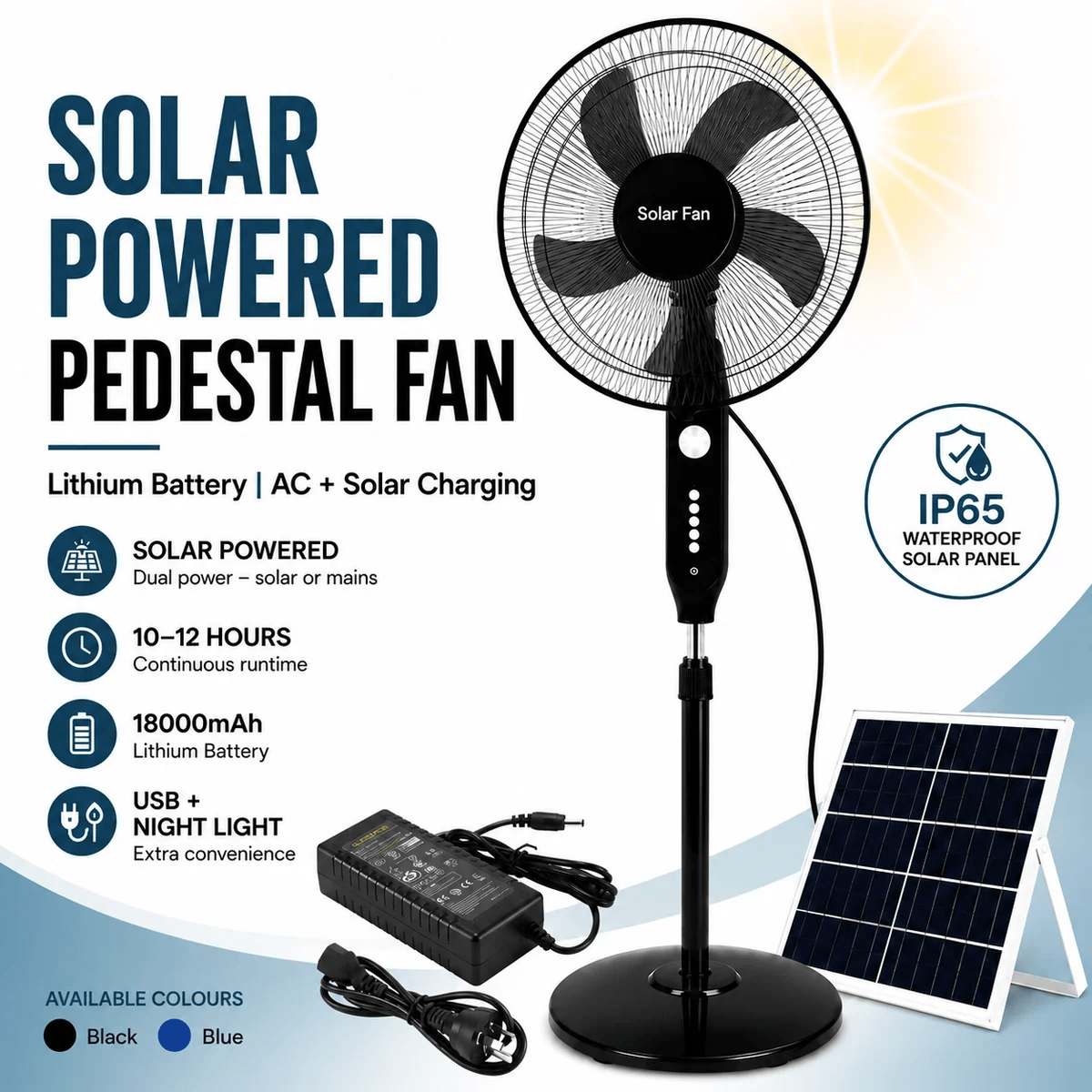
Many models also feature rechargeable batteries for cordless operation, while selected products offer USB mobile phone charging and built-in night lights.
But not all dual-power solar fans are designed the same way.
Before buying one, it is important to understand the charging system, battery performance and additional features that can make a real difference to everyday use.
1. What Is a Dual-Power Solar Fan?
A dual-power solar fan is a fan designed to use two different electricity sources or charging methods.
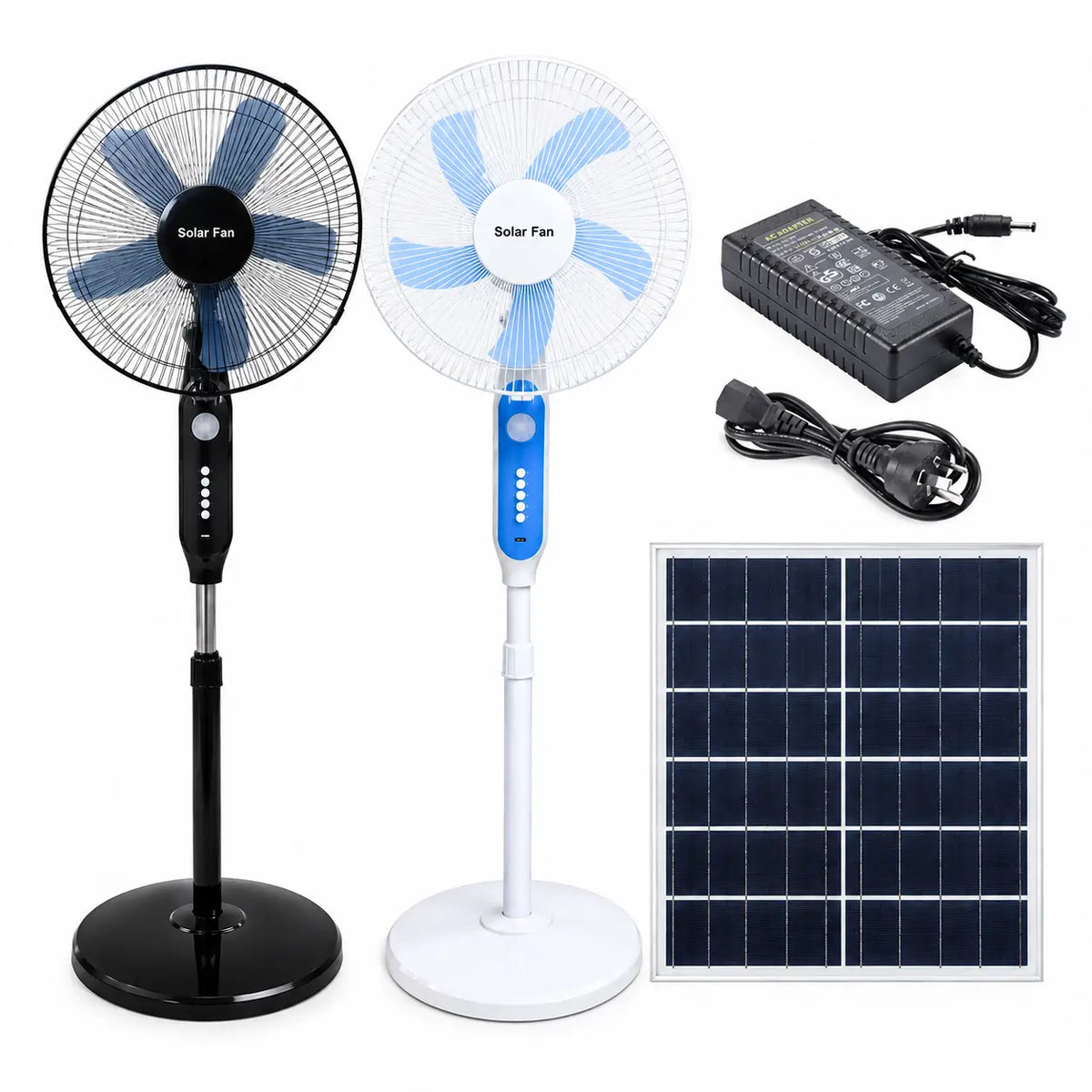
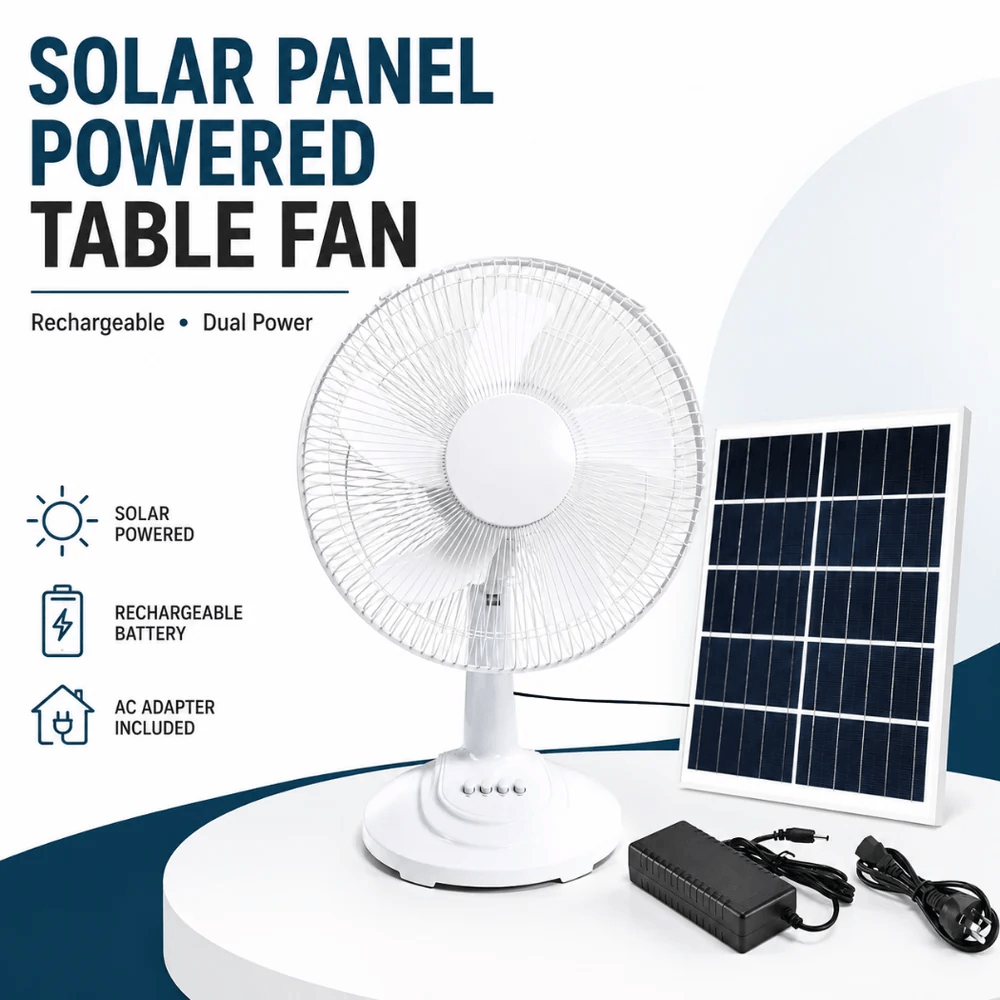
For the purpose of this guide, dual-power refers to solar panel charging and AC adapter charging.
The fan typically includes a rechargeable battery that stores electricity for later operation.
This creates three practical operating situations:
Solar Charging: The solar panel generates electricity from sunlight to recharge the battery.
AC Adapter Charging: A compatible power adapter allows the battery to be charged using household electricity.
Battery Operation: The fan operates using stored energy without needing a continuous connection to either charging source.
Some models may also support direct operation from an external power source, but this should not be assumed.
Always check whether the manufacturer's specifications describe charging capability, direct operation or both.
2. Solar Charging: What Should You Check?
Solar charging is the defining feature of a solar powered fan.
However, different products may include solar panels with different power ratings and installation arrangements.
Is the Solar Panel Included?
Before purchasing, confirm whether the solar panel is supplied with the fan.
Some products are sold as complete packages, while others may require a separately purchased panel.
Check the package contents carefully.
Can the Solar Panel Be Positioned Outdoors?
For effective charging, the solar panel should receive direct sunlight.
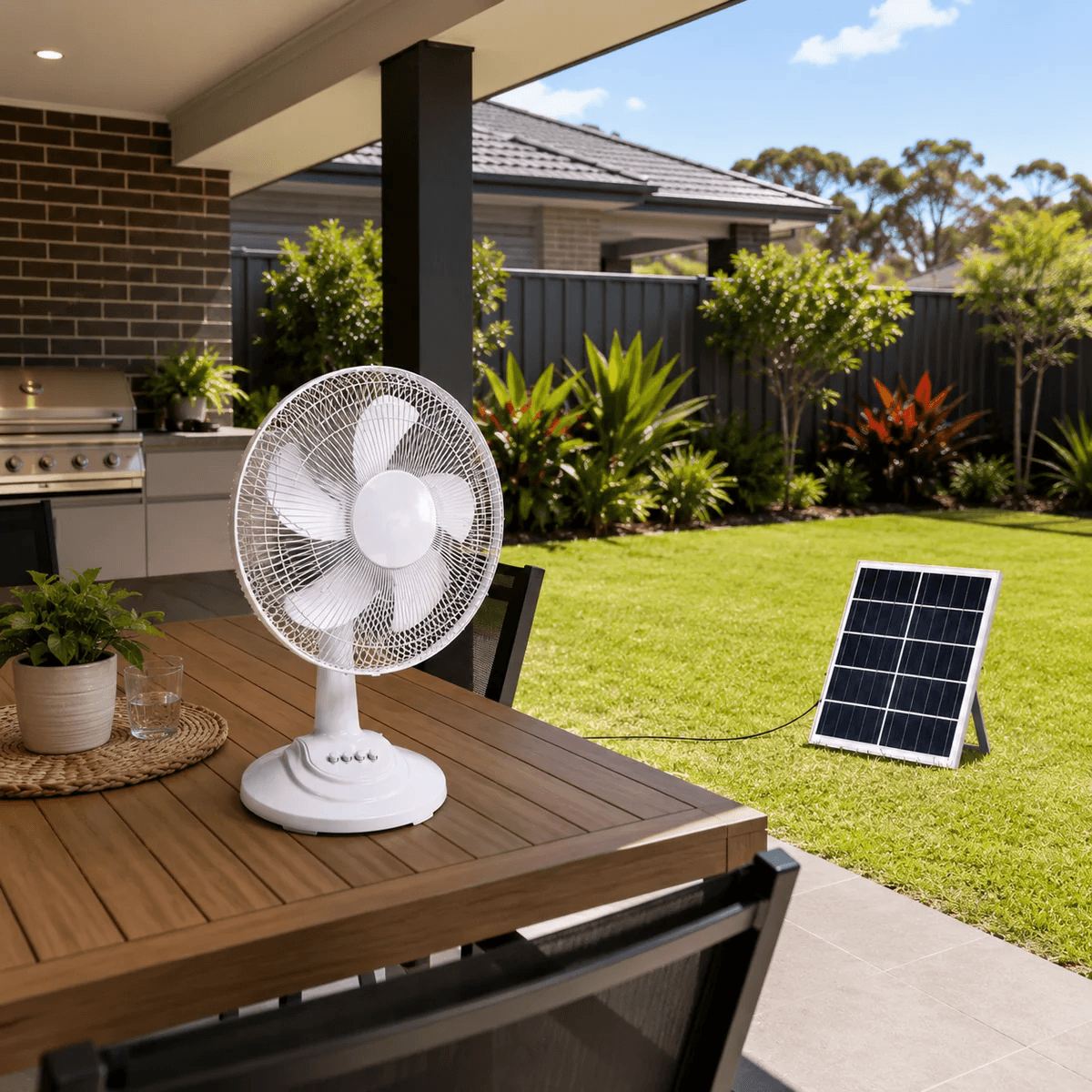
A useful arrangement for Australian homes is a fan with a separate solar panel and connecting cable.
For example, the panel can be positioned outdoors in direct sunlight while the fan remains inside a bedroom or living room.
This arrangement is only possible when the fan is designed for remote-panel charging and the supplied cable is suitable.
Can the Fan Operate While Charging?
Some dual-power solar fans allow the fan to operate while the solar panel charges the battery.
Others may have restrictions on simultaneous charging and operation.
This is an important feature to confirm if you intend to use the fan throughout the day.
Buying Tip: Check the included panel wattage, cable length, charging time and whether simultaneous charging and operation are supported.
3. AC Adapter Charging: Why Does It Matter?
Australia generally has favourable solar conditions, but sunshine is not available every day.
Extended cloud cover and rainy weather can reduce solar charging performance.
An AC adapter provides an alternative charging method.
Charging During Cloudy Weather
When solar energy is insufficient, a compatible AC adapter can recharge the fan's battery using household electricity.
This can be particularly useful if you rely on the fan for regular evening use.
Convenient Indoor Charging
AC charging also allows users to recharge the fan indoors without positioning the solar panel outside.
For example, if you return home late in the evening and the battery is low, you can connect the fan to its compatible adapter rather than waiting for sunlight the following day.
Check Adapter Compatibility
Before purchasing, confirm:
- Whether an AC adapter is included.
- The required adapter output voltage and current.
- Whether the adapter is suitable for Australian household power.
- Whether the fan supports operation while connected to the adapter.
- The manufacturer's estimated AC charging time.
Important: Never assume that any adapter with a matching plug is suitable. Incorrect voltage, polarity or other electrical specifications may damage the fan or create a safety risk.
Buying Tip: A complete package with a manufacturer-approved AC adapter can make everyday charging more convenient.
4. Battery Runtime: What Should You Look For?
The rechargeable battery is one of the most important components of a dual-power solar fan.
It allows the fan to operate without being continuously connected to the solar panel or household electricity.
Why Battery Runtime Matters
Consider a typical Australian summer evening.
During the day, the solar panel charges the battery while positioned outdoors.
At night, you disconnect the panel if the design permits and move the fan into your bedroom.
The fan then operates using stored battery energy.
This allows cordless cooling without leaving the solar panel connected overnight.
Understanding Advertised Runtime
Manufacturers may advertise operating times such as:
- Up to 6 hours
- Up to 8 hours
- Up to 12 hours
However, these figures may refer to operation at the lowest fan speed under specific test conditions.
Higher fan speeds generally consume more electricity and reduce runtime.
Questions to Ask Before Buying
Rather than relying only on the longest advertised operating time, check:
Runtime at Different Speeds: How long will the fan operate at low, medium and high settings?
Battery Capacity: Is the battery energy specified in watt-hours (Wh)?
Charging Time: How long does it take to recharge the battery using solar power or an AC adapter?
Battery Replacement: Is the battery replaceable or serviceable if its capacity declines?
For buyers planning overnight use, tested runtime at a comfortable fan speed is more meaningful than a maximum-runtime claim.
Buying Tip: Choose a fan whose documented battery runtime comfortably covers your expected usage rather than selecting one that only just meets your requirements under ideal conditions.
5. USB Mobile Phone Charging: A Useful Extra Feature
Some dual-power solar fans include a USB output port that allows their rechargeable battery to supply electricity to compatible electronic devices.
This feature can be particularly convenient when travelling, camping or experiencing a temporary power outage.
Can a Solar Fan Charge an iPhone?
Yes, selected models can charge an iPhone or another compatible mobile phone through a suitable USB connection.
However, the fan must include a USB power output designed for device charging.
A USB port intended only for charging the fan itself may not support charging other devices.
What Should You Check?
Before purchasing, confirm:
- Whether the USB port supports power output.
- The output voltage and maximum current.
- Whether your phone's charging cable is compatible.
- Whether the fan supports device charging while operating.
- Whether sufficient battery capacity is available.
Will Phone Charging Reduce Fan Runtime?
Yes.
When a mobile phone is charged from the fan's internal battery, some stored energy is transferred to the phone.
This leaves less energy available for operating the fan.
For example, charging a phone during the evening may shorten the fan's remaining runtime compared with using the fan alone.
Buying Tip: If USB device charging is important to you, prioritise a model with clearly specified USB output capabilities and sufficient battery capacity.
6. Built-In Night Light: Small Feature, Practical Convenience
Another feature available on selected dual-power solar fans is a built-in night light.
This is particularly useful for bedrooms, camping and temporary power interruptions.
What Is a Solar Fan Night Light?
A night light is a small, low-intensity light designed to provide gentle illumination.
It is not intended to replace a conventional room light.
Instead, it can help users see nearby objects or move around a dark space more conveniently.
Where Is It Useful?
Bedrooms: Provides gentle illumination when you need basic visibility at night.
Camping: Offers convenient lighting inside a tent or sheltered camping area.
Power Outages: Provides limited lighting while the fan operates on battery power.
Does the Night Light Affect Battery Runtime?
Yes, although the effect depends on the light's power consumption.
Using the fan and night light simultaneously consumes more energy than operating the fan alone.
For buyers who intend to use both functions overnight, this should be considered when comparing battery runtime.
Buying Tip: Check whether the night light can be switched on and off independently of the fan.
7. Compare Dual-Power Solar Fans Using Real-World Scenarios
Different households may prioritise different features.
The following examples can help you identify what matters most.
| Usage Scenario | Most Important Features |
|---|---|
| Bedroom cooling | Quiet operation, battery runtime, timer |
| Living room | Suitable airflow, oscillation, AC charging |
| Camping | Portability, solar charging, battery capacity |
| Caravanning | Compact design, charging flexibility, USB output |
| Power outages | Stored battery energy, USB charging, night light |
| Covered outdoor areas | Suitable airflow, portability, appropriate weather protection |
For example, someone purchasing a fan primarily for bedroom use may value quiet operation and long battery runtime.
A camper may place greater importance on solar charging, portability and USB device charging.
A household using the fan every day may prefer a model that includes both solar and AC charging.
The best dual-power solar fan is the one whose charging and operating capabilities match your actual usage.
8. Common Mistakes to Avoid When Buying a Dual-Power Solar Fan
Before making your purchase, avoid these common misunderstandings.
Mistake 1: Assuming Every Solar Fan Supports AC Charging
Some solar fans only support solar charging.
Always confirm that AC charging is included in the specifications.
Mistake 2: Confusing Charging Time With Operating Time
A fan that takes six hours to recharge does not necessarily provide six hours of operation.
Charging time and battery runtime are separate specifications.
Mistake 3: Assuming Every USB Port Can Charge a Phone
Some USB connections are inputs rather than outputs.
Confirm that the fan supports USB device charging.
Mistake 4: Expecting the Night Light to Illuminate an Entire Room
Built-in night lights generally provide limited illumination.
They should not be treated as substitutes for dedicated lighting.
Mistake 5: Overlooking Included Accessories
Check whether the package includes the solar panel, AC adapter, connecting cables and other required accessories.
A lower advertised price may not represent better value if essential components must be purchased separately.
9. Final Dual-Power Solar Fan Buying Checklist
Before choosing a dual-power solar fan, use this checklist.
| Feature | What to Confirm |
|---|---|
| Solar Charging | Solar panel included and compatible |
| AC Charging | Compatible adapter included or available |
| Battery Runtime | Tested runtime at different speeds |
| Solar Charging Time | Manufacturer's estimated charging time |
| AC Charging Time | Manufacturer's estimated charging time |
| Simultaneous Operation | Can the fan run while charging? |
| USB Output | Can it charge compatible mobile phones? |
| Night Light | Included and independently controlled? |
| Accessories | Are the necessary cables and adapters included? |
| Warranty | What warranty and after-sales support are provided? |
Final Thoughts
A dual-power solar fan offers a practical combination of renewable energy and everyday charging convenience.
By supporting both solar charging and AC adapter charging, suitable models provide greater flexibility during changing weather conditions.
Their rechargeable batteries also allow cordless operation, making it possible to charge the fan during the day and use it indoors at night without keeping the solar panel connected.
Additional features such as USB mobile phone charging and built-in night lights can make selected models even more useful for Australian households, camping and emergency situations.
When choosing a dual-power solar fan, prioritise charging compatibility, realistic battery runtime and the features you will actually use.
Explore solar powered cooling solutions from SolarEasy Australia and find a fan that suits your lifestyle.