
What Size Solar Powered Fan Do You Need? Understanding Fan Size, Airflow & Cooling Performance
When choosing a solar powered fan, size matters. However, finding the right size involves more than simply selecting a fan with the largest blades.
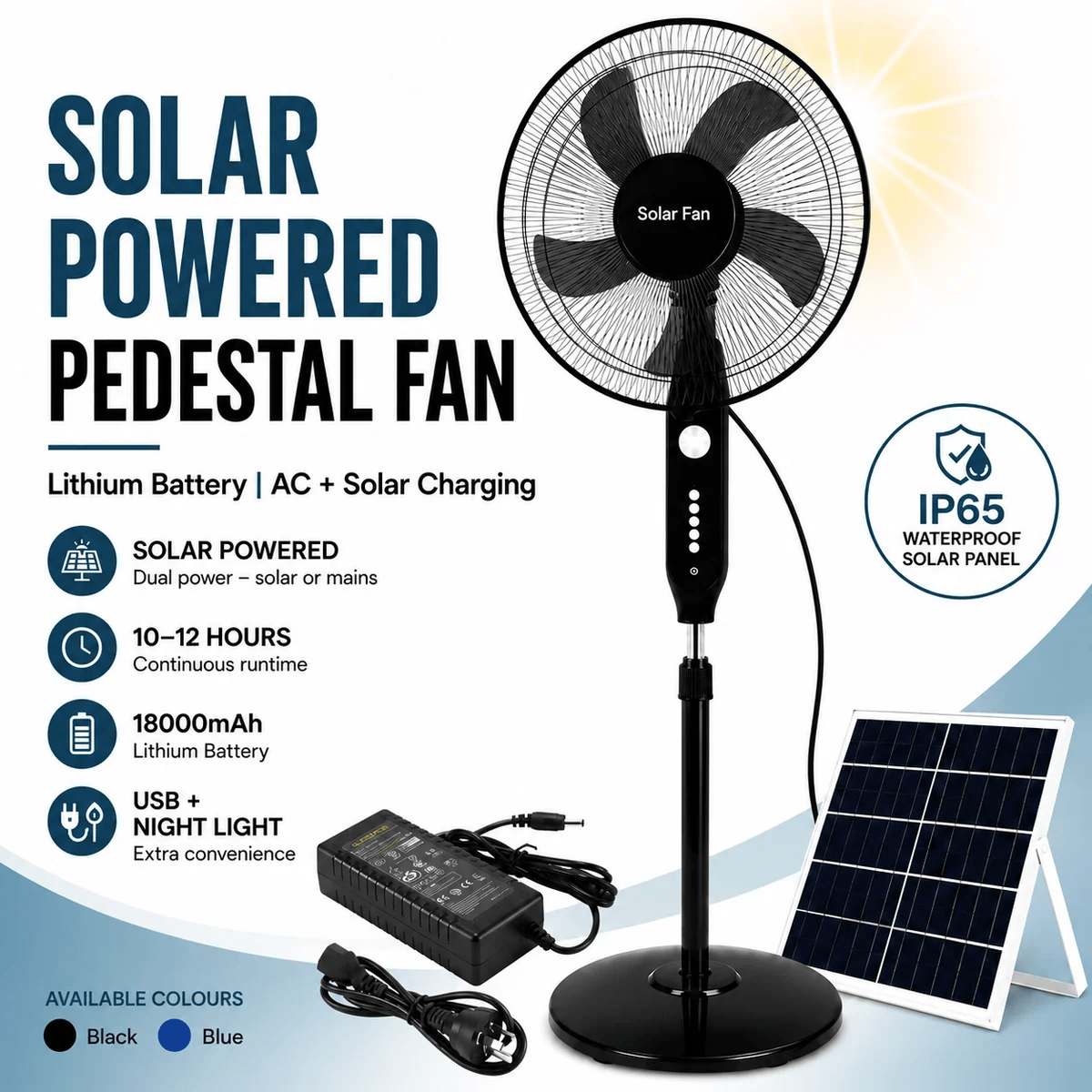
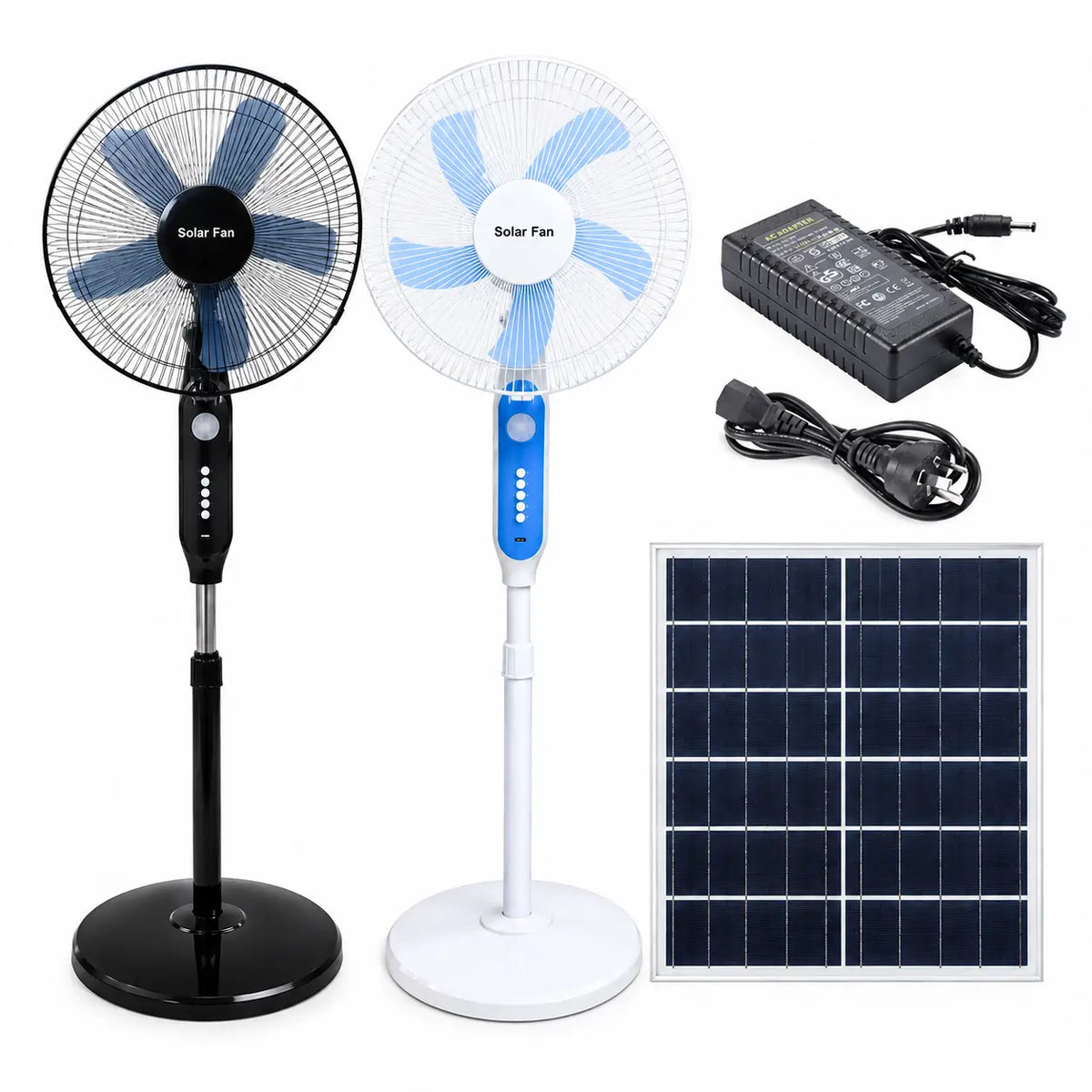
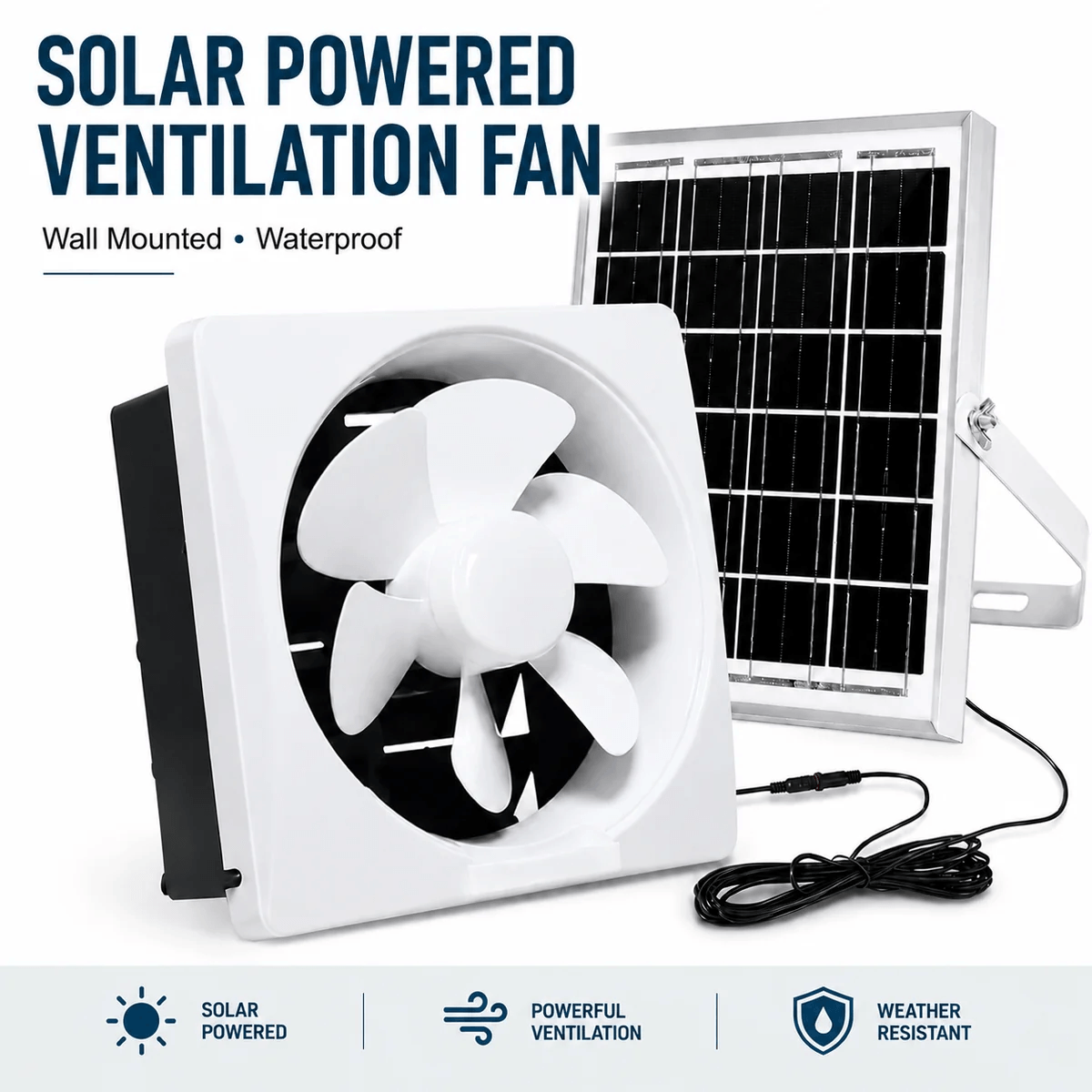
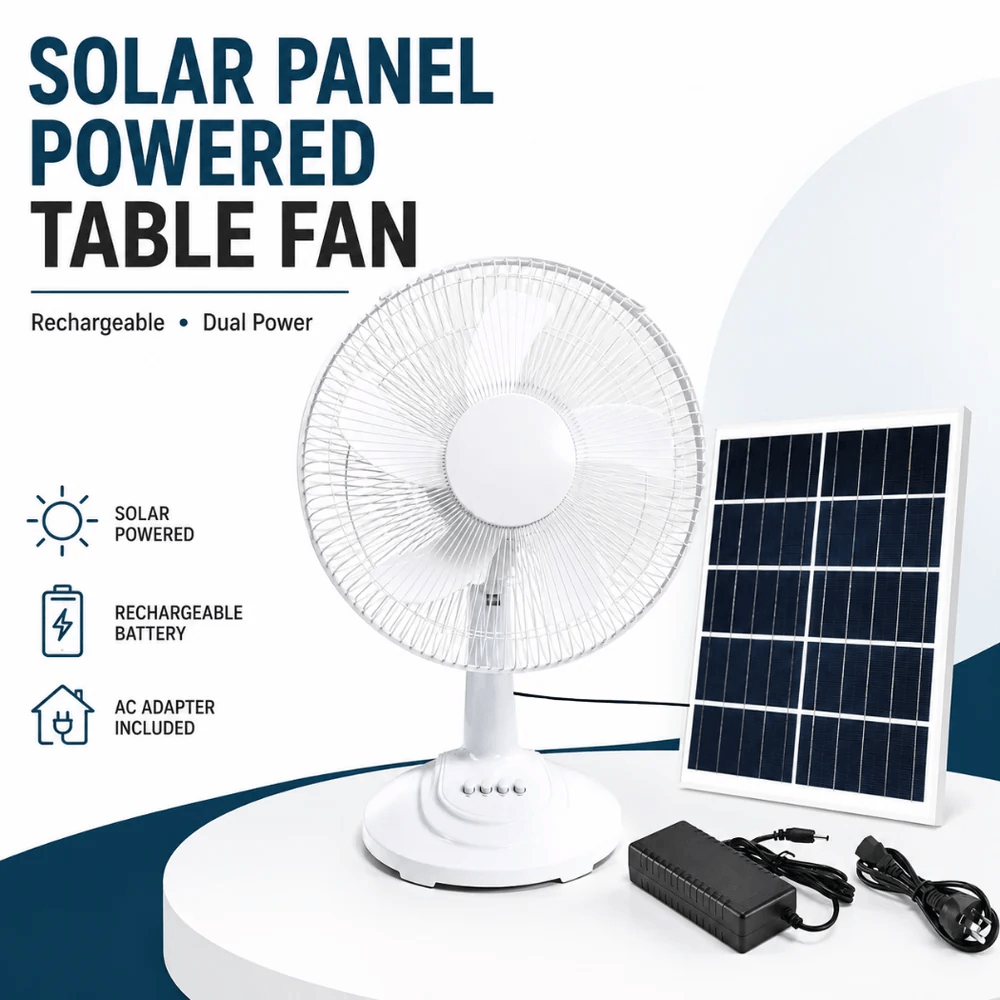
A solar powered fan combines three important components: the fan itself, a rechargeable battery and a solar panel. Each component plays a different role in determining how effectively the system performs.
The fan's blade diameter and motor design influence airflow, the battery determines how much energy can be stored, and the solar panel affects how quickly that energy can be replenished.
For Australian households, understanding how these components work together can help you choose a fan that delivers comfortable airflow without unnecessary expense.
This guide explains how to match fan size, battery capacity and solar panel output to your everyday cooling requirements.
1. Understanding Solar Powered Fan Sizes
Solar powered fans are available in different sizes, generally measured by the diameter of their fan blades or fan head.
Common portable and household fan sizes include approximately 8, 10, 12, 14, 16 and 18 inches, although available sizes vary between manufacturers.
Larger fans are generally designed to circulate air across wider areas, while smaller fans are often better suited to personal cooling.
Typical Fan Size Comparison
| Fan Size | Approximate Diameter | Typical Application |
|---|---|---|
| 8 inches | 20 cm | Desk, bedside table, personal cooling |
| 10 inches | 25 cm | Small bedrooms, home offices |
| 12 inches | 30 cm | Bedrooms, compact living spaces |
| 14 inches | 35 cm | Bedrooms, medium-sized rooms |
| 16 inches | 40 cm | Living rooms, covered patios |
| 18 inches | 46 cm | Larger rooms, workshops, shared spaces |
These are general application examples, not guaranteed room-size ratings. Actual suitability depends on airflow performance, fan placement and room conditions.
Does a Bigger Fan Always Mean Better Cooling?
Not necessarily.
Although larger blades can move more air under suitable operating conditions, airflow also depends on motor performance, blade design and rotational speed.
A well-designed 12-inch fan may outperform a poorly designed 16-inch model.
The best approach is to compare airflow specifications alongside fan size rather than relying on blade diameter alone.
2. How Does Fan Size Affect Airflow?
Airflow describes the volume of air a fan moves over a given period.
It is commonly measured in cubic metres per minute (m³/min) or cubic metres per hour (m³/h).
A fan with higher airflow capacity can generally move more air, although the actual cooling sensation also depends on air velocity, distance and positioning.
Small Fans: Focused Airflow
Smaller solar powered fans are generally suitable for directing airflow towards one person.
They work well when positioned close to the user, such as on a desk or bedside table.
Medium Fans: Everyday Household Cooling
Medium-sized fans can provide comfortable airflow in bedrooms and smaller living areas.
Depending on their design, they may offer a useful balance between portability, airflow and electricity consumption.
Large Fans: Wider Air Circulation
Larger fans are often designed for family rooms, workshops and covered outdoor entertaining areas.
They may provide greater air movement across a wider area, particularly when equipped with oscillation.
However, fan size alone does not determine effective cooling distance.
Buying Tip: When available, compare the manufacturer's airflow rating and tested performance rather than relying solely on advertised fan diameter.
3. What Fan Size Is Suitable for Different Rooms?
The ideal fan size depends on room dimensions, the number of people using the space and how the fan will be positioned.
Unlike air conditioners, fans do not normally lower the actual room temperature. Instead, they create airflow that helps people feel cooler.
Therefore, selecting a fan should focus on delivering airflow where people need it.
Bedrooms
For a typical bedroom, a 10–14-inch fan may provide suitable personal cooling, depending on its airflow performance.
If the fan will operate overnight, consider noise levels and lower-speed airflow.
Living Rooms
For family living areas, a 14–18-inch fan may be worth considering.
A larger fan with oscillation can help distribute airflow across several seating positions.
Home Offices
Compact 8–12-inch fans are often convenient for desks and smaller workspaces.
They can provide focused airflow without occupying excessive space.
Covered Patios and Outdoor Areas
Outdoor airflow requirements can be different because natural wind and open surroundings affect performance.
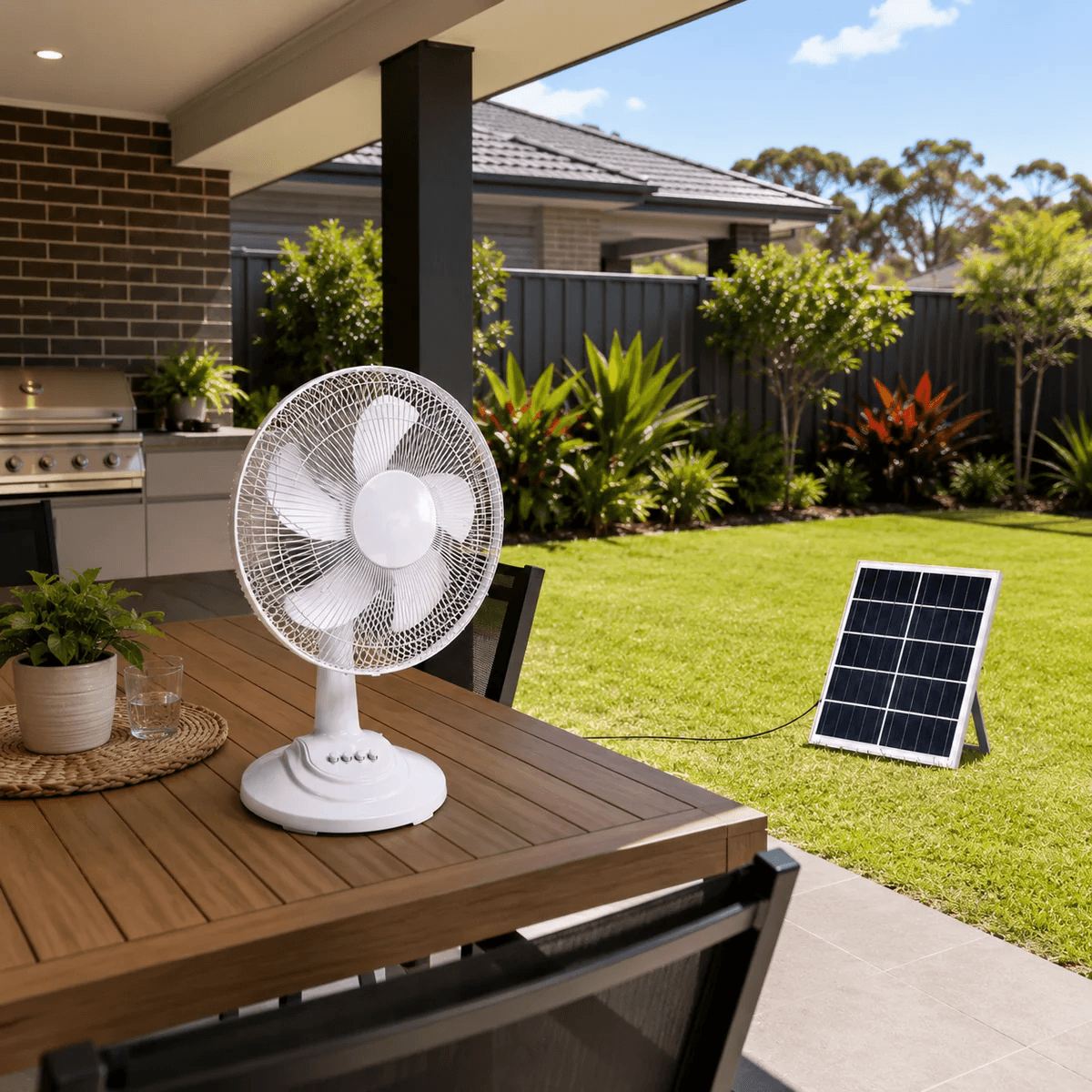
A larger fan may be useful for covered patios, although placement and airflow strength are more important than diameter alone.
Important: Only use the fan outdoors in conditions permitted by its manufacturer. Many portable solar fans are not waterproof.
4. Battery Size: How Much Capacity Do You Need?
While fan size affects airflow, battery capacity determines how much energy is available when the solar panel is not generating sufficient electricity.
This is particularly important for evening and overnight use.
Battery capacity is often advertised in amp-hours (Ah), milliamp-hours (mAh) or watt-hours (Wh).
For comparing batteries with different voltages, watt-hours provide the most useful measure.
Understanding Battery Capacity
Battery energy can be estimated using:
Battery Capacity (Wh) = Battery Voltage (V) × Battery Capacity (Ah)
For example:
| Battery Specification | Nominal Energy |
|---|---|
| 6V 5Ah | 30Wh |
| 6V 10Ah | 60Wh |
| 12V 5Ah | 60Wh |
| 12V 10Ah | 120Wh |
Notice that a 6V 10Ah battery and a 12V 5Ah battery both store approximately 60Wh of nominal energy.
This is why comparing Ah values alone can be misleading.
How Does Battery Capacity Affect Runtime?
A simple theoretical calculation is:
Runtime (hours) = Battery Energy (Wh) ÷ Fan Power Consumption (W)
For example, a fan consuming 15W with a 90Wh battery has a theoretical runtime of six hours.
Actual runtime may be shorter due to electrical losses, battery condition and operating conditions.
Matching Battery Size to Your Needs
If you mainly use your fan during sunny afternoons, extended battery runtime may be less important.
However, if you want to use the fan overnight, battery capacity becomes a key consideration.
Buying Tip: Compare battery energy in Wh and the manufacturer's tested runtime at your preferred fan speed.
5. Solar Panel Size: How Much Solar Power Do You Need?
The solar panel is another essential component of a solar powered fan system.
Its job is to convert sunlight into electricity for charging the battery or supporting fan operation, depending on the model.
Solar panels are usually rated by their maximum power output in watts (W) under standard test conditions.
Why Solar Panel Wattage Matters
A higher-wattage solar panel can potentially generate more electricity during the same period of suitable sunlight.
For example, a 30W solar panel has a higher rated output than a 15W panel.
However, this does not mean it will always charge a battery twice as quickly.
Actual charging performance depends on sunlight intensity, temperature, shading and charging system efficiency.
Understanding Solar Charging Time
Consider a simplified example involving a 60Wh battery.
| Solar Panel Rating | Idealised Minimum Energy-Generation Time |
|---|---|
| 10W | 6 hours |
| 15W | 4 hours |
| 20W | 3 hours |
| 30W | 2 hours |
These figures are theoretical calculations based on continuous rated output and 100% energy transfer. Real charging times will be longer and depend on sunlight, charging losses and battery charging characteristics.
Why Physical Panel Size Matters
Larger solar panels can often generate more electricity because they contain a greater area of solar cells.
However, panel efficiency also matters.
A more efficient panel may generate similar power from a smaller surface area.
Therefore, compare rated wattage rather than judging solar panel performance by physical dimensions alone.
6. Matching Fan Size, Battery Capacity and Solar Panel Output
The most important consideration is how the three components work together.
A large fan with a small battery may provide strong airflow but limited operating time.
A large battery paired with an undersized solar panel may require a longer charging period.
A well-matched system balances airflow requirements, stored energy and available charging power.
Example 1: Personal Cooling
Application: Desk or bedside cooling.
Suggested priorities:
- Compact fan size
- Comfortable airflow at close range
- Moderate battery capacity
- Convenient solar charging
Example 2: Overnight Bedroom Cooling
Application: Extended evening or overnight operation.
Suggested priorities:
- Comfortable airflow at low speed
- Quiet operation
- Battery capacity matched to required runtime
- Solar panel capable of replenishing daily energy use
Example 3: Family Living Area
Application: Cooling several people in a shared space.
Suggested priorities:
- Wider airflow coverage
- Oscillation
- Suitable motor performance
- Battery and panel capacity matched to expected daily operation
Example 4: Camping and Caravanning
Application: Portable cooling away from mains electricity.
Suggested priorities:
- Easy transportation
- Adequate battery storage
- Practical solar panel dimensions
- Reliable charging connections
Buying Tip: Rather than choosing the largest components individually, select a balanced system suited to your actual usage.
7. A Simple Method to Estimate Your Solar Fan Requirements
Before purchasing, consider how many hours you expect to use the fan each day.
For example, suppose you need a fan consuming 12W for six hours each evening.
Your estimated daily energy requirement would be:
12W × 6 hours = 72Wh
You would then need a battery with sufficient usable capacity to provide that energy.
For solar charging, the panel would need to generate enough electricity to replace the energy consumed.
If you assume four equivalent peak-sun hours and an overall charging efficiency of 75%, the approximate minimum panel rating would be:
72Wh ÷ (4 hours × 0.75) = 24W
In practice, choosing some additional capacity can help accommodate variable sunlight and operating conditions.
This example is illustrative rather than a product-specific recommendation. Actual sizing should account for the manufacturer's battery limits, charging system and local solar conditions.
8. Do USB Charging and Night Lights Affect Fan Sizing?
Some rechargeable solar powered fans offer additional features such as USB device charging and built-in night lights.
These features can be convenient, but they also consume stored battery energy.
USB Mobile Phone Charging
If your fan includes a compatible USB output, charging a mobile phone will reduce the battery energy available for fan operation.
Built-In Night Light
A small night light generally consumes less electricity than the fan motor, but it still contributes to total energy usage.
If you plan to use these features regularly, consider allowing additional battery capacity.
However, USB charging and night lights should remain secondary considerations when selecting fan size.
Your primary priorities should be airflow, required runtime and solar charging performance.
9. Solar Powered Fan Sizing Checklist
Before choosing a solar powered fan, review these essential questions.
| Component | What to Check |
|---|---|
| Fan Diameter | Is the fan suitable for personal or shared-space cooling? |
| Airflow Rating | Does it provide sufficient air movement? |
| Motor Power | How much electricity does the fan consume? |
| Battery Capacity | How many watt-hours of energy can it store? |
| Battery Runtime | Will it operate for the required number of hours? |
| Solar Panel Wattage | Can it replenish the energy used under expected sunlight conditions? |
| Charging System | Is the panel compatible with the battery and controller? |
| Additional Features | Will USB charging or night-light use increase energy requirements? |
Final Thoughts
Choosing the right solar powered fan involves more than selecting a particular blade diameter.
For the best results, you need to consider three connected factors:
Fan Size & Airflow + Battery Capacity + Solar Panel Output
The fan determines how air is circulated, the battery provides stored energy for operation without sunlight, and the solar panel replenishes that energy.
For Australian households, a balanced combination can provide practical cooling during sunny afternoons and convenient battery-powered operation in the evening.
By understanding these specifications, you can select a solar powered fan that matches your space, daily usage and charging requirements.
Explore the solar powered cooling solutions available from SolarEasy Australia to find a model suited to your needs.