
Solar Powered Fans vs Traditional Electric Fans: Which Is Better for Australian Homes?
When summer temperatures rise across Australia, electric fans are one of the simplest ways to improve indoor comfort.
Traditional electric fans have been used in Australian households for decades. They are affordable, easy to operate and provide reliable airflow when connected to household electricity.
However, solar powered fans are becoming an alternative worth considering, particularly for households interested in renewable energy, portable cooling and greater flexibility.
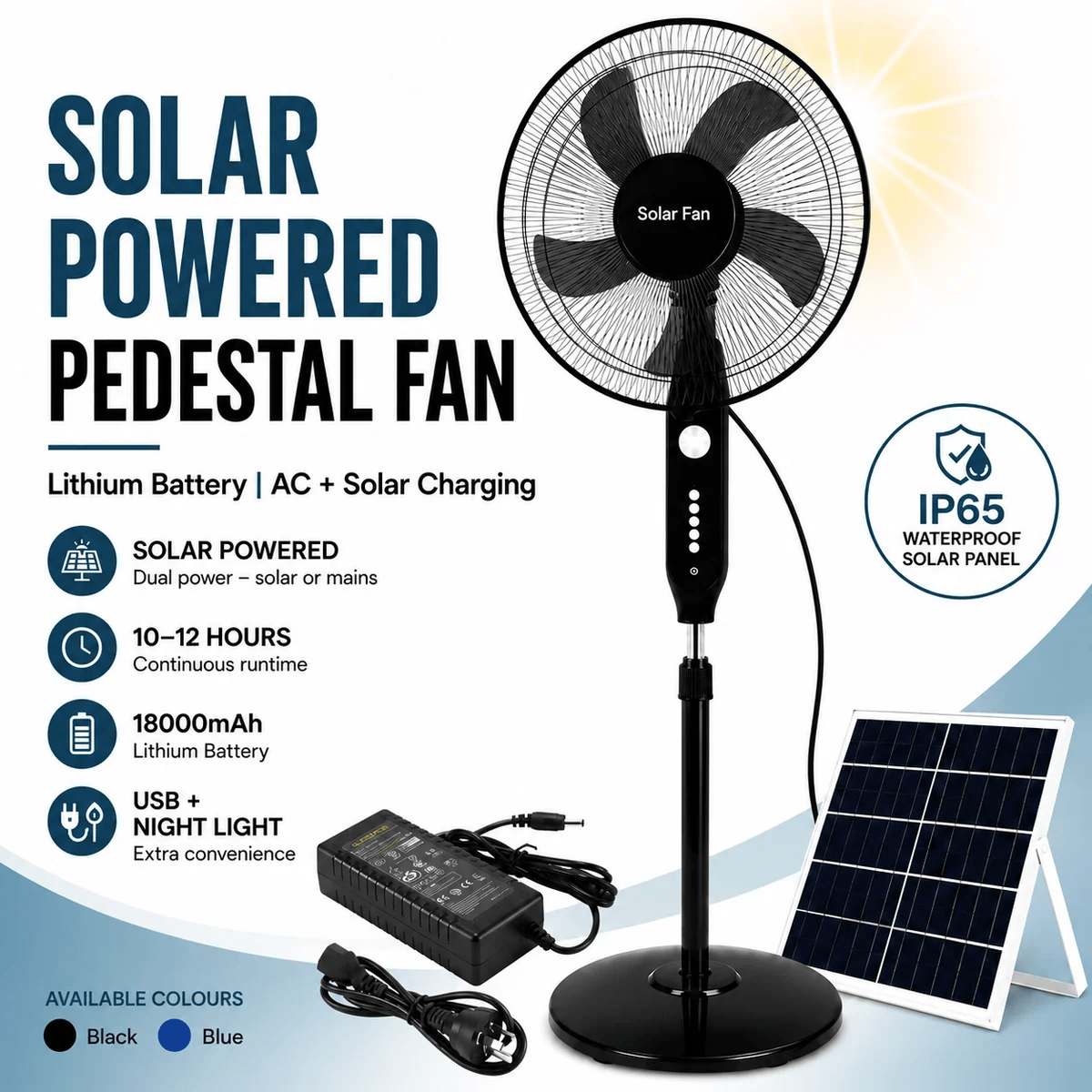
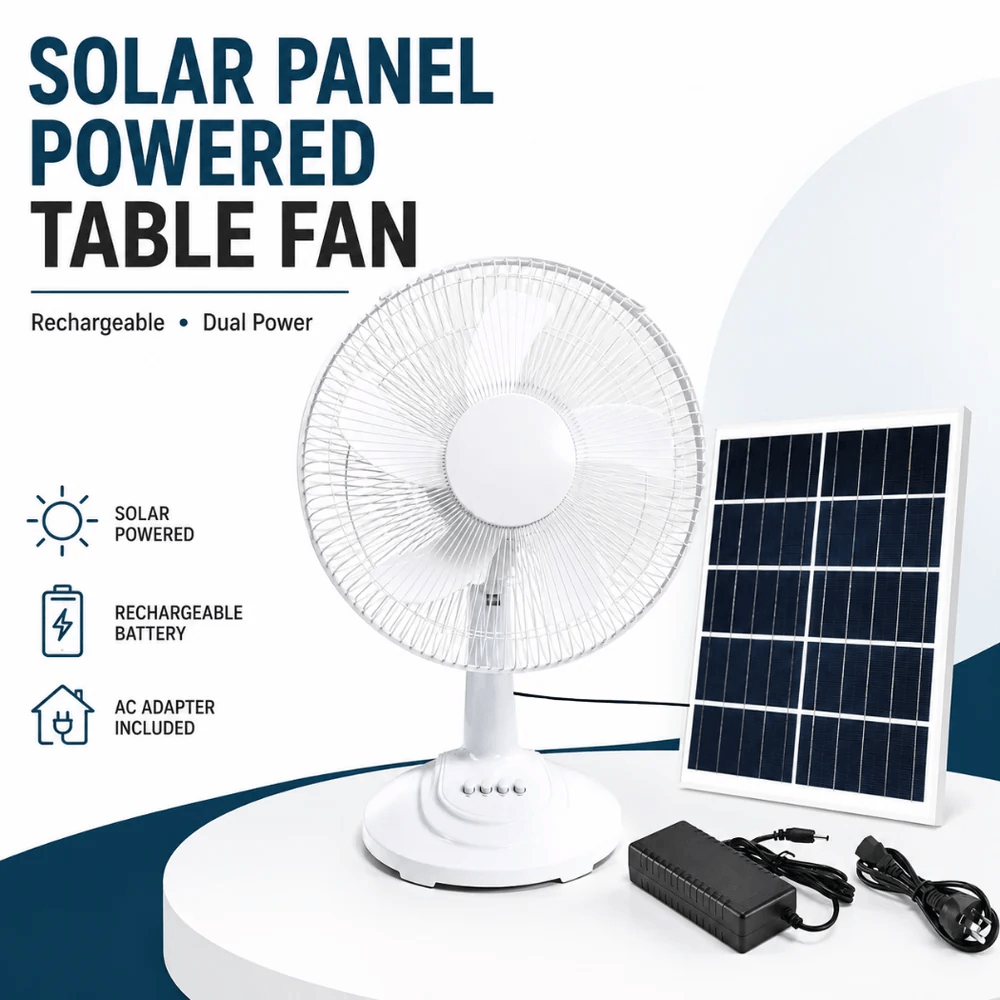
Unlike conventional electric fans, many modern solar powered fans combine solar charging, rechargeable battery storage and cordless operation.
Some models also include useful features such as USB mobile phone charging and built-in night lights.
But are solar powered fans actually better than traditional electric fans?
The answer depends on your cooling requirements, budget and how you intend to use the fan.
Let's compare their main differences.
1. Power Source: Solar Energy vs Household Electricity
The most fundamental difference between solar powered fans and traditional electric fans is how they receive electricity.
Traditional Electric Fans
Conventional electric fans generally operate using electricity supplied through a household power outlet.
As long as electricity is available, they can operate continuously without needing to recharge a battery.
However, most standard mains-powered fans cannot operate during a power outage.
Solar Powered Fans
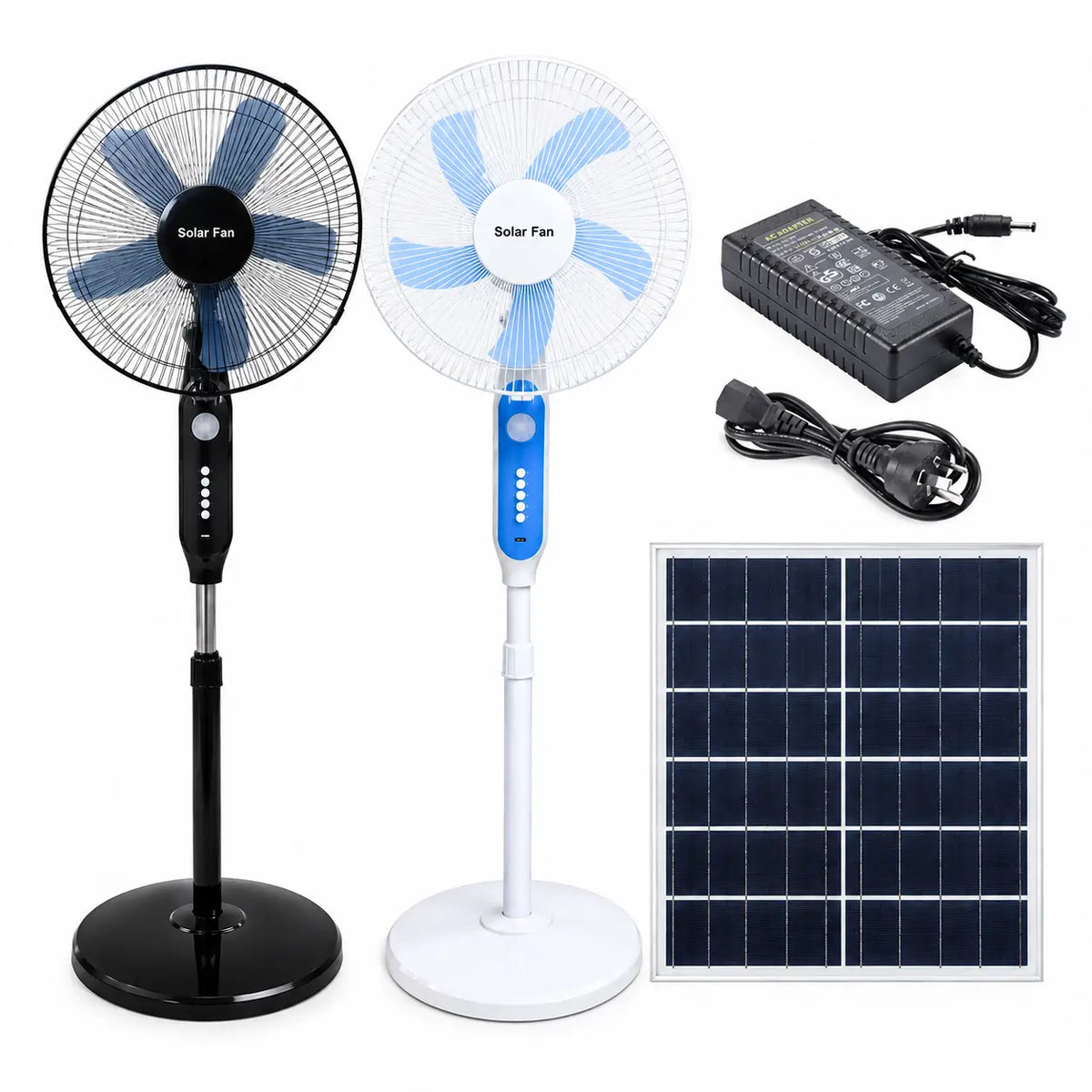
Rechargeable solar powered fans use electricity generated by solar panels to charge their batteries.
Depending on the model, the solar panel may also supply electricity while the fan operates.
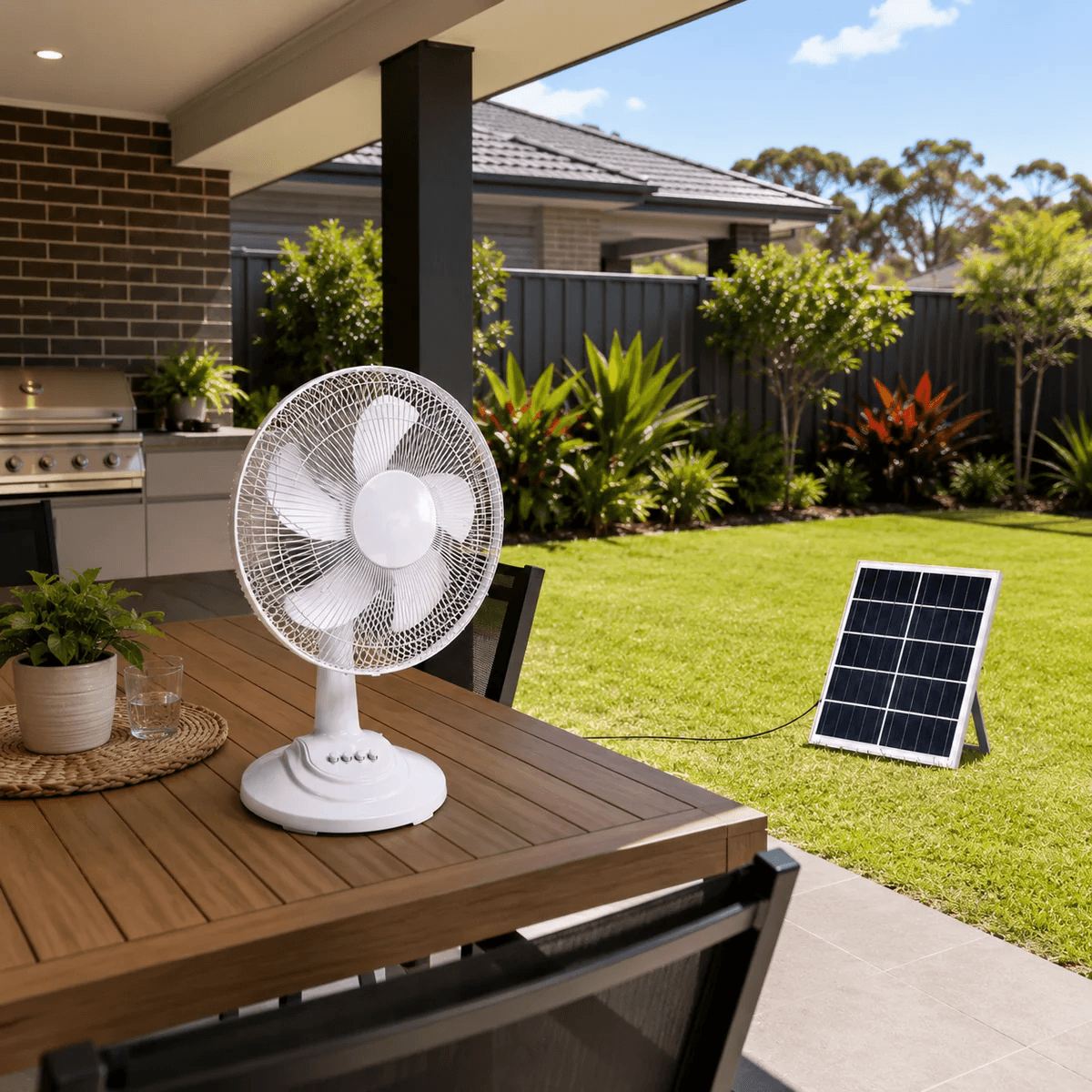
During sunny conditions, the solar panel can be positioned outdoors to collect sunlight.
Once the battery is charged, the fan can operate independently of the solar panel.
Some models also support charging through an AC adapter, providing an alternative when sunlight is limited.
Key Difference: Traditional electric fans depend on a continuous mains electricity supply, while rechargeable solar fans can store solar energy for later use.
2. Running Costs: Which Fan Is Cheaper to Operate?
Running costs are an important consideration for Australian households.
Traditional Electric Fan Running Costs
A conventional electric fan consumes electricity whenever it operates.
For example, consider a fan rated at 50 watts.
If it operates for eight hours per day:
50W × 8 hours = 400Wh
This equals 0.4kWh per day.
At an illustrative electricity rate of A$0.30 per kWh:
Daily electricity cost: A$0.12
Over 30 days, the estimated cost would be approximately A$3.60.
Actual costs depend on electricity tariffs, fan power consumption and operating hours.
Solar Powered Fan Running Costs
When a solar powered fan operates using electricity generated by its solar panel, it does not require purchased grid electricity for that energy.
This can reduce ongoing electricity expenses.
However, solar powered fans may have higher initial purchase costs because they include additional components such as solar panels and rechargeable batteries.
Battery replacement costs may also need to be considered over the product's lifetime.
Which Offers Better Value?
For occasional household use, a conventional electric fan may be more economical because of its lower purchase price.
For people who value portability, solar charging and battery-powered operation, a rechargeable solar fan may provide additional benefits beyond electricity savings.
Key Difference: Solar fans can reduce grid electricity consumption, but their overall financial value depends on purchase price, usage and long-term battery performance.
3. Cooling Performance: Which Fan Is More Powerful?
A common misconception is that traditional electric fans are always more powerful than solar powered fans.
In reality, cooling performance depends on the individual fan's design and specifications.
Traditional Electric Fans
Mains-powered fans are available in a wide range of sizes and motor capacities.
Some models are designed for personal cooling, while others provide strong airflow across larger rooms.
Because they receive continuous electricity, their operating time is not limited by battery capacity.
Solar Powered Fans
Solar powered fans also come in different sizes, including tabletop and pedestal models.
Their airflow performance depends on factors such as:
- Fan blade diameter
- Motor efficiency
- Fan speed
- Airflow design
- Available electrical power
A well-designed solar fan can provide airflow comparable to a conventional electric fan with similar performance specifications.
However, battery-powered operation introduces an additional consideration: higher fan speeds generally consume more energy and reduce battery runtime.
Do Solar Fans Actually Cool the Room?
Like conventional electric fans, solar powered fans primarily circulate air rather than actively refrigerating it.
Their airflow helps people feel cooler, particularly by improving evaporation from the skin.
Key Difference: Neither fan type is automatically more powerful. Compare actual airflow specifications rather than relying on the power source alone.
4. Portability: The Advantage of Cordless Solar Fans
Portability is one of the most noticeable advantages of rechargeable solar powered fans.
Traditional Electric Fans
Most conventional electric fans require a continuous connection to a household power outlet.
This limits where they can be positioned.
Moving the fan between rooms may require unplugging and reconnecting it.
Solar Powered Fans
Rechargeable solar fans offer greater flexibility because they can operate using stored battery energy.
For example, during the day, you can position the solar panel outdoors where it receives direct sunlight.
If the fan has a separate panel and suitable connecting cable, the fan itself may remain indoors while the battery charges.
What Happens at Night?
Once the battery is charged, you can disconnect the solar panel if the design permits.
The fan can then be moved into a bedroom, living room or another convenient location.
There is no need to keep the solar panel connected while the fan operates on battery power.
This makes rechargeable solar fans particularly convenient for:
- Bedrooms without conveniently located power outlets
- Covered patios and verandahs
- Camping and caravanning
- Garages and workshops
- Temporary outdoor activities
Key Difference: Rechargeable solar powered fans offer cordless operation, allowing greater freedom of placement than standard mains-powered fans.
5. Battery Backup: What Happens During a Power Outage?
Power outages can occur during storms, extreme weather or electricity network maintenance.
This is another area where rechargeable solar powered fans offer a practical advantage.
Traditional Electric Fans
Most conventional electric fans stop operating when household electricity becomes unavailable.
Unless connected to a separate backup power system, they cannot continue running.
Solar Powered Fans
A rechargeable solar fan can continue operating during a power outage, provided its battery has sufficient stored energy.
For example, a fan charged during the afternoon may provide useful airflow during an evening electricity interruption.
If sunlight is available, the solar panel may also recharge the battery during the outage.
However, the available runtime depends on battery capacity and fan power consumption.
Key Difference: Rechargeable solar fans can provide temporary cooling during electricity interruptions without requiring an external backup power supply.
6. Additional Features: USB Charging and Built-In Night Lights
Some modern solar powered fans offer additional functions that are less commonly included in traditional mains-powered fans.
These features can make a solar fan useful beyond cooling.
USB Mobile Phone Charging
Selected rechargeable solar fans include a USB output port.
This allows the fan's internal battery to provide electricity to compatible devices, such as:
- iPhones and other mobile phones
- Small USB-powered lights
- Compatible low-power electronic accessories
For example, during a camping trip, you may use the solar panel to recharge the fan's battery during the day.
At night, the stored electricity can operate the fan and, if the model supports it, recharge your mobile phone.
This can be useful when a household power outlet is unavailable.
However, charging a phone consumes stored battery energy and may reduce the fan's remaining operating time.
Always check the USB output specifications and device compatibility.
Built-In Night Light
Some rechargeable solar fans also include a small built-in night light.
This feature is designed to provide gentle illumination rather than bright room lighting.
It may be useful for:
- Basic visibility in bedrooms
- Finding nearby items at night
- Camping and tent use
- Temporary illumination during power outages
The night light should not be considered a replacement for a normal room light or dedicated emergency torch.
Operating the light also consumes battery energy.
Key Difference: Selected solar fans combine cooling, portable USB power and gentle night-time illumination in one appliance.
These features are model-dependent and are not exclusive to solar fans; some rechargeable non-solar fans offer similar functions.
7. Environmental Impact: Is Solar Always Better?
Solar powered fans can reduce reliance on electricity purchased from the grid.
When charged using sunlight, they make use of renewable energy rather than requiring electricity directly from a household power outlet.
However, environmental impact involves more than electricity consumption during use.
Traditional Electric Fans
Conventional electric fans require energy to manufacture and consume electricity during operation.
Their environmental impact depends partly on the source of that electricity.
For example, a conventional fan operating on electricity generated by a household rooftop solar system may also use renewable energy.
Solar Powered Fans
Solar fans include additional components such as solar panels, rechargeable batteries and charging electronics.
Manufacturing and eventually disposing of these components also have environmental impacts.
Therefore, the overall environmental benefits depend on factors such as product lifespan, usage patterns, battery durability and responsible disposal.
Key Difference: Solar powered fans can reduce grid electricity consumption, but their overall environmental advantage depends on how they are manufactured, charged, used and maintained.
8. Solar Powered Fans vs Electric Fans: Quick Comparison
The following table summarises the main differences.
| Feature | Solar Powered Fan | Traditional Electric Fan |
|---|---|---|
| Primary Energy Source | Solar energy, with alternative charging on selected models | Household electricity |
| Continuous Mains Connection | Not required during battery operation | Generally required |
| Rechargeable Battery | Common on portable models | Not normally included in standard mains-only models |
| Night-Time Operation | Battery-powered when sufficiently charged | Requires electricity |
| Solar Panel | Included or compatible, depending on model | Not normally included |
| Power Outage Operation | Possible with sufficient battery charge | Generally unavailable |
| Portability | Often cordless and portable | Limited by power cord |
| Cooling Performance | Depends on model specifications | Depends on model specifications |
| USB Phone Charging | Available on selected models | Uncommon on standard models |
| Built-In Night Light | Available on selected models | Uncommon on standard models |
| Initial Purchase Cost | May be higher | Often lower |
| Grid Electricity Use | Can be reduced through solar charging | Required unless supplied by another source, such as rooftop solar |
This comparison refers primarily to rechargeable solar fans and conventional mains-only fans. Individual product features may vary.
9. Which Fan Is Better for Australian Homes?
The best choice depends on how and where you plan to use the fan.
Choose a Traditional Electric Fan If:
- You primarily use the fan near a power outlet.
- You want a straightforward cooling appliance.
- You prefer a lower initial purchase cost.
- You need continuous operation without managing battery charging.
Choose a Solar Powered Fan If:
- You want to use solar energy for charging.
- You prefer cordless operation.
- You need portable cooling for different locations.
- You want battery backup during power outages.
- You regularly go camping or caravanning.
- You value additional features such as USB charging or a night light.
What About Using Both?
For some Australian households, using both types may be the most practical solution.
A conventional electric fan can provide continuous airflow in a fixed location.
A rechargeable solar powered fan can provide portable cooling, solar charging and battery backup when needed.
Rather than treating the two technologies as direct replacements, consider how each could serve different household requirements.
Final Thoughts
Solar powered fans and traditional electric fans both provide practical ways to improve comfort during Australia's warmer months.
Traditional electric fans offer simplicity, affordability and continuous operation when mains electricity is available.
Rechargeable solar powered fans offer additional flexibility through solar charging, battery storage and cordless operation.
For households that enjoy outdoor activities or want a portable cooling option during electricity interruptions, solar powered fans can be particularly useful.
Selected models also provide additional functions, including USB mobile phone charging and gentle built-in night lights.
Ultimately, the better choice depends on your priorities: continuous mains-powered operation or the flexibility of solar charging and rechargeable battery power.
Explore the solar powered cooling solutions available from SolarEasy Australia and discover which option best suits your lifestyle.