
Solar Powered Security Camera Information Hub | Section 2: Types of Solar Powered Security Cameras
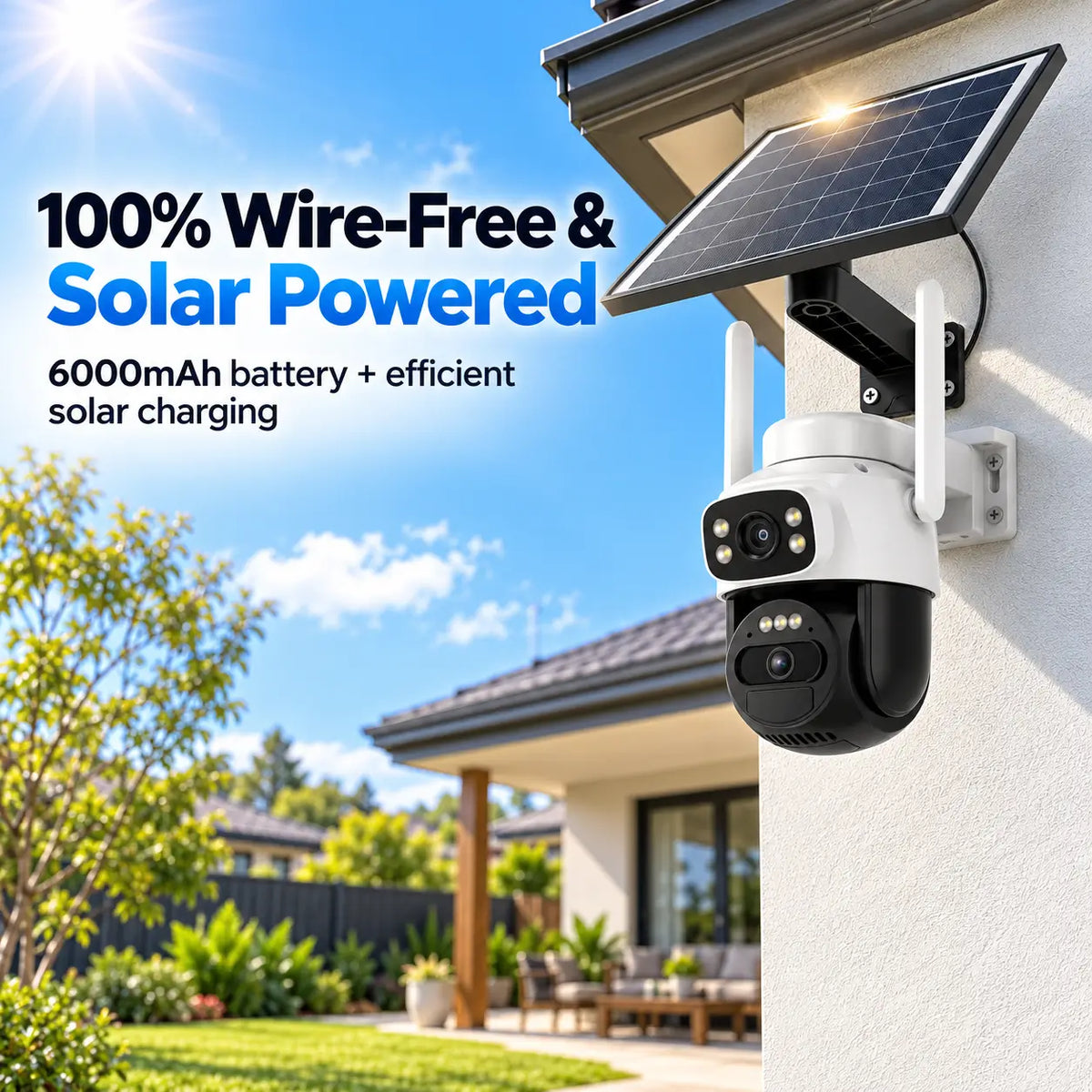
Solar powered security cameras are becoming an increasingly practical security solution for Australian homes, farms and outdoor properties. With no permanent mains power connection required for many models, these cameras offer flexible installation options for locations where traditional wired security systems may be inconvenient.
However, not all solar security cameras are the same.
Some connect through home Wi-Fi networks, while others use 4G mobile networks. Certain models have fixed viewing angles, while others can rotate to monitor larger areas. Cameras may also feature single, dual or triple lenses, different recording resolutions and various storage options.
Understanding these differences can help Australian consumers identify which type of solar powered security camera is most suitable for their property.
This guide introduces the main categories of solar security cameras, explains their basic characteristics and highlights where each type may be useful.
1. Wi-Fi vs 4G Solar Powered Security Cameras
One of the most important distinctions between solar security cameras is how they communicate with users.
Wi-Fi Solar Security Cameras
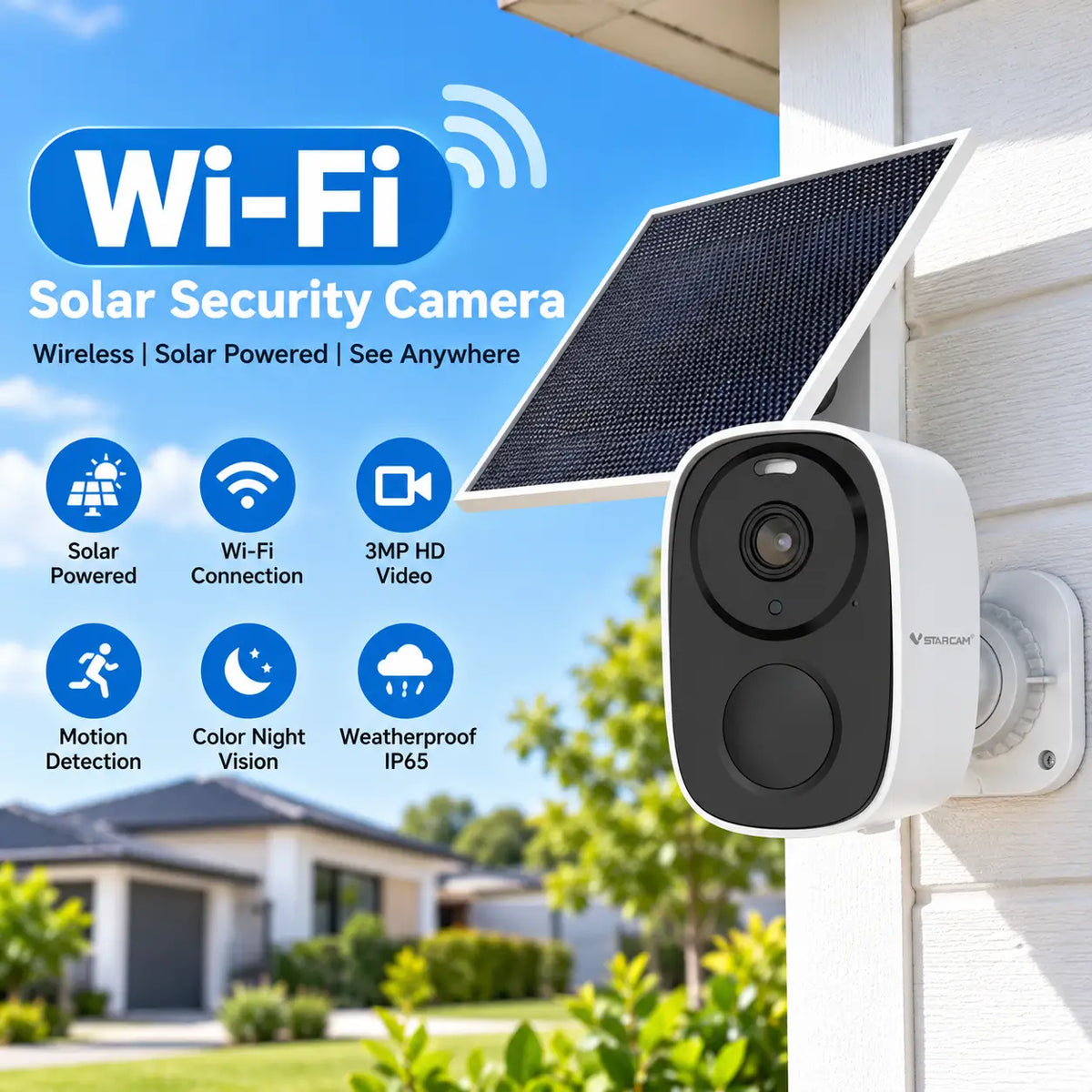
Wi-Fi solar security cameras connect to a compatible wireless network, usually provided by a home or business router.
They are commonly used around residential properties where Wi-Fi coverage is available.
Typical applications include:
- Front doors and residential entrances.
- Driveways and garages.
- Backyards and garden areas.
- Outdoor sheds within Wi-Fi range.
Wi-Fi cameras can be practical for homeowners who already have a reliable home internet connection.
However, their remote monitoring capabilities depend on suitable network connectivity.
4G Solar Security Cameras
4G solar security cameras use a compatible mobile network rather than relying on a nearby Wi-Fi router.
These cameras typically require a SIM card and an appropriate mobile data service.
They can be particularly useful for locations without fixed broadband or accessible Wi-Fi.
Examples include:
- Farm entrances.
- Rural equipment sheds.
- Remote storage areas.
- Agricultural properties.
- Outdoor locations away from residential buildings.
However, 4G cameras still require adequate mobile network coverage.
The key difference: Wi-Fi cameras use a local wireless network, while 4G cameras communicate through a mobile network.
For a detailed comparison, see T02 – Wi-Fi vs 4G Solar Security Cameras: What's the Difference?
2. Fixed vs PTZ Solar Security Cameras
Solar powered security cameras can also be classified according to how they monitor an area.
Fixed Solar Security Cameras
A fixed camera monitors an area from a stationary position.
Its viewing direction remains unchanged unless the camera is physically repositioned.
Fixed cameras are commonly suitable for monitoring specific locations such as:
- Front gates.
- Building entrances.
- Narrow pathways.
- Garage doors.
- Storage shed entrances.
Their main advantage is consistent monitoring of a predetermined area.
PTZ Solar Security Cameras
PTZ stands for Pan, Tilt and Zoom.
PTZ cameras are designed to provide greater viewing flexibility.
Depending on the model, users may be able to rotate the camera horizontally, adjust its vertical viewing angle and use digital or optical zoom.
Some models also support automatic movement tracking.
PTZ cameras can be useful for monitoring larger outdoor spaces, including driveways, courtyards and farmyards.
However, camera movement does not necessarily mean that every direction is recorded simultaneously.
The available PTZ functions also vary between models.
For more information, see T03 – Fixed vs PTZ Solar Security Cameras: Understanding the Differences.
3. Single-Lens, Dual-Lens and Triple-Lens Solar Security Cameras
Another increasingly common way to classify solar security cameras is by the number of camera lenses.
Single-Lens Solar Security Cameras
Single-lens cameras use one imaging lens to capture video.
They are often designed to monitor a particular direction or area.
Depending on the model, a single-lens camera may have either a fixed viewing direction or PTZ functionality.
These cameras can be suitable for straightforward monitoring applications where one camera view is sufficient.
Dual-Lens Solar Security Cameras
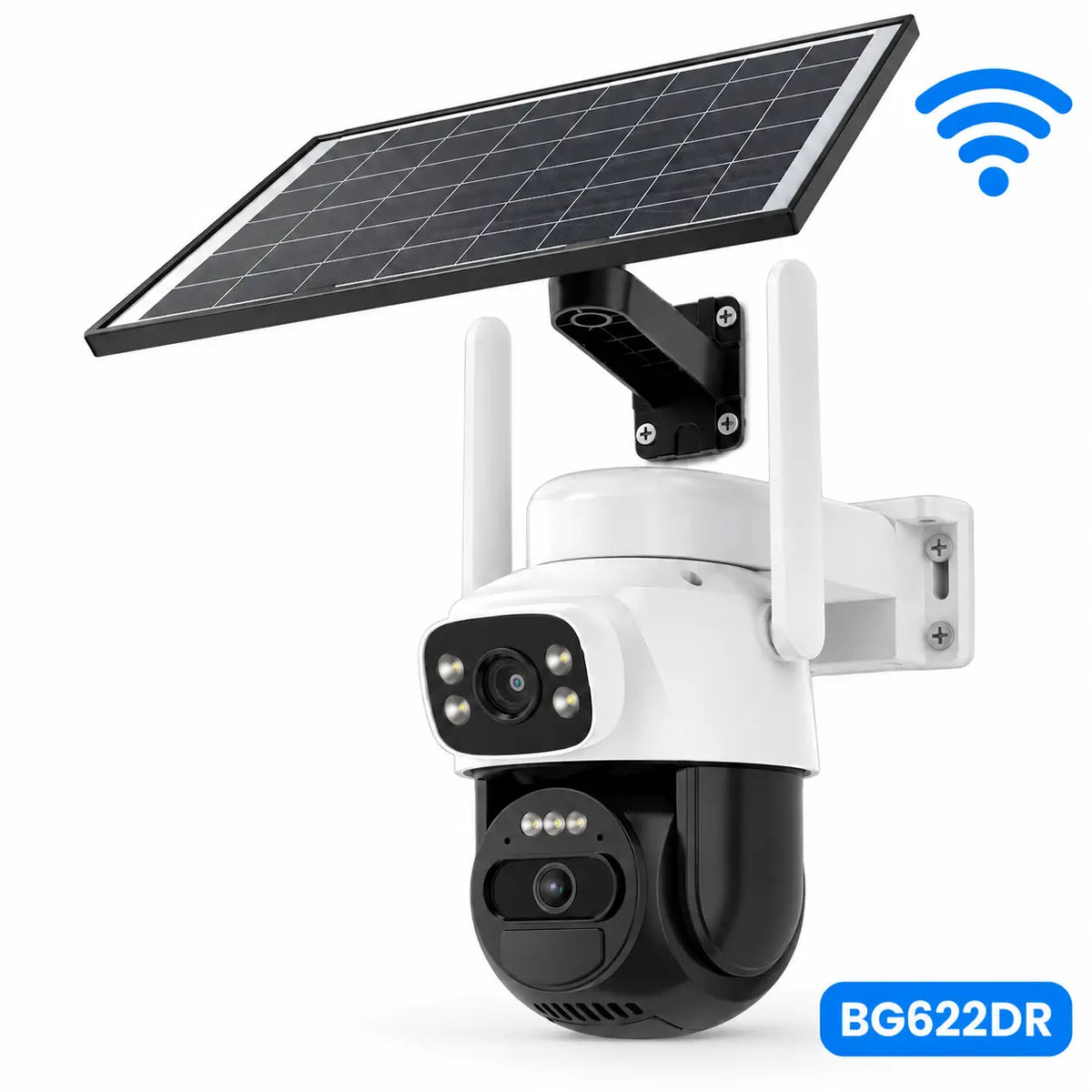
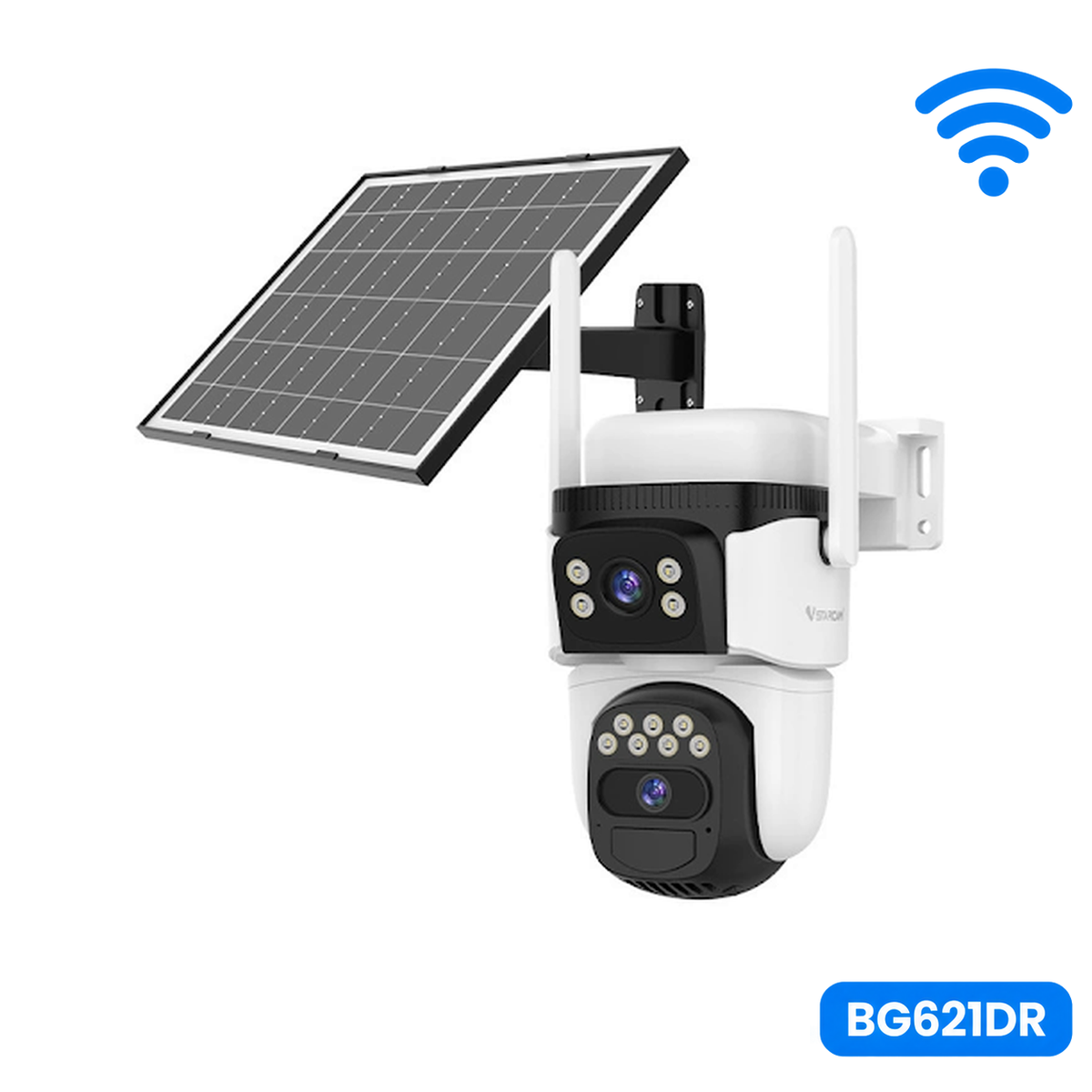
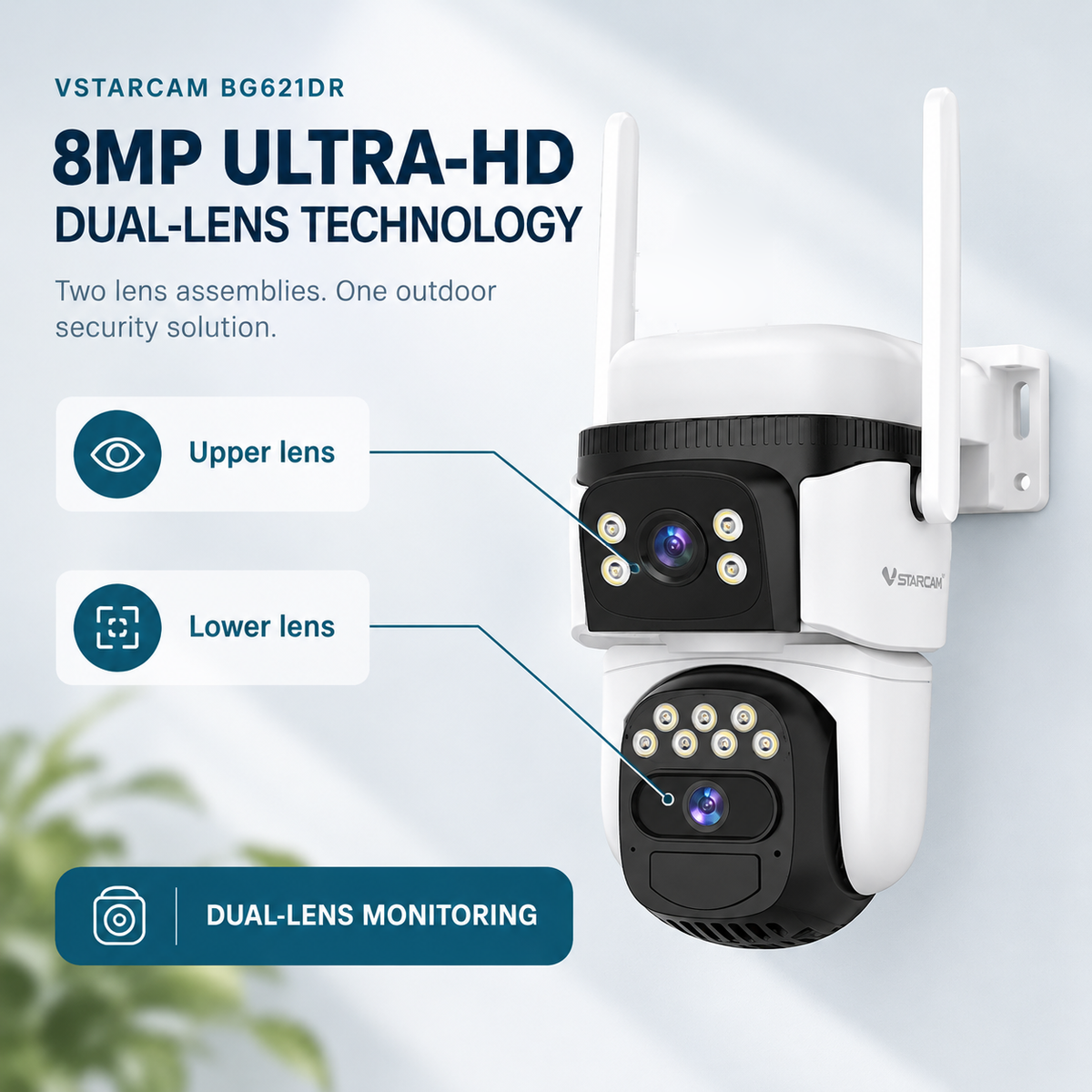
Dual-lens cameras contain two imaging lenses.
Depending on their design, the lenses may provide different viewing angles, different magnification levels or separate video views.
For example, some dual-lens cameras combine a fixed wide-angle view with a movable camera view.
This arrangement may allow users to monitor a general area while examining activity in another direction.
However, not all dual-lens cameras operate in the same way.
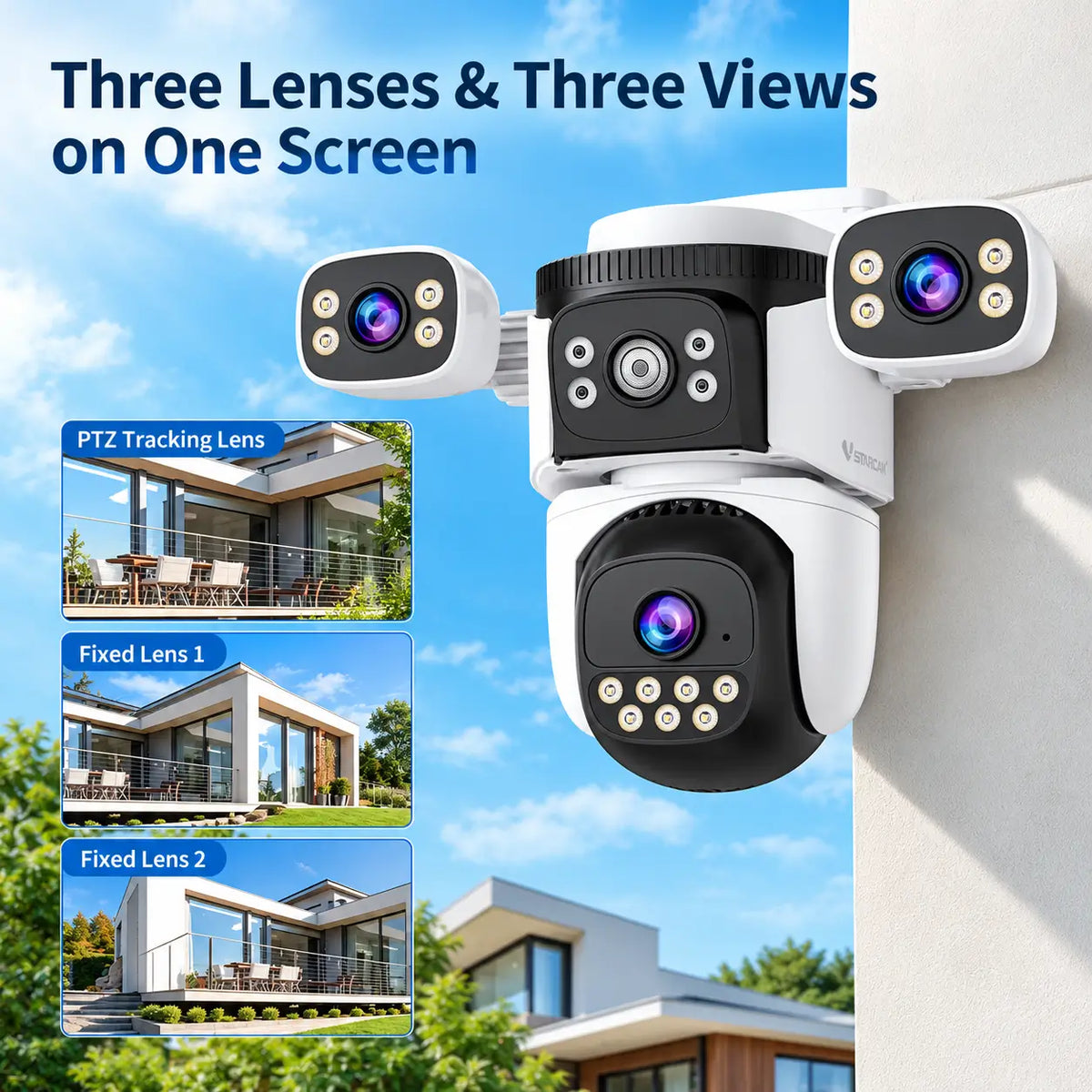
Triple-Lens Solar Security Cameras
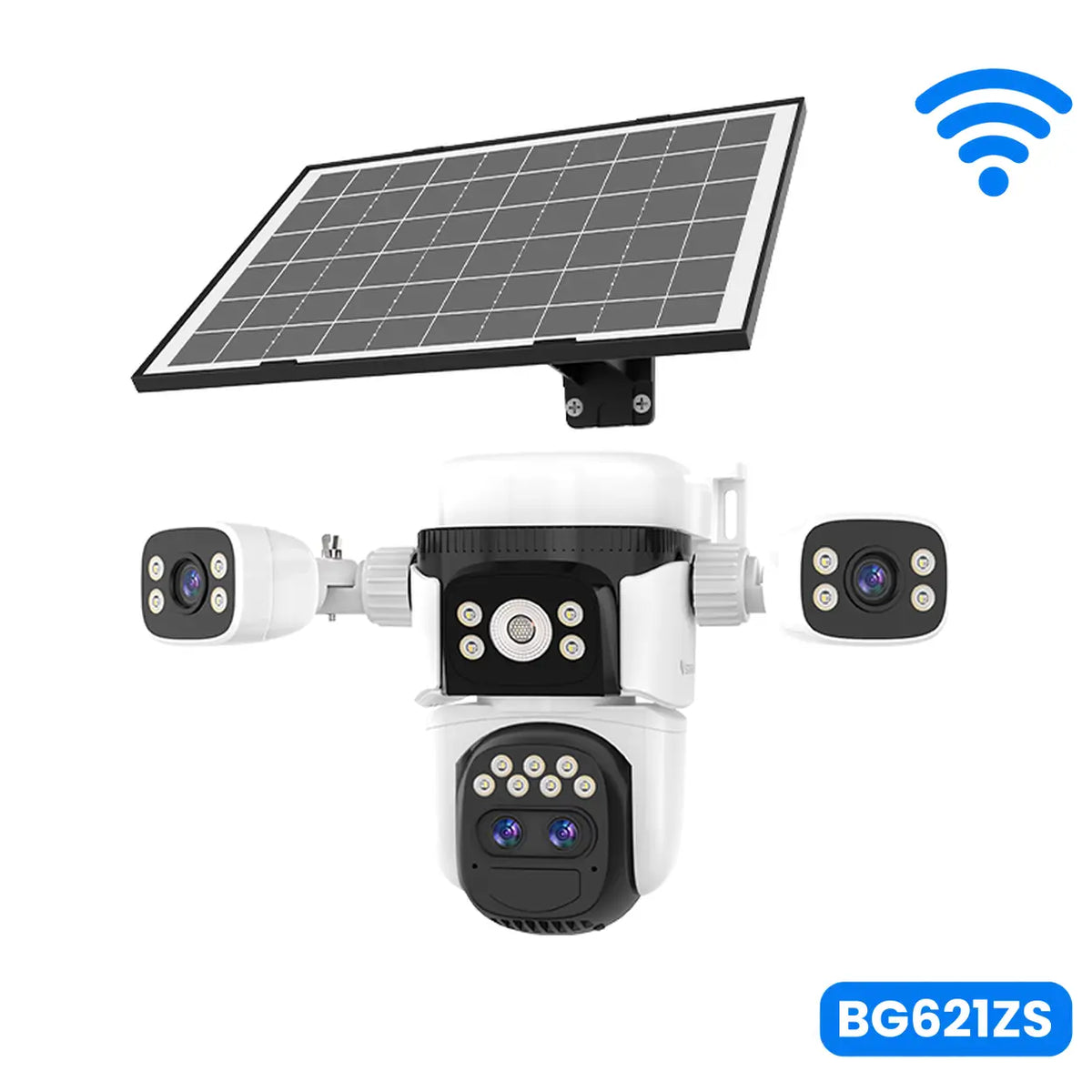
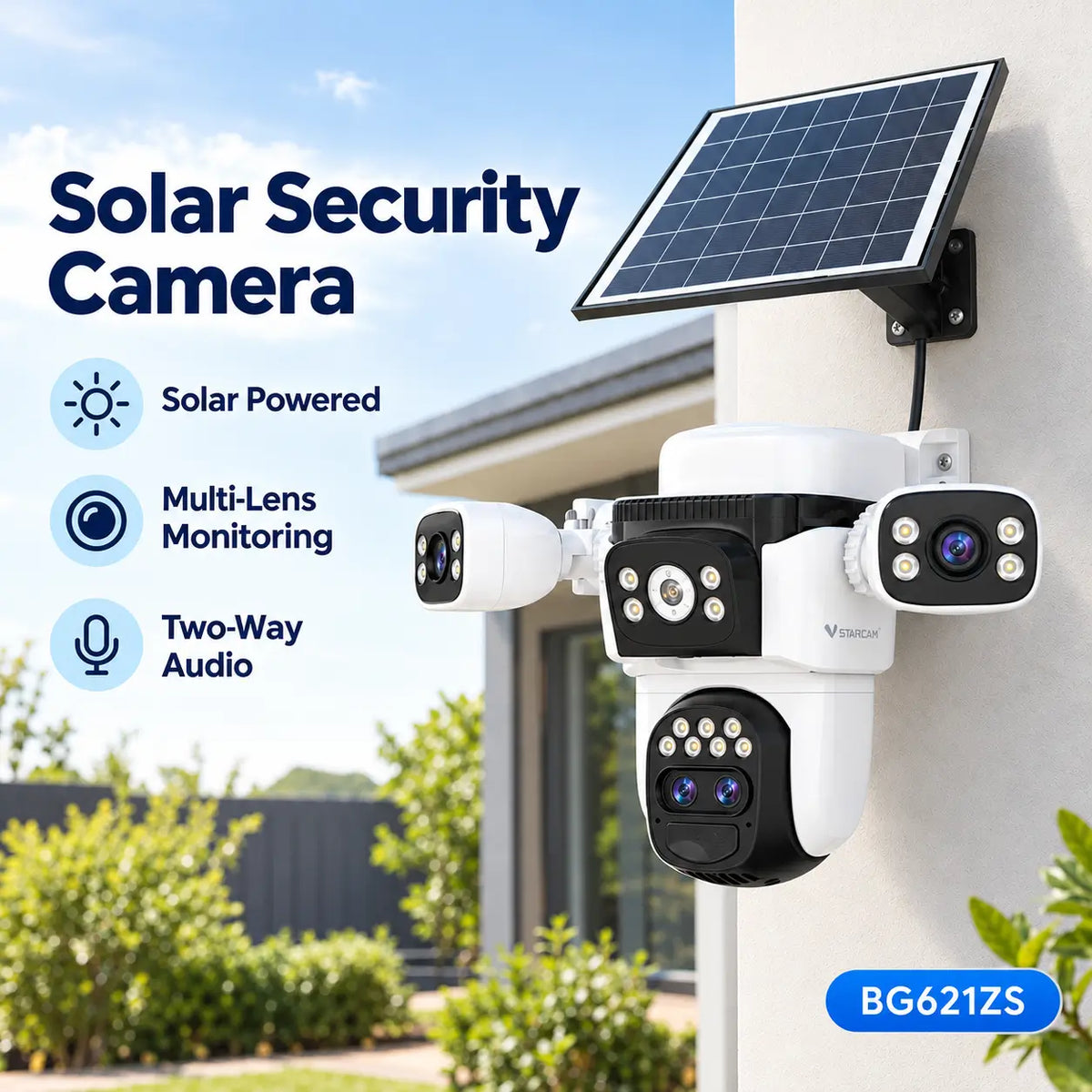
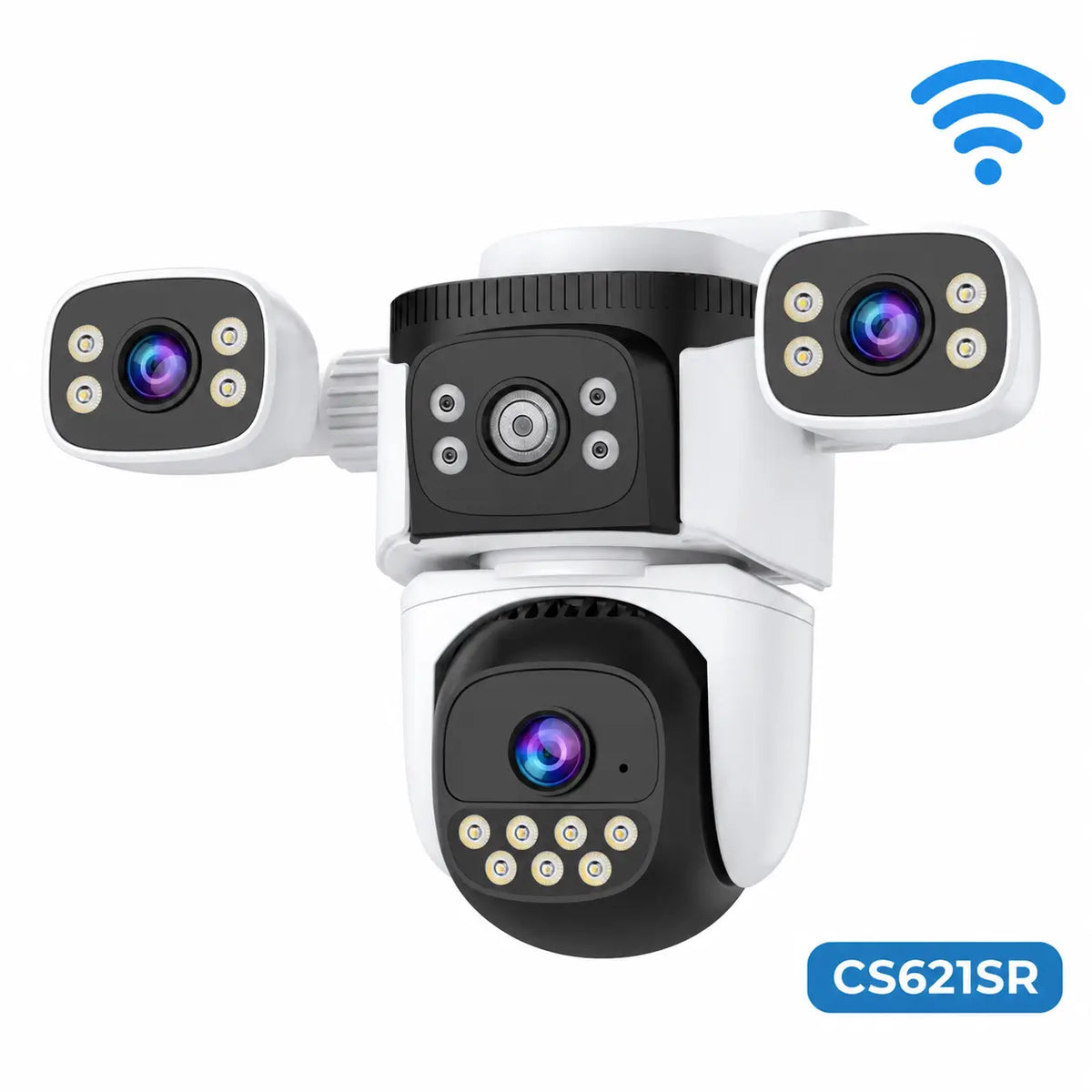
Triple-lens cameras contain three imaging lenses.
Some models are designed to provide multiple viewing directions or combine wide-area monitoring with more focused camera views.
These cameras may be useful for larger outdoor areas where several viewing perspectives are desirable.
However, having more lenses does not automatically mean better image quality or more reliable security.
Performance depends on the camera's overall design, image sensors, software and supported recording functions.
A detailed comparison is available in T04 – Single-Lens vs Dual-Lens vs Triple-Lens Solar Security Cameras.
4. Solar Security Cameras with Local Storage or Cloud Storage
Solar powered security cameras also differ in how they store recorded footage.
Local Storage Cameras
Many solar security cameras support local recording using a microSD card or another compatible storage device.
Recorded footage is stored directly on the camera or associated equipment.
Potential advantages include:
- No mandatory cloud subscription for supported local recording.
- Direct access to locally stored footage.
- Reduced dependence on cloud storage services.
However, storage capacity is limited, and recordings stored only inside the camera may be lost if the device is stolen or damaged.
Cloud Storage Cameras
Cloud-enabled cameras can upload supported recordings to a remote storage service.
This may allow users to access recordings without relying entirely on storage inside the camera.
However, cloud services may require an internet connection, a subscription and ongoing data usage.
Some solar security cameras support both local and cloud storage.
Important: Storage options are not always separate camera categories. A single camera may offer multiple recording and storage methods.
These differences will be examined in T05 – Solar Security Cameras with Local Storage vs Cloud Storage: What's the Difference?
5. Understanding Different Camera Resolutions
Image resolution is another important characteristic of solar powered security cameras.
Resolution describes the number of pixels used to create a video image.
Common resolution descriptions include:
| Resolution | Typical Pixel Dimensions | General Description |
|---|---|---|
| 1080p | 1920 × 1080 | Full HD |
| 2K | Varies by manufacturer | Higher resolution than Full HD in many products |
| 4MP | Approximately 4 million pixels | Higher pixel count than 1080p |
| 6MP | Approximately 6 million pixels | Higher pixel count, depending on sensor configuration |
| 4K | Commonly 3840 × 2160 | Approximately 8.3 million pixels |
Higher resolution can provide more image detail under suitable conditions.
However, resolution alone does not determine overall video quality.
Other factors include lens quality, image sensor performance, lighting conditions and video compression.
It is also important to understand that marketing descriptions such as 2K are not always used consistently across manufacturers.
Consumers should check the actual recorded pixel dimensions rather than relying only on advertised labels.
For a more detailed explanation, see T06 – Solar Security Camera Resolution Explained: 1080p, 2K, 4MP, 6MP and 4K.
6. Which Type of Solar Security Camera Suits Different Australian Properties?
Different properties have different monitoring requirements.
The following table provides a general overview of camera types that may be worth considering.
| Location | Camera Types to Consider | Main Consideration |
|---|---|---|
| Front Door | Wi-Fi, Fixed or Single-Lens | Monitoring a specific entrance |
| Residential Driveway | Wi-Fi, Fixed or PTZ | Viewing vehicles and driveway activity |
| Backyard or Garden | Wi-Fi, Fixed or PTZ | Monitoring outdoor activity |
| Detached Garage | Wi-Fi or 4G | Available network coverage |
| Farm Entrance | 4G, Fixed or PTZ | Remote access and mobile coverage |
| Large Rural Yard | 4G, PTZ or Multi-Lens | Wider monitoring requirements |
| Outdoor Storage Area | Wi-Fi or 4G, Fixed | Monitoring a defined location |
These examples are general guidance rather than specific product recommendations.
For instance, a fixed camera may be preferable for consistently monitoring a farm gate, while a PTZ camera may provide greater viewing flexibility around a large yard.
Similarly, a Wi-Fi camera may be suitable for a detached garage if the home network reaches that location.
A 4G camera may be more practical where reliable Wi-Fi is unavailable but mobile coverage exists.
The best arrangement depends on the property's actual monitoring requirements.
7. A Solar Security Camera Can Belong to Several Categories
An important point to understand is that these camera classifications are not mutually exclusive.
A single solar security camera may combine several characteristics.
For example, one model could be:
- A 4G solar powered camera.
- A PTZ camera.
- A dual-lens camera.
- A 4MP recording system.
- A camera supporting both local and cloud storage.
These descriptions refer to different aspects of the same product.
Similarly, another camera might combine Wi-Fi connectivity, a fixed single-lens design and local microSD card recording.
There is no single classification that fully describes every solar security camera.
Understanding how these characteristics work together makes it easier to compare different models without confusing their features.
It also helps consumers recognise that two cameras advertised under the same general category may offer significantly different capabilities.
8. What Should Australian Buyers Consider First?
Before comparing individual camera models, it is useful to identify the property's main monitoring requirements.
Three questions provide a practical starting point.
Where Will the Camera Be Installed?
Consider whether the camera will monitor a specific entrance, a driveway or a larger outdoor area.
This helps determine whether a fixed camera, PTZ camera or multi-lens design may be appropriate.
What Network Connection Is Available?
Check whether reliable Wi-Fi or suitable 4G mobile coverage is available at the intended location.
Network availability can significantly influence which camera types are practical.
What Type of Monitoring Is Required?
Consider whether the main objective is to record activity at a specific location, observe a wider area or access recordings remotely.
These requirements help identify relevant camera capabilities.
More detailed purchasing considerations will be discussed in Section 4 – Buying Guides & Comparisons.
Final Thoughts
Solar powered security cameras are available in several different configurations, each designed to address particular monitoring requirements.
Wi-Fi and 4G cameras differ in their communication methods, while fixed and PTZ cameras provide different approaches to viewing outdoor areas.
Single-lens, dual-lens and triple-lens designs offer different viewing arrangements, and recording resolution and storage options introduce further differences between models.
For Australian homeowners and rural property owners, understanding these basic categories is an important first step towards selecting suitable security equipment.
Rather than focusing on one advertised feature, consumers should consider how connectivity, camera design, recording capabilities and installation conditions work together.
The following articles in Section 2 will explore each of these categories in greater detail.
About SolarEasy
SolarEasy is an Australian-owned online retailer specialising in solar powered products for homes, gardens and outdoor applications.
Our Solar Powered Security Camera Information Hub provides practical educational resources to help Australian customers understand solar security technology and make informed purchasing decisions.