
Why Rainman Uses Die-Cast Aluminium Instead of Cheap Plastic
Built Stronger. Runs Cooler. Lasts Longer.
When people compare solar street lights or solar floodlights, they usually focus on brightness, battery size, solar panel wattage or the number of LEDs.
The housing often receives much less attention.
But the housing is not just the outside shell of a solar light.
It plays an important role in protecting the battery, controller, LEDs and wiring from heat, rain, dust and long-term outdoor exposure.
This is why Rainman uses a one-piece die-cast aluminium housing rather than relying on a lightweight plastic body.
The difference is not only about appearance.
It affects structural strength, cooling, weather protection, sealing and long-term durability.
For a solar light that may remain outdoors every day and every night for years, these factors matter.
Why the Housing Matters More Than It Looks
A solar street light is exposed to much harsher conditions than many indoor electrical products.
It may experience:
- strong summer sun;
- high daytime temperatures;
- cold winter nights;
- heavy rain;
- wind;
- dust;
- constant temperature changes.
If the housing becomes weak, cracked or poorly sealed, the internal electronics are put at risk.
A small crack around a screw point may eventually allow water in.
A weakened seal may allow moisture to reach the controller.
Poor heat dissipation may raise the operating temperature of the LEDs.
A light can therefore fail even when the battery and LED chips themselves are still capable of working.
Rainman approaches the housing as part of the technical system, not simply as a cover.
The housing is part of the light's protection and thermal-management system.
Why Low-Cost Plastic Can Become a Weak Point
Plastic has advantages.
It is lightweight, inexpensive and easy to mould.
That is why it is widely used in lower-cost solar lights.
The problem is that outdoor use can place significant stress on plastic over time.
Long-term UV exposure, heat and repeated temperature changes can gradually affect some lower-cost plastic materials.
Depending on the quality of the material and design, possible problems may include:
- brittleness;
- fading;
- deformation;
- cracking around mounting points;
- reduced sealing performance;
- loosening around joints.
This does not mean every plastic solar light will fail quickly.
Good engineering plastics can perform well.
However, in low-cost outdoor lighting, the housing is often one of the areas where manufacturers reduce cost.
Rainman takes a different approach by using die-cast aluminium as the main structural material.
One-Piece Die-Cast Aluminium Provides Greater Structural Strength
Rainman's housing is made using a one-piece die-cast aluminium structure.
Die casting allows the housing to be formed as a strong integrated body rather than being assembled from many separate structural pieces.
This gives the light several practical advantages.
The body is more rigid.
Mounting points are better supported.
There are fewer major structural joints.
The housing is less likely to deform under normal outdoor use.
This becomes especially important for larger solar street lights and floodlights.
These lights may be mounted several metres above the ground where they are exposed to wind and vibration every day.
A stronger housing provides a more stable platform for the solar panel, LEDs, controller and battery inside.
For long-term outdoor equipment, structural strength is not a cosmetic feature.
It is part of reliability.
Heat Is One of the Biggest Enemies of LED Life
One of the most important advantages of aluminium is heat dissipation.
LED lighting is highly efficient, but high-output LEDs still generate heat.
That heat must go somewhere.
If heat remains trapped around the LED board, the operating temperature of the LED chips rises.
Over time, excessive heat can contribute to:
- faster lumen depreciation;
- greater stress on LED components;
- reduced driver reliability;
- shorter overall operating life.
This is where aluminium provides a major advantage.
Aluminium conducts heat far more effectively than ordinary plastic.
Rainman's die-cast aluminium body therefore acts as a large heat-dissipation structure.
Heat generated by the LED board can be transferred into the housing and then released into the surrounding air.
This helps keep operating temperatures under better control.
The result is not simply a cooler housing.
It is a more stable environment for the entire lighting system.
Better Cooling Protects More Than the LEDs
Heat management is not only about LED lifetime.
Inside a solar street light there are several other heat-sensitive components.
These may include:
- the charging controller;
- the battery;
- wiring;
- electronic connections;
- circuit boards.
In Australian summer, a solar light can already become hot from direct sunlight before the LEDs even turn on.
If internal electronics then generate additional heat during operation, the total thermal stress can become significant.
Rainman's aluminium housing helps move heat away from internal components more effectively.
At the same time, the system uses an efficient controller and LED design to reduce unnecessary heat generation.
Lower operating temperatures generally mean less thermal stress across the whole system.
This supports long-term reliability.
Why Heat Management Matters for the Battery
Rainman uses CATL 33155 LiFePO₄ battery cells, but battery quality alone is not enough.
The surrounding environment also matters.
All rechargeable batteries are affected by temperature.
Excessive heat can accelerate battery ageing and increase long-term stress.
This is why Rainman's aluminium housing, efficient LEDs and GaN charging controller are designed to work together.
The aluminium body helps dissipate heat.
The controller is designed to reduce conversion losses.
The LEDs are designed to produce useful light efficiently.
Together, these features help reduce unnecessary internal thermal load.
This is another example of Rainman's system approach.
A high-quality battery performs best when the rest of the product is also designed to protect it.
IP65 Protection Helps Keep Dust and Rain Out
Outdoor solar lights must also deal with water and dust.
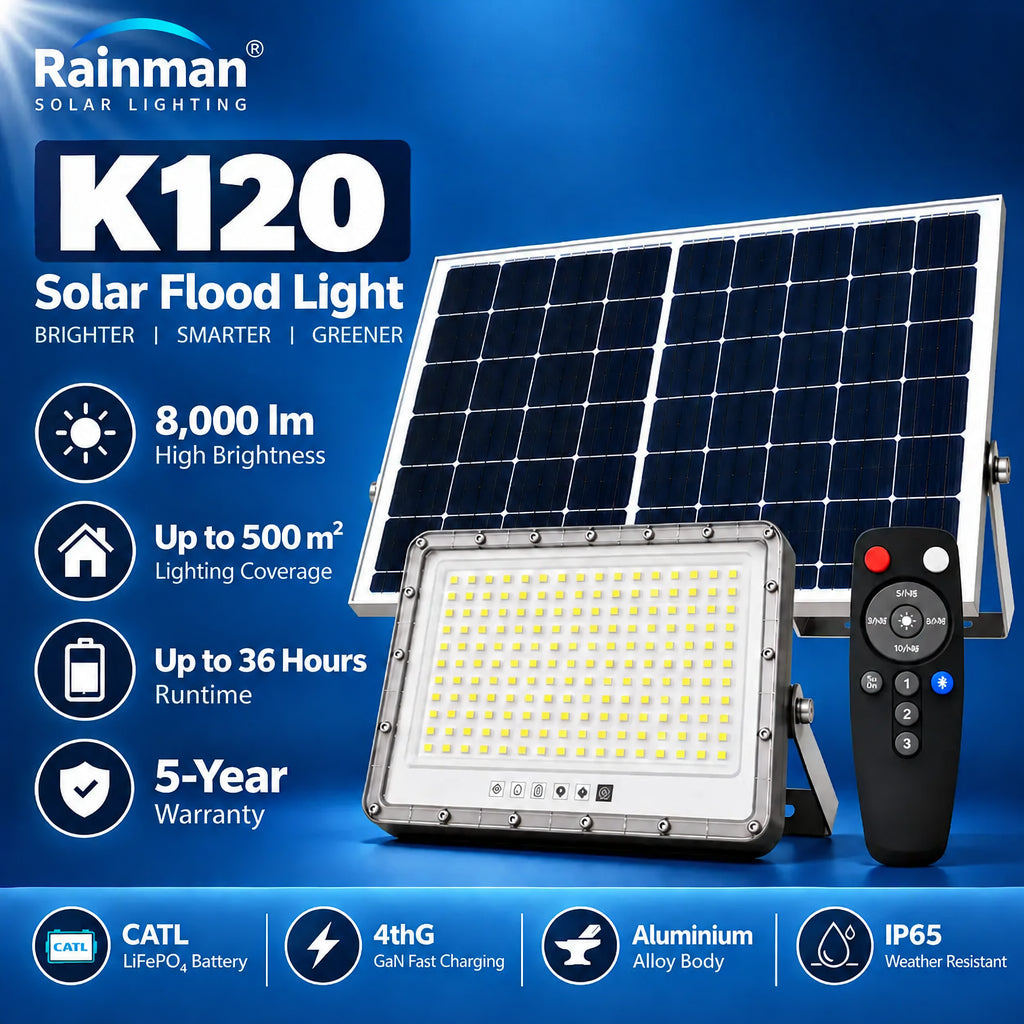
Rainman is designed around an IP65-rated enclosure.
In simple terms, IP65 indicates protection against dust ingress and protection against water jets from different directions.
For a solar street light or floodlight, this matters because water entering the housing can damage multiple components.
Moisture may affect:
- the controller;
- battery terminals;
- electrical connections;
- printed circuit boards;
- LED assemblies.
In many cases, water ingress can destroy a light much faster than normal component ageing.
This is why the enclosure design and sealing system are so important.
Rainman combines its die-cast aluminium body with a sealed outdoor structure designed to reduce the risk of water entering the internal electronics.
Fewer Joints Mean Fewer Potential Leak Points
Every joint in an outdoor enclosure creates another location that needs to be sealed correctly.
A housing assembled from many pieces may require:
- additional screws;
- extra seams;
- more sealing surfaces;
- more connection points.
Over time, each additional joint can become a potential weak point if seals deteriorate or components move.
A one-piece die-cast structure reduces the number of major structural seams.
This helps simplify sealing.
The basic principle is straightforward:
Fewer joints mean fewer potential entry points for moisture.
Combined with proper seals around the lens, access points and internal compartments, this contributes to better protection of the electronics inside.
Better Suited to Australian Outdoor Conditions
Australia can be demanding on outdoor equipment.
A solar street light may be exposed to:
- intense UV;
- high summer temperatures;
- sudden storms;
- wind-driven rain;
- dust;
- coastal air;
- large temperature changes.
These conditions can accelerate the ageing of lower-quality materials.
Die-cast aluminium provides a strong foundation for outdoor durability.
With an appropriate protective surface coating, aluminium also offers good resistance to corrosion and does not rust in the same way as ordinary steel.
This makes it well suited to long-term outdoor applications.
For coastal areas, rural properties and exposed installations, material quality becomes even more important because the light may remain in the same location continuously for years.
Long Product Life Often Comes from Preventing Small Failures
Outdoor lights do not always fail because of one major defect.
Often, failure begins with something small.
A seal weakens.
A small amount of moisture enters.
A mounting point develops a crack.
Heat builds up around an LED board.
A controller operates too hot for too long.
Corrosion gradually begins around a connection.
Each problem may initially appear minor.
But over months or years, small weaknesses can develop into major failures.
This is why Rainman focuses on reducing these failure points from the beginning.
The die-cast aluminium housing helps provide:
- stronger structural support;
- better thermal management;
- fewer major seams;
- improved sealing;
- better long-term weather resistance.
Long product life often comes from preventing small problems before they become major failures.
Aluminium Costs More – But There Is a Reason
A one-piece die-cast aluminium housing generally costs more to manufacture than a basic plastic housing.
The tooling is more expensive.
The material is heavier.
Manufacturing is more demanding.
Shipping weight can also be higher.
So why use it?
Because the housing has a direct effect on product reliability.
A lower-cost housing may reduce the initial purchase price.
But if the light later cracks, overheats or allows water into the electronics, the cost of replacing the whole product can be much greater.
Rainman is designed around long-term value rather than minimum manufacturing cost.
That is why aluminium is used where it provides a meaningful technical advantage.
A cheaper housing can reduce the purchase price. A better housing can reduce the chance of replacing the whole light later.
The Housing Supports the Entire Rainman System
Rainman's five core technologies are designed to work together.
The CATL LiFePO₄ battery stores energy.
The high-density monocrystalline solar panel collects energy.
The GaN charging controller manages that energy.
The dual 5054 LED system converts stored energy into useful light.
The die-cast aluminium body protects all of these components while helping manage heat.
This is why the housing cannot be viewed separately from the rest of the product.
If the body does not protect the electronics properly, even high-quality internal components can be compromised.
If heat is not managed properly, LED and battery performance can deteriorate faster.
If water enters the housing, the entire electrical system may be affected.
The housing is therefore part of Rainman's overall reliability strategy.
Designed from the Outside In
Rainman's aluminium body is not used simply to make the product look more premium.
It has a practical purpose.
It supports:
- stronger construction;
- improved LED cooling;
- lower thermal stress;
- better protection of the battery and controller;
- improved weather resistance;
- longer-term outdoor durability.
For a solar light expected to remain outside through Australian summers, winters, rain and wind, these are not minor details.
They are part of what determines whether the product can continue working reliably year after year.
Rainman's die-cast aluminium body does not simply make the light feel stronger.
It helps the entire system work better and last longer.
Built Stronger. Runs Cooler. Lasts Longer.