
Why Rainman Uses CATL LiFePO₄ Batteries
EV-Grade Battery Technology Inside a Solar Light
When people compare solar street lights or solar floodlights, they usually notice the parts they can see first.
They look at the solar panel.
They look at the size of the light.
They compare the number of LEDs.
They check the claimed wattage.
They may even look at the remote control or mounting bracket.
But one of the most important components is hidden inside the light.
The battery.
The battery determines how much solar energy can be stored during the day, how long the light can operate at night, how well it performs during winter, and how much useful capacity remains after years of daily charging and discharging.
That is why Rainman does not treat the battery as a hidden component where cost should be reduced as much as possible.
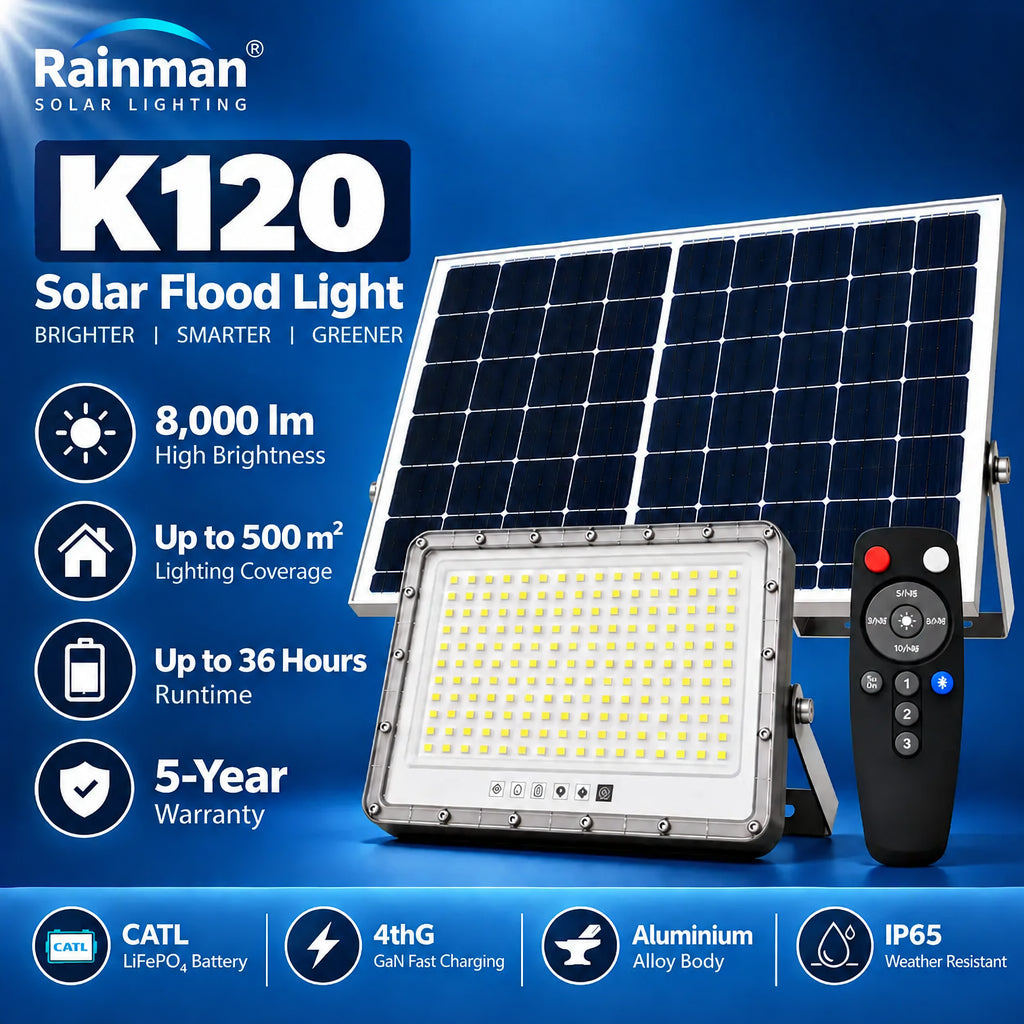
Rainman uses CATL 33155 LiFePO₄ battery cells, rated at approximately 3.2V and 14.5Ah per cell.
For Rainman, battery quality is one of the foundations of the entire lighting system.
A Solar Light Is Only as Reliable as the Battery Inside It
Solar lighting places unusual demands on a battery.
During the day, the battery charges from the solar panel.
At night, it discharges to power the LEDs.
The next day, the process begins again.
This can happen almost every day of the year.
One daily charging cycle may not sound like much, but over time it adds up quickly.
A solar light operating every day may experience approximately:
- 365 charging cycles in one year;
- more than 1,800 cycles in five years;
- thousands of cycles over a long service life.
This is one reason battery quality matters so much in solar lighting.
A low-quality battery may perform reasonably well when it is new, but after repeated daily cycling, usable capacity can gradually decline.
That may appear to the customer as:
- shorter overnight runtime;
- earlier dimming;
- reduced winter performance;
- the light switching off before sunrise.
In many cases, the LED itself may still be functional.
The real problem is that the battery can no longer store as much energy as it once could.
This is why we believe a solar light should be judged not only by how bright it is on the first night, but also by how well the battery performs after years of daily use.
Who Is CATL?
Many Australian customers may not immediately recognise the name CATL.
CATL stands for Contemporary Amperex Technology Co. Limited.
It is one of the world's leading manufacturers of lithium batteries for electric vehicles and large-scale energy storage applications.
That matters because battery manufacturing for the electric vehicle industry operates at a very different level from producing a small generic battery for a low-cost consumer product.
Electric vehicle batteries need to meet demanding requirements for:
- safety;
- manufacturing consistency;
- cycle life;
- thermal stability;
- energy storage;
- long-term reliability.
Rainman uses CATL battery cells because we want the battery inside the light to come from a manufacturer with extensive experience in these demanding applications.
Put simply:
EV-Grade Battery Technology Inside a Solar Light.
That does not mean a solar light battery is identical to an electric vehicle battery pack.
It means Rainman is using battery cells from a manufacturer whose core expertise comes from advanced lithium battery technology used in much more demanding energy applications.
For us, that gives Rainman a much stronger battery foundation than simply stating:
"Lithium battery included."
Why Rainman Uses CATL 33155 Cells
Rainman solar lighting systems use CATL 33155 LiFePO₄ cells, with each cell rated at approximately 3.2V and 14.5Ah.
The 33155 format provides substantial capacity in an individual cylindrical cell.
For solar street lights and floodlights, this is valuable because these products may need to operate for many hours every night.
An always-on solar street light has a very different energy requirement from a small decorative garden light or a motion-sensor light that operates only occasionally.
If the light is expected to operate from dusk until late at night, or potentially until dawn, then the battery must store enough real energy to support that load.
This is why Rainman places emphasis on actual battery capacity.
The goal is not to create an impressive number in the product title.
The goal is to store enough usable energy to support long and reliable overnight operation.
Why LiFePO₄ Is So Well Suited to Solar Lighting
The CATL 33155 cells used in Rainman are based on lithium iron phosphate, or LiFePO₄, chemistry.
LiFePO₄ is widely used in applications where safety, cycle life and thermal stability are important.
These characteristics make it particularly suitable for outdoor solar lighting.
Long Cycle Life
A solar light may charge and discharge every day.
For that reason, cycle life is extremely important.
LiFePO₄ chemistry is known for its ability to tolerate a large number of charging and discharging cycles compared with many lower-cost battery chemistries.
This helps make it better suited to equipment expected to operate night after night for years.
Thermal Stability
Outdoor solar lights are exposed to temperature extremes.
In Australian summer, the light body may become very hot after hours of direct sunlight.
Battery chemistry therefore needs to remain stable under challenging thermal conditions.
LiFePO₄ is well regarded for its thermal stability, making it a strong choice for outdoor solar applications.
Strong Safety Characteristics
Battery safety is especially important when the battery is installed permanently inside outdoor equipment.
The battery must cope with regular charging, temperature changes and long-term use.
LiFePO₄ chemistry is widely recognised for strong safety characteristics and stable behaviour compared with some conventional lithium-ion chemistries.
Stable Discharge Performance
The battery also needs to deliver energy consistently throughout the night.
Stable discharge characteristics help support predictable LED operation and more reliable runtime.
For a product that may charge and discharge every day for years, battery chemistry matters.
Battery Capacity Matters More Than a Big Wattage Number
One of the biggest problems in the solar lighting market is that customers are often encouraged to compare products by advertised wattage.
A product may be promoted as:
500W
1000W
2000W
But these numbers do not tell you how much real energy is stored in the battery.
A solar light can only use the energy it has collected and stored.
If the battery is small, the light cannot provide high output for a long period, regardless of the number printed on the product title.
This becomes especially obvious in winter.
During summer, strong sunlight and longer days may help compensate for a smaller battery.
During winter, however, daily charging energy is reduced and nights are longer.
If the battery has very little reserve, the light may run for only a few hours before stored energy is depleted.
The important question is therefore not simply:
"How many watts does the light claim?"
A better question is:
"How much real energy can the battery store, and how efficiently is that energy used?"
A large wattage claim cannot compensate for a small battery.
Rainman takes the opposite approach.
Instead of building the product story around exaggerated wattage, the system is designed around real battery capacity, efficient charging and practical overnight runtime.
Why Battery Reserve Matters in Winter
Battery capacity is not only about making it through one night.
It is also about reserve.
Imagine a solar light that has just enough battery capacity to operate through one normal night.
After a strong sunny day, it may work perfectly.
But what happens if the next day is cloudy?
The battery may receive only a partial recharge.
The following night therefore begins with less stored energy.
If poor weather continues for another day, the battery level may fall even further.
This is where a larger reserve becomes valuable.
Rainman is designed around the idea that the battery should not only support tonight.
It should also help prepare for tomorrow.
That is the concept behind:
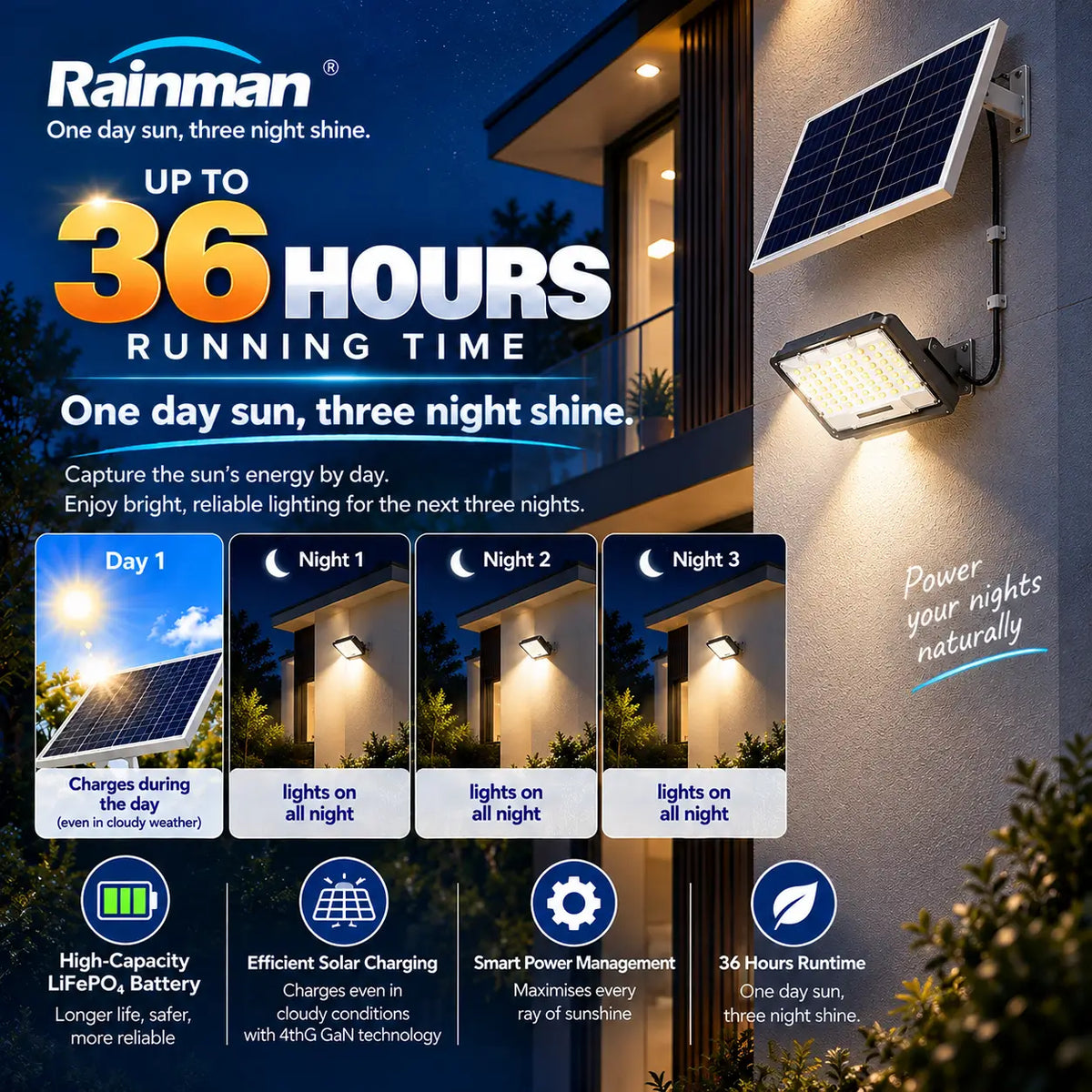
One Day of Sun. Three Nights of Shine.
The slogan does not mean every Rainman installation will provide exactly three full nights regardless of weather, brightness setting or installation conditions.
Actual runtime always depends on factors such as:
- available sunlight;
- panel orientation;
- shading;
- operating hours;
- brightness level;
- temperature;
- weather.
The important point is that Rainman is designed around multi-night energy reserve, rather than the minimum battery capacity needed for one ideal night.
That reserve becomes especially useful during winter and consecutive cloudy days.
Better Battery Quality Matters More After Several Years
One of the most important differences between a quality solar light and a low-cost solar light may not be obvious when the products are new.
Both may work well on the first night.
The real difference can appear later.
After hundreds or thousands of charging cycles, battery capacity can gradually decline.
This is normal for all rechargeable batteries.
The question is how quickly that decline occurs.
A lower-quality cell may lose usable capacity much faster.
As a result, a light that originally operated for most of the night may later run for only a few hours.
Rainman uses CATL LiFePO₄ cells because long-term battery performance matters.
The objective is not simply to maximise runtime when the product is new.
It is to maintain useful capacity and reliable operation over a much longer period.
This is one of the reasons battery quality should be considered an investment in product life, not just a specification.
Battery Quality and Heat Management Must Work Together
Even a high-quality battery needs a well-designed environment around it.
Heat is one of the major stresses affecting electronic equipment and batteries.
Rainman therefore combines its CATL LiFePO₄ battery system with:
- a one-piece die-cast aluminium housing;
- efficient LED thermal management;
- a high-efficiency charging controller;
- intelligent power management.
The aluminium housing helps transfer heat away from internal components.
The GaN-based controller is designed to reduce unnecessary conversion losses and heat generation.
The LED system is also designed for efficient light output rather than simply driving excessive power.
Together, these features help reduce thermal stress on the entire system.
Battery quality alone is not enough.
The surrounding system must also protect it.
This is another example of why Rainman is designed as a complete energy system rather than a collection of unrelated components.
Why We Tell Customers the Battery Brand
Many solar lights simply state:
Lithium battery
or
LiFePO₄ battery
with no further information.
The customer does not know who made the cells.
They do not know the cell format.
They often do not know the actual quality level.
Rainman takes a more transparent approach.
We specify:
CATL 33155 LiFePO₄ battery cells.
Why?
Because we believe the battery is too important to hide.
The battery is one of the most expensive and performance-critical components in the system.
It influences:
- overnight runtime;
- winter performance;
- cycle life;
- long-term reliability;
- overall product value.
We believe the battery brand should be something worth showing, not something worth hiding.
For Rainman, CATL is not simply another specification.
It is part of the product philosophy.
Built Around the Battery, Not Around the Label
A good solar street light should be designed from the inside out.
That means starting with real energy requirements.
How much energy needs to be stored?
How many hours must the light operate?
How often will the battery cycle?
What happens in winter?
What happens after several years?
Only after answering these questions can a reliable solar lighting system be designed.
Rainman uses CATL 33155 LiFePO₄ cells because the battery needs to support the entire system over years of daily use.
The choice provides a strong foundation for:
- substantial energy storage;
- long overnight runtime;
- multi-night reserve;
- daily charge and discharge cycling;
- thermal stability;
- long-term reliability.
The battery is not a hidden cost-saving component in Rainman.
It is one of the technologies the entire lighting system is built around.