
How Solar Panel Size and Charging Performance Affect Overnight Runtime
When people compare solar flood lights or solar street lights, battery capacity often receives most of the attention. A larger battery sounds reassuring because it can store more energy and potentially keep the light running for longer.
But a large battery is only half the story.
Every night, the light takes energy out of the battery. The following day, the solar panel needs to put that energy back.
If the solar panel cannot replace enough of the energy used overnight, even a large battery will eventually run low.
This is why reliable overnight performance depends on the balance between solar panel capacity, charging performance, battery storage and night-time energy consumption.
For Australian conditions, particularly during winter and periods of cloudy weather, getting this balance right is extremely important.
What Does Solar Panel Size Actually Tell You?
The solar panel is the energy source of an outdoor solar lighting system.
Its job is relatively simple: capture sunlight during the day, convert it into electrical energy and use that energy to recharge the battery.
One of the first specifications to look at is the panel wattage.
A larger-wattage panel can generally produce more energy under the same sunlight conditions than a smaller panel. However, wattage alone doesn't tell the entire story.
Charging performance can also be affected by:
- Solar cell efficiency
- Panel orientation and tilt angle
- Hours of direct sunlight
- Shade from trees or buildings
- Cloud cover
- Seasonal changes
- Dirt, dust or leaves on the panel
- Charging-controller efficiency
Physical size can also provide a useful reality check.
If you see an extremely small solar panel paired with a product advertised as a very high-powered "1000W" or "2000W" solar flood light, it is reasonable to question how the system could possibly collect enough solar energy to support that claimed power.
The numbers need to make sense together.
Think About the Daily Energy Budget
One of the easiest ways to understand solar-light performance is to think of the system as having a daily energy budget.
Suppose a solar light consumes an average of 20 watts while operating and runs for 10 hours:
20W × 10 hours = 200Wh
The light has therefore consumed approximately 200 watt-hours (Wh) of stored energy during the night.
The following day, the solar system needs to replace that energy.
In an ideal world, you might assume that collecting another 200Wh would bring the system back to exactly where it started.
Real systems, however, are not 100% efficient.
Some energy is lost through charging, battery storage, voltage conversion, wiring and electronic control. Temperature and other operating conditions can also affect performance.
For that reason, a properly designed solar lighting system needs some margin rather than operating at its theoretical limit every day.
This leads to one of the most important principles in solar lighting:
The system needs to collect enough energy during the day to replace the energy it uses at night.
If it cannot do that consistently, the battery will gradually become depleted.
Ten Hours of Daylight Does Not Mean Ten Hours of Full Solar Charging
This is another area where solar-light specifications can be misunderstood.
A location may receive many hours between sunrise and sunset, but that doesn't mean the solar panel operates at its rated output for all those hours.
Early morning sunlight is relatively weak. The sun becomes stronger as it rises, reaches its most productive period around the middle of the day, and then declines again toward sunset.
Clouds, shade and the angle of the panel can reduce output further.
This is why solar-system calculations often consider peak sun hours rather than simply counting the number of daylight hours.
For example, having 10 hours between sunrise and sunset does not mean a 40W solar panel will necessarily produce:
40W × 10 hours = 400Wh
Real-world energy production can be considerably lower.
This distinction becomes particularly important when assessing whether a solar flood light can reliably operate throughout the night.
Australian Winter Is the Real Test
Australian summers can provide excellent conditions for solar lighting.
Days are longer, solar radiation can be strong and a well-positioned panel may have plenty of opportunity to recharge the battery.
Winter is different.
Days become shorter, the sun sits lower in the sky and weather conditions may provide less usable solar energy. Several cloudy or rainy days can make the situation even more challenging.
This is where a marginally designed solar lighting system can begin to struggle.
Imagine that a light uses 200Wh overnight but, because of poor winter weather, its solar panel only replaces 140Wh the following day.
The system now has a 60Wh energy deficit.
If similar conditions continue, another deficit may occur the next day.
The light might work normally on the first night because the battery started fully charged. After several days, however, you may notice that it dims earlier, reduces its operating time or switches off before morning.
The problem isn't necessarily that the battery suddenly became faulty.
The system may simply be using more energy each night than it can replace during the day.
This is why judging a solar light only by how it performs after one sunny day can be misleading.
Long-term performance is about maintaining the energy balance over many days and changing weather conditions.
Bigger Solar Panel or Bigger Battery?
These two components perform different jobs, and understanding the difference is important.
A larger battery stores more energy.
That can help a solar light:
- Run for longer overnight
- Maintain operation through longer winter nights
- Carry reserve energy into cloudy or rainy periods
A larger solar panel, on the other hand, increases the system's ability to collect energy.
That can help:
- Recharge the battery faster
- Recover more effectively after a cloudy day
- Make better use of limited winter sunshine
- Reduce the chance of repeated daily energy deficits
This means that simply installing a very large battery with a small solar panel isn't necessarily good system design.
The battery might provide impressive runtime when fully charged, but if the panel cannot recharge it properly, that advantage quickly disappears.
Likewise, a large solar panel paired with an undersized battery may collect plenty of energy during the day but have nowhere to store enough of it for a long night.
Good solar lighting requires balance:
Adequate Solar Panel + Adequate Battery + Efficient LEDs + Intelligent Power Management
All four elements need to work together.
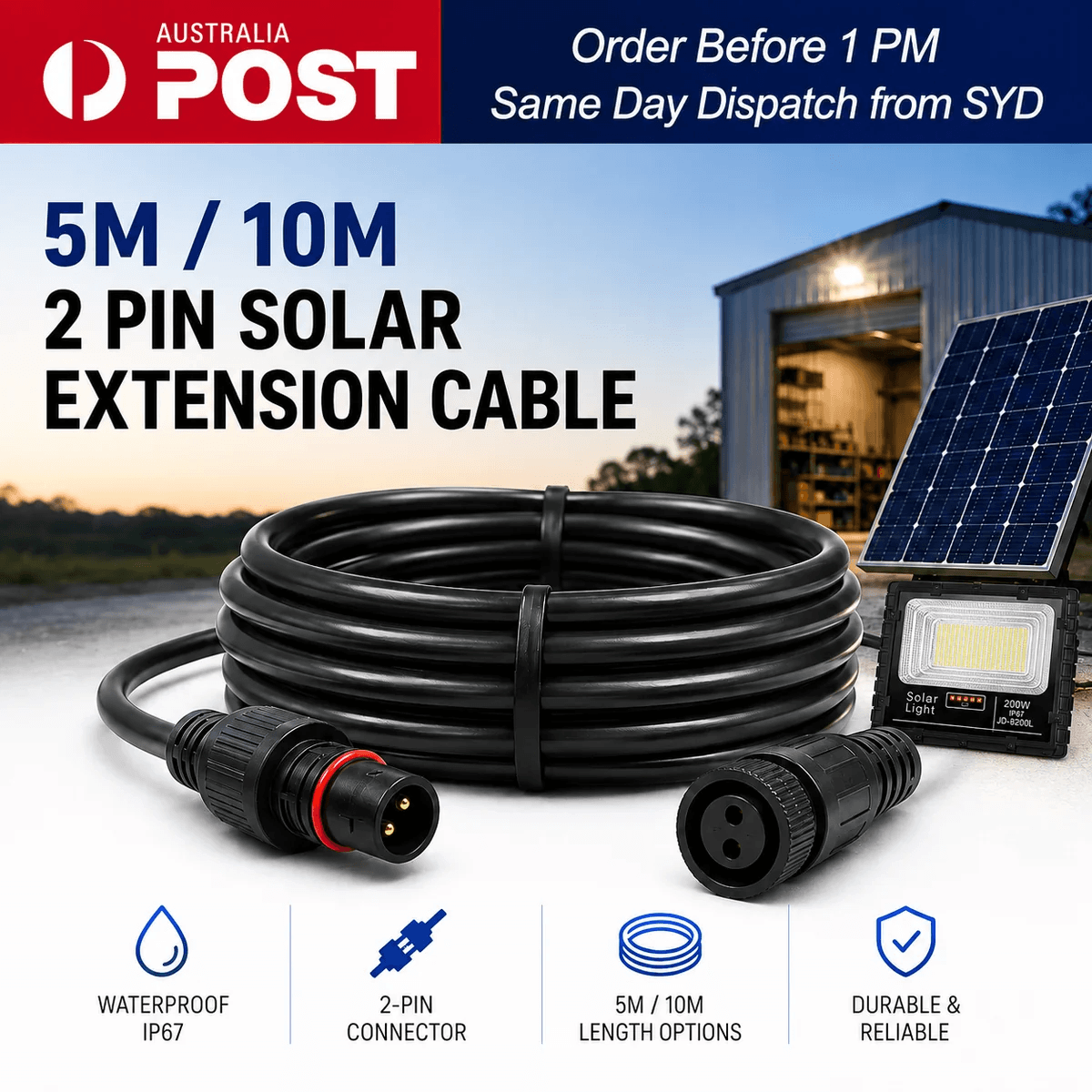
Why Separate Solar Panels Can Be an Advantage
Another important consideration is where the solar panel is installed.
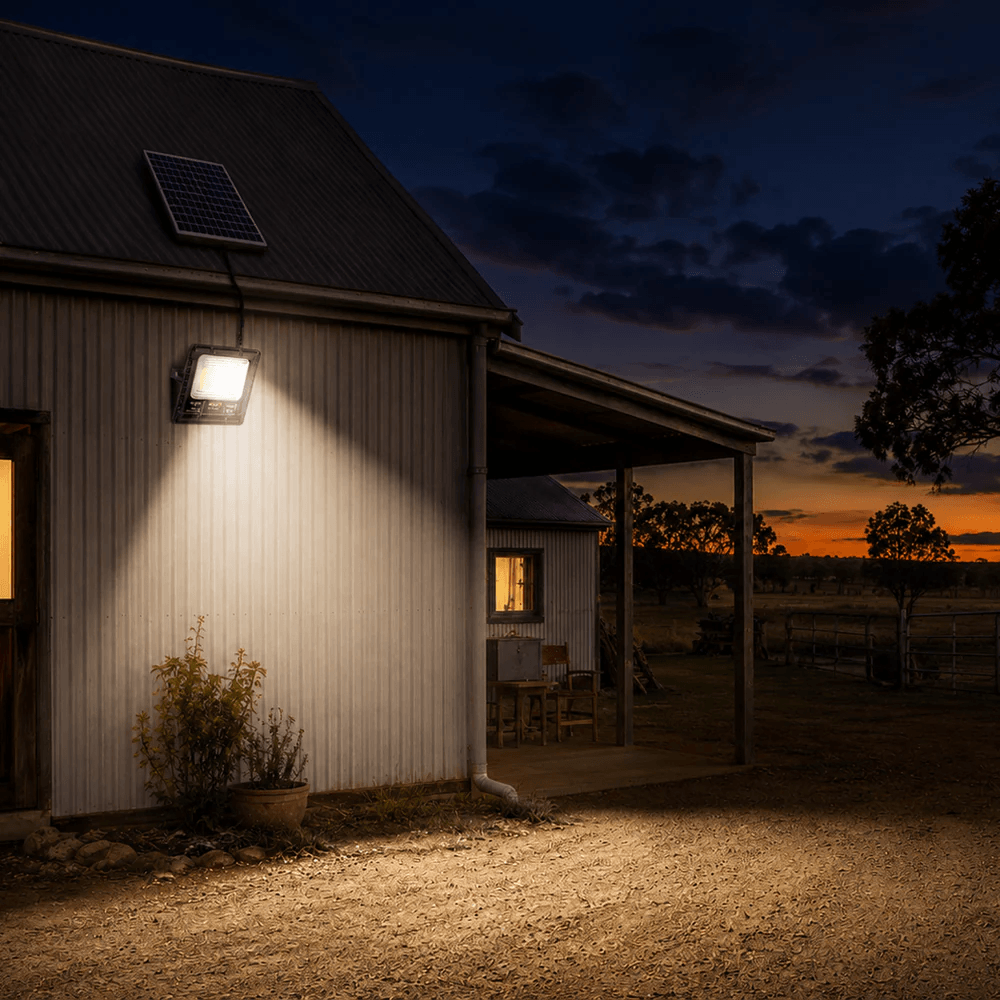
With an all-in-one solar light, the panel and light are usually fixed together. This makes installation simple, but the best position for the light is not always the best position for collecting sunlight.
For example, you may want the light installed:
- Under the edge of a roof
- Beside a driveway
- Against a building
- Near a shed
- On a wall partly shaded by trees
These may be excellent locations for illumination but poor locations for solar charging.
A separate solar panel gives you more flexibility.
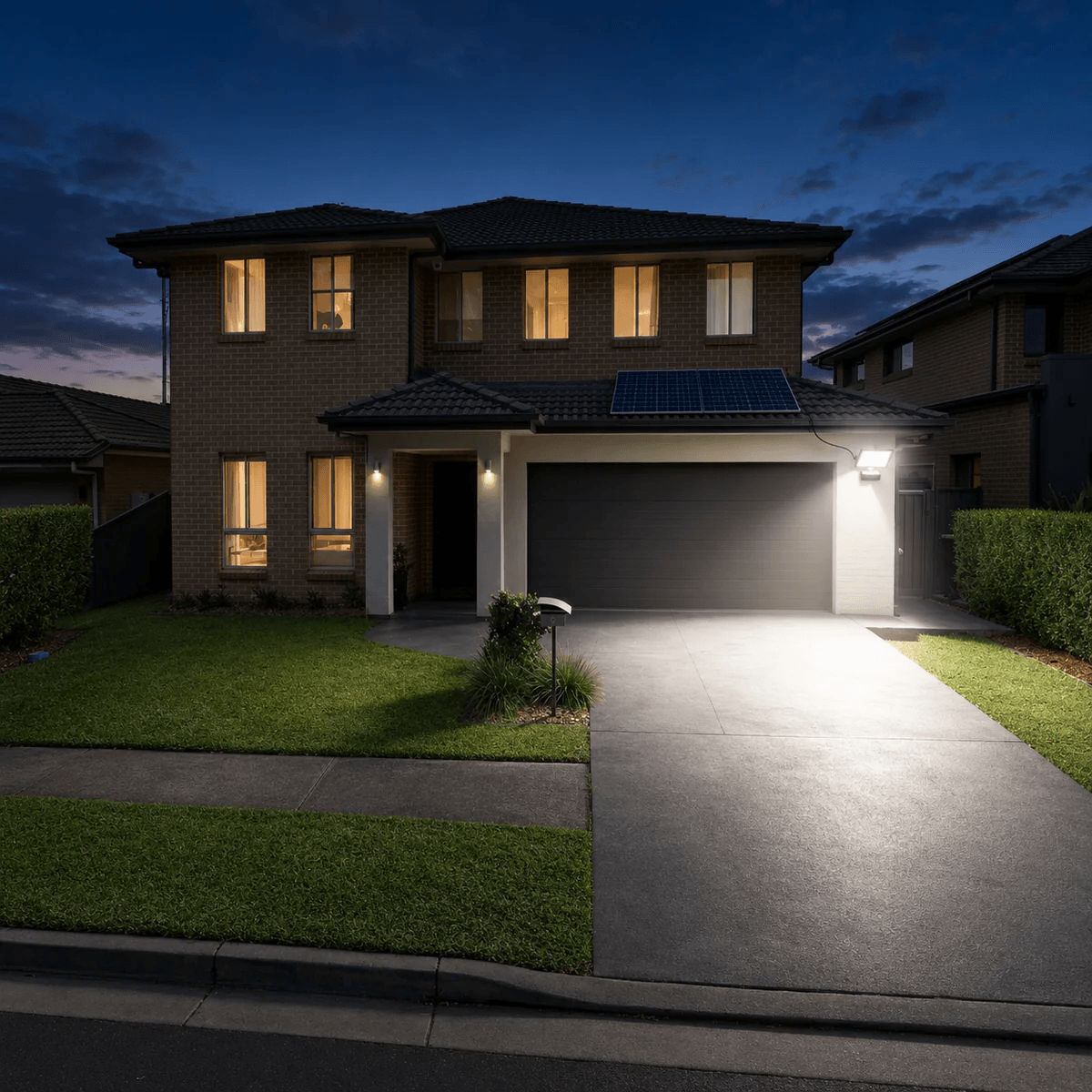
The light can be installed where illumination is required, while the panel can be positioned where it receives stronger and longer direct sunlight.
The panel angle and orientation can also be optimised more easily.
This can be particularly useful for larger solar flood lights installed around Australian homes, farms, sheds, car parks, yards and commercial properties.
What Should You Check Before Buying?
When comparing outdoor solar lights, don't look at the advertised light wattage alone.
Look at the entire energy system.
Ask:
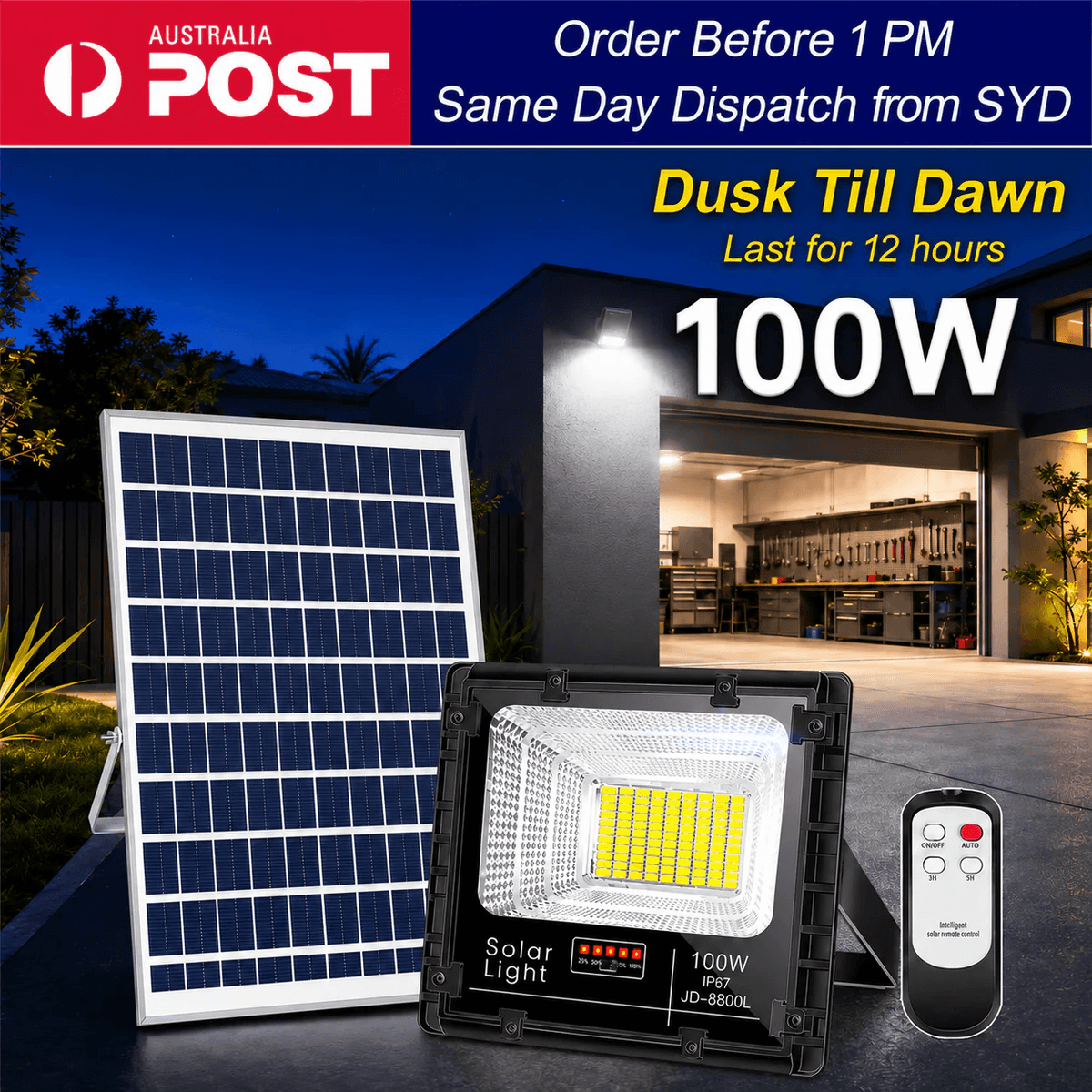
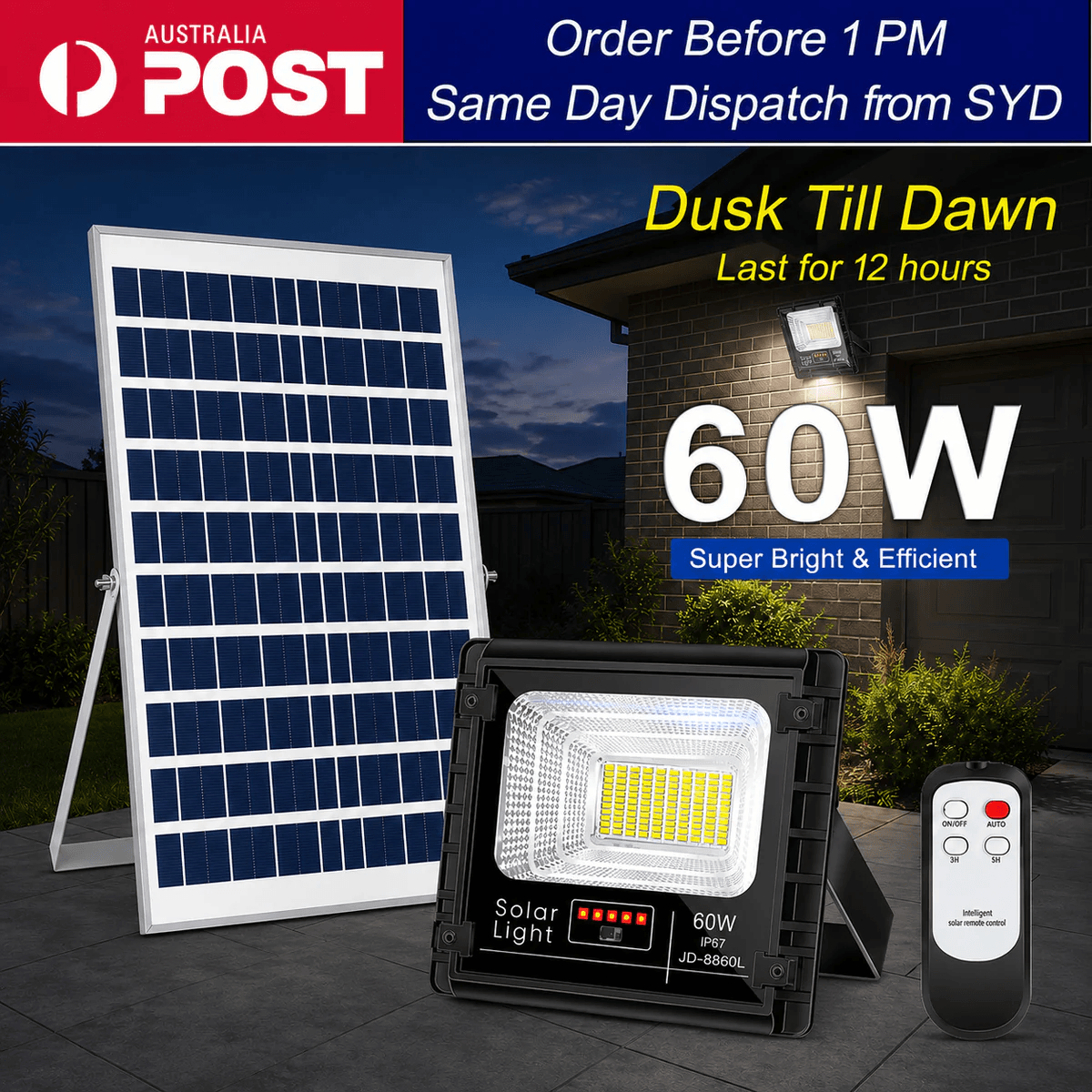
What is the solar panel wattage?
A larger light generally needs an appropriately sized energy source.
What is the battery capacity?
Where possible, look for capacity expressed in watt-hours (Wh), as this makes energy comparisons easier.
How long does the battery take to recharge?
Charging time can tell you a lot about how well the panel and battery have been matched.
What runtime can you realistically expect?
Look beyond maximum advertised runtime and consider how the product performs under normal operating conditions.
What happens after several cloudy days?
A well-designed system should have some ability to manage periods of reduced solar input.
Can the solar panel be positioned separately?
This can make a substantial difference when the ideal lighting position doesn't receive enough direct sunlight.
Does the light use intelligent power management?
Efficient LEDs and sensible power control can reduce unnecessary energy consumption and extend useful runtime.
These questions tell you far more about the real performance of a solar light than an impressive wattage number printed on the box.
Think of a Solar Light as a Complete Energy System
A solar flood light isn't simply an LED connected to a battery and solar panel.
It is a complete energy system:
Sunlight → Solar Panel → Charging System → Battery → LED → Light
If any part of this chain is poorly matched, it can become the bottleneck.
A large battery cannot solve an undersized solar panel.
A large solar panel cannot compensate for an inefficient LED system.
And impressive brightness means very little if the light cannot maintain that performance throughout the night.
This is why good solar lighting design is ultimately about energy balance.
The goal isn't simply to store as much energy as possible. The system needs to collect, store and use energy efficiently enough to continue operating night after night — including when Australian weather is less than ideal.
A useful way to remember it is:
A good solar light isn't designed just to have a big battery. It's designed to replace tomorrow the energy it uses tonight.
That balance is one of the most important differences between a solar light that performs well after one sunny day and one that can deliver reliable outdoor lighting over the long term.